Subscribe now

Letters archive

Join the conversation in New Scientist's Letters section, where readers can share their thoughts and opinions on articles and see responses from experts and enthusiasts across a range of science topics. To submit a letter, please see our terms and email letters@newscientist.com


1 August 2012

Winning biology

From Craig Sharp, Centre for Sports Medicine and Human Performance, Brunel University

As a former director of the British Olympic Medical Centre, I totally agree with Katrina Karkazis and Rebecca Jordan-Young's condemnation of the new sex-testing rules for female athletes (21 July, p 26) . All elite athletes are statistical outliers of our species, be they genetically advantaged by high-speed type IIx muscle fibres for sprinters and …

1 August 2012

Sports metallurgy

From Oliver Sacks

Steve Haake's fascinating Instant Expert on sports engineering (7 July) revived a thought I had, long ago, in my shot-putting days. Having relatively small hands, and finding the 16-pound (7.26 kilogram) shot difficult to grip, I could not help thinking that if it were made of tungsten – which is nearly two-and-a-half times as dense …

1 August 2012

New iron age?

From Michael Steinke, University of Essex

You report on a successful trial of ocean iron-seeding to promote plankton growth and potential carbon sequestration via the sinking of their remains to the depths of the ocean (21 July, p 15) . In demonstrating that at least half the material disappeared into the deep sea, the trial by Victor Smetacek and his colleagues …
1 August 2012

On punishment

From Steve Hawkins

That multiple personality disorder, also known as dissociative identity disorder (DID), might be supported by brain scan evidence and be used as a legal defence by a person's "normal" personality, opens a can of worms (7 July, p 10) . We all have various denial and defence mechanisms from an early age which are integral …

1 August 2012

Science is fair

From Caroline Herzenberg

So there have been some nationalistic concerns that the great accomplishments of Pakistani physicist Abdus Salam and Indian physicist Satyendranath Bose have not been sufficiently appreciated within the historical context of the recent discovery of the Higgs boson (14 July, p 5) . Physicist Jim Al-Khalili's depiction of the two is accurate: among physicists both …

1 August 2012

That's disgusting

From John Grant

Your feature on disgust (14 July, p 34) rekindled a relevant memory. Several years ago while working in Denmark, I visited the magnificent Aalborg Zoo. The gorilla enclosure was separated from visitors by a clear screen rather than bars, and so you could get quite close to the animals. One particular day many parents and …

1 August 2012

Northern delights

From Victor Meyer-Rochow

You mention North Korea's capital Pyongyang as a "drab and featureless" city for lacking billboards, neon signs and shopfronts (19 May, p 3) . But I lived and worked there for a few months, and found it surprisingly beautiful and clean, with lots of parks, viewpoints, attractive buildings, recreation spots and fantastic subway stations.

1 August 2012

Heifer hangover

From Peter Stockill

In his letter, Paul Bennett says that he bears witness to drunken waxwings (16 June, p 33) . I can bear witness to drunken cows. I used to live on a commune in Glastonbury, Somerset, UK, where the farm animals could wander at will. The cows used to go into the orchard and eat fallen …

1 August 2012

Political gap

From Brian Robinson

Letters from Roger Taylor (14 July, p 28) and John Hastings (14 July, p 29) highlight a problem with politicians. Basically, not just in North Carolina where they contemplated a bill to forbid predictions of accelerating sea-level rises, but in most elected governments, politicians are not clever enough to understand complex issues such as climate …

1 August 2012

It takes two

From Steve Wilson

I have always been surprised at the annoyance over Pluto being "demoted" to dwarf planet status (21 July, p 11) . The meaning of the word planet has changed as new discoveries have been made. Pre-Copernicus, the sun and moon were considered planets because they were lights in the sky seen to move in a …

1 August 2012

Biological bicycle

From Martin Gregorie

Robert Bright is undoubtedly on the right track with his biological theory of why some objects multiply while others disappear (14 July, p 29) , but is late to the game. Avram Davidson was first, though the life cycle he described in his short story "Or all the seas with oysters" ( Galaxy Science Fiction …

1 August 2012

For the record

• In our piece on von Economo cells (21 July, p 32) , we claim that time seems to pass more slowly when we feel excited emotionally. In fact, we probably perceive time to pass more quickly when there is more emotional information to process.

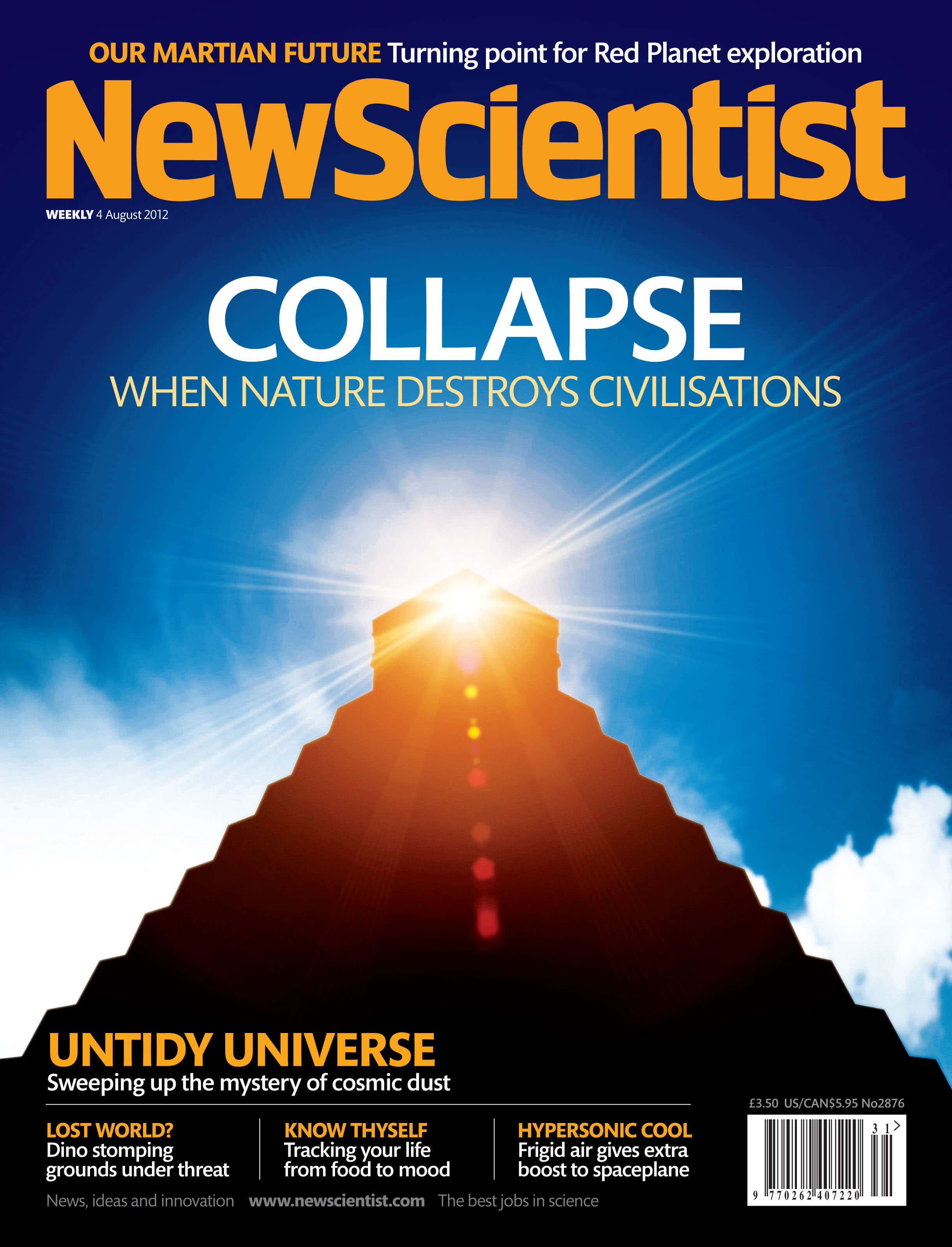
Issue no. 2876 published 4 August 2012

Sign up to our weekly newsletter

Receive a weekly dose of discovery in your inbox. We'll also keep you up to date with New Scientist events and special offers.

Sign up
Piano Exit Overlay Banner Mobile Piano Exit Overlay Banner Desktop