Subscribe now

Letters archive

Join the conversation in New Scientist's Letters section, where readers can share their thoughts and opinions on articles and see responses from experts and enthusiasts across a range of science topics. To submit a letter, please see our terms and email letters@newscientist.com


5 September 2012

Some more equal

From Bruce Denness

Your graph of income inequality in the US since 1920 ( 28 July, p 37 ) shows the top 1 per cent receiving more than 15 per cent of total income during the Depression before about 1930, then the proportion slowly declining to half that rate mid-century and rising back toward it from around 1980. …

5 September 2012

Banking on air

From Dhiren Rao

Philip Penton implies that the mortgage debacle occurred because of people lying on their loan applications (7 July, p 31) . He appears to overlook the fact that nobody was holding a gun to the bankers' heads to force them to make loans. Once upon a time, banks made mortgage loans and held the paper, …

5 September 2012

Trouble at pit

From Martin Savage

Your look at the increasing automation in mining and quarrying (28 July, p 18) discusses how machines can improve safety standards for workers. It neglects to mention that the principal way in which automation improves worker safety is by making the workers redundant. I am not advocating a return to medieval mining: but it has …

5 September 2012

Cycles come around

From John Woodgate

Peter Turchin's "cliodynamics" method of predictive history (18 August, p 46) was predicted in considerable detail by Isaac Asimov in his classic novel Foundation – although Turchin may be early, since that was set 24,000 years in the future. An important principle stated early on is that the predictive power of cliodynamics – which Asimov …

5 September 2012

Life on Mars

From Javier Martín-Torres, Javier Martín-Torres, science lead, Rover Environmental Monitoring Station

The sentence, "Curiosity begins its epic search for signs of life" on the front cover of your magazine ( 11 August ) is misleading. The aim of Curiosity is not to search for life on Mars. It is not loaded with the suite of instruments that would pursue that goal, unlike, for example, the Viking …

5 September 2012

Sweet smell of fungi

From Name withheld

In light of reports about microbiomes and the positive effects of certain bacteria and fungi in our environment (for example, 28 July, p 32) , I have an anecdote to share. Some time ago, I had the misfortune to contract thrush, for which my partner and I took oral anti-yeast tablets. Within 24 hours of …

5 September 2012

After Higgs

From Tommy Ohlsson, KTH Royal Institute of Technology

You write about the euphoria following the likely discovery of the Higgs particle (14 July, p 3) but send a negative signal that the young generation of physicists could run out of problems, since finding the Higgs particle marks "the end of the road". However, most theories and models in particle physics have assumed its …
5 September 2012

Ranking algorithms

From Roger Hull

I was surprised that in your look at the simplex algorithm (11 August, p 32) , the list "2000 years of algorithms" does not include the well-known Dijkstra algorithm (published in 1959) for finding the shortest path through a weighted graph. This is the basis for internet routing protocols and thus a challenger for the …

5 September 2012

For the record

• We misquoted Jeff Youngblood as saying that nanocrystalline cellulose is 2 nanometres long: it is 200 nanometres long (18 August, p 24) . We also incorrectly said that it has eight times the tensile strength of stainless steel – that should have been the strength-to-weight ratio. Sorry. • The dieting that may produce ketosis …

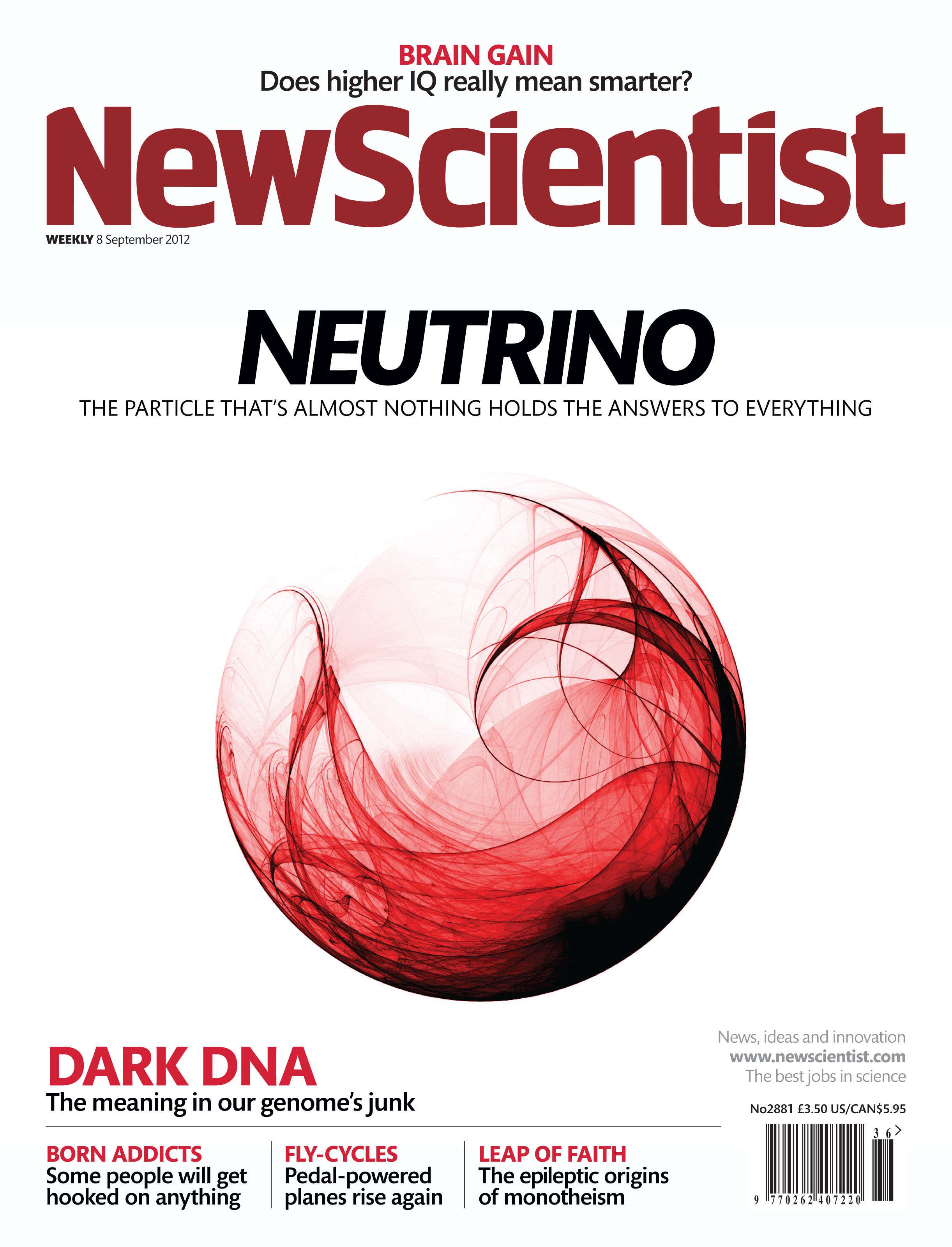
Issue no. 2881 published 8 September 2012

Sign up to our weekly newsletter

Receive a weekly dose of discovery in your inbox. We'll also keep you up to date with New Scientist events and special offers.

Sign up
Piano Exit Overlay Banner Mobile Piano Exit Overlay Banner Desktop