Subscribe now

Letters archive

Join the conversation in New Scientist's Letters section, where readers can share their thoughts and opinions on articles and see responses from experts and enthusiasts across a range of science topics. To submit a letter, please see our terms and email letters@newscientist.com


10 October 2012

Floating away

From Mikolaj Habryn

My own experience tells me the greater body of purported seasteaders (22 September, p 26) emanate from that particular species of libertarian ( L. americanus ) who decry the evils of government spending while choosing to continue living in the highest taxing, most socialist US states rather than simply upping sticks. So the chances seem …

10 October 2012

Losses and gains

From Harm J. Schoonhoven

On the positive side, your look at the human propensity to lose technologies in the mists of time (29 September, p 30) raises the hope that the art of making guidance systems for intercontinental ballistic missiles will be lost, in the same way as the recipe for Greek fire. On the negative side, we have …

10 October 2012

Word of God

From Dave Goodwin

Surgeon Hutan Ashrafian suggests "visions" during epileptic seizures may have inspired the birth of monotheism in ancient Egypt (8 September, p 10) . I feel hard done by. Having developed adult-onset temporal lobe epilepsy years ago, which went undiagnosed for a long time, I had a religious experience during what I now know was a …

10 October 2012

Amphibian hope

From Samuel M. McGinnis

You suggested that research showing a regenerated lizard's tail has an inferior anatomy to the one it replaced could weaken hopes of achieving limb regeneration in humans (15 September, p 10) . But it is the salamanders, of the order Caudata, and not lizards that potentially hold the key to future human-limb regeneration. There is …

10 October 2012

That's a fact

From Staffan Ulfstrand, Uppsala University

That a journal paper many years old is no longer cited may not be because of the "decay" of the truth of its findings (22 September, p 36) but because its results have become so thoroughly supported by evidence that they are properly regarded as facts. For example, that our planet is orbiting the sun, …

10 October 2012

Brighter future

From John Latham, US National Center for Atmospheric Research and Alan Gadian, University of Leeds

Your article on geoengineering was balanced and wide-ranging (22 September, p 30) . We would, however like to add several points to the idea of global cooling by cloud whitening or marine cloud brightening (MCB), which involves seeding maritime clouds with seawater droplets to make them reflect more sunlight. MCB is not ineffectual vis-à-vis polar …
10 October 2012

Better than normal

From Susan Hall

Stuart Leslie suggests that infidelity may be normal for humans, as it is for albatrosses (18 August, p 33) . Of course it is normal, as are racism, sexism, dishonesty and war, given that they are so widespread. In a wide range of circumstances they can further the survival and reproduction of the perpetrators. However, …

10 October 2012

Just like us?

From Colin Morrison

In the absence of an agreed explanation for subjective experience, isn't declaring animals to be conscious just because they have similar neural substrates to us (22 September, p 24) a bit like 19th-century phrenologists declaring that people with skulls similar to those of criminals are also criminals? Our reasoning should surely be that human consciousness …

10 October 2012

'Ello, 'ello, 'ello

From Maryse Palemans

It was great to read about individuals with extraordinary powers of facial recognition (15 September, p 36) . It was a skill my father shared: he could recall a face decades later. One such case concerned a policeman whom he met once. About 20 years later their paths crossed again, but this time the policeman …

10 October 2012

So misguided

From Robert Willis

Further to your commentary about textbooks used under the Accelerated Christian Education programme (25 August) , you should also note that the Biology 1099 edition misinforms its readers about the scientific method, claiming the only truly reliable method of scientific discovery is the "Word of God".

10 October 2012

Ask a pharmacist

From Sheila Handley

There is nothing odd about the phrase "for extemporaneous use only" on a packet of potassium citrate, as mentioned in Feedback (8 September) . It's just pharmaceutical talk for an ingredient used to prepare a "one-off" medicine for a particular patient or group of patients because it is not available as a licensed preparation in …

10 October 2012

For the record

• Sorry physics grads. In the online Graduate Careers Special for UK readers ( 29 September ) your average salary six months after graduating (based on last year's salaries) should be £23,094, not £16,255.

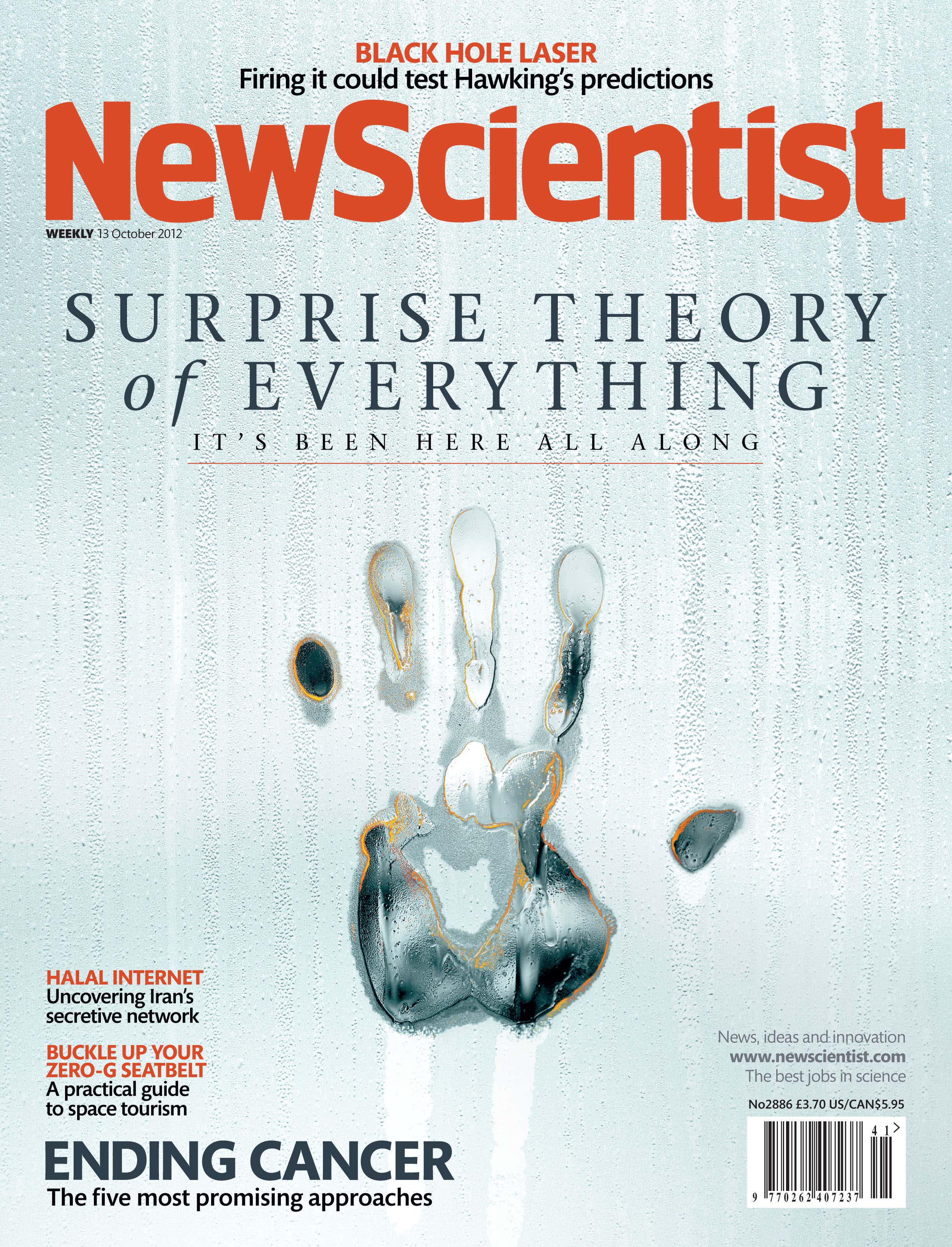
Issue no. 2886 published 13 October 2012

Sign up to our weekly newsletter

Receive a weekly dose of discovery in your inbox. We'll also keep you up to date with New Scientist events and special offers.

Sign up
Piano Exit Overlay Banner Mobile Piano Exit Overlay Banner Desktop