Subscribe now

Letters archive

Join the conversation in New Scientist's Letters section, where readers can share their thoughts and opinions on articles and see responses from experts and enthusiasts across a range of science topics. To submit a letter, please see our terms and email letters@newscientist.com


21 November 2012

Life of brain

From Chris Nunn

Randal A. Koene's article "How to copy a brain" was a blast from the past, with its implicit assumption that neurons are all that matters when it comes to the basis of "mind", and that associated computations are primarily digital (27 October, p 26) . In fact, we now know that we should be thinking …

21 November 2012

Ending cancer

From Eric Werner, University of Oxford

The promising new treatments for cancer that you describe are good news (13 October, p 38) . However, such treatments have inherent limitations because they are based on a fundamentally mistaken view of cancer centred on the role of individual genes. This prevents true understanding of how cancer develops and how it can be cured. …

21 November 2012

Fear of dying

From Chris Warman

Shelley Kagan's article about death is for the most part a bracing response to our fears, but as a British citizen of a certain age I have my reservations about the statement: "One thing you might worry about is the process of dying" (20 October, p 42) . At the moment, we are hearing that …

21 November 2012

Helping hands

From Jessica Miller

For those of us who have never worked in a restaurant and do not have the skill of holding many plates at once, the extra robotic arms you report (27 October, p 18) could be useful when hosting a dinner party. More seriously, could they help elderly people perform tasks they struggle with, such as …

21 November 2012

Monopoly genetics

From Matt Carmichael

Having read your editorial "Farms for the future" (13 October, p 5) , I turned eagerly to Michael Marshall's article putting forward the case for the defence for genetically modified food (p 8) to learn of the "host of benefits that have received little attention". What I read was a familiar, and rather short, list …

21 November 2012

Political evolution

From John Campion

A cry for academic freedom is often the last refuge of the intellectual charlatan. It appears that the article on political instincts by Jesse Graham and Sarah Estes (3 November, p 40) reports an example. Born into a middle-class, Christian, Conservative family, I inherited my beliefs from the culture that surrounded me at home and …

21 November 2012

Young blood

From Paul Tighe

Your article on transfusions of blood from young donors possibly reversing senility (20 October, p 10) sparked a long-forgotten memory of Alexander Bogdanov , an early 20th-century Russian experimentalist who made radical claims for the effects of transfusion. His claims have been viewed sceptically, but could be worth revisiting.

21 November 2012

Out of cite

From Virginia Trimble, University of California, Irvine

Samuel Arbesman (22 September, p 36) and subsequent letters such as Alan Bundy's (20 October, p 31) seem to have missed a major reason for old, very important papers being cited less often as time goes on. The term in Scientometrics is "incorporation", meaning that the result has become so integral a part of a …
21 November 2012

Wandering star

From John Cleveland

While reading the latest thinking on the past climate of Mars (20 October, p 44) , I found myself wondering whether the planet has always been in its present orbit. If it had a warmer, wetter climate 3.6 billion years ago, could it have been closer to the sun then? Could Mars have somehow been …

21 November 2012

Of lice and men

From Keith Cameron

I enjoyed your article on the insight into human evolution provided by lice (3 November, p 36) . However, the statement that similarities between genital lice and gorilla lice sparked speculation about the sexual proclivities of our ancestors led me to consider the possibility that the jump from gorilla to human could mark the point …

21 November 2012

For the record

• We referred to "powdered nylon... called ABS" (6 October, p 22) . Nylon and ABS are distinct groups of plastics. • Oliver Sacks is no longer at Columbia University, but is currently a professor of neurology at the New York University School of Medicine (3 November, p 28) .

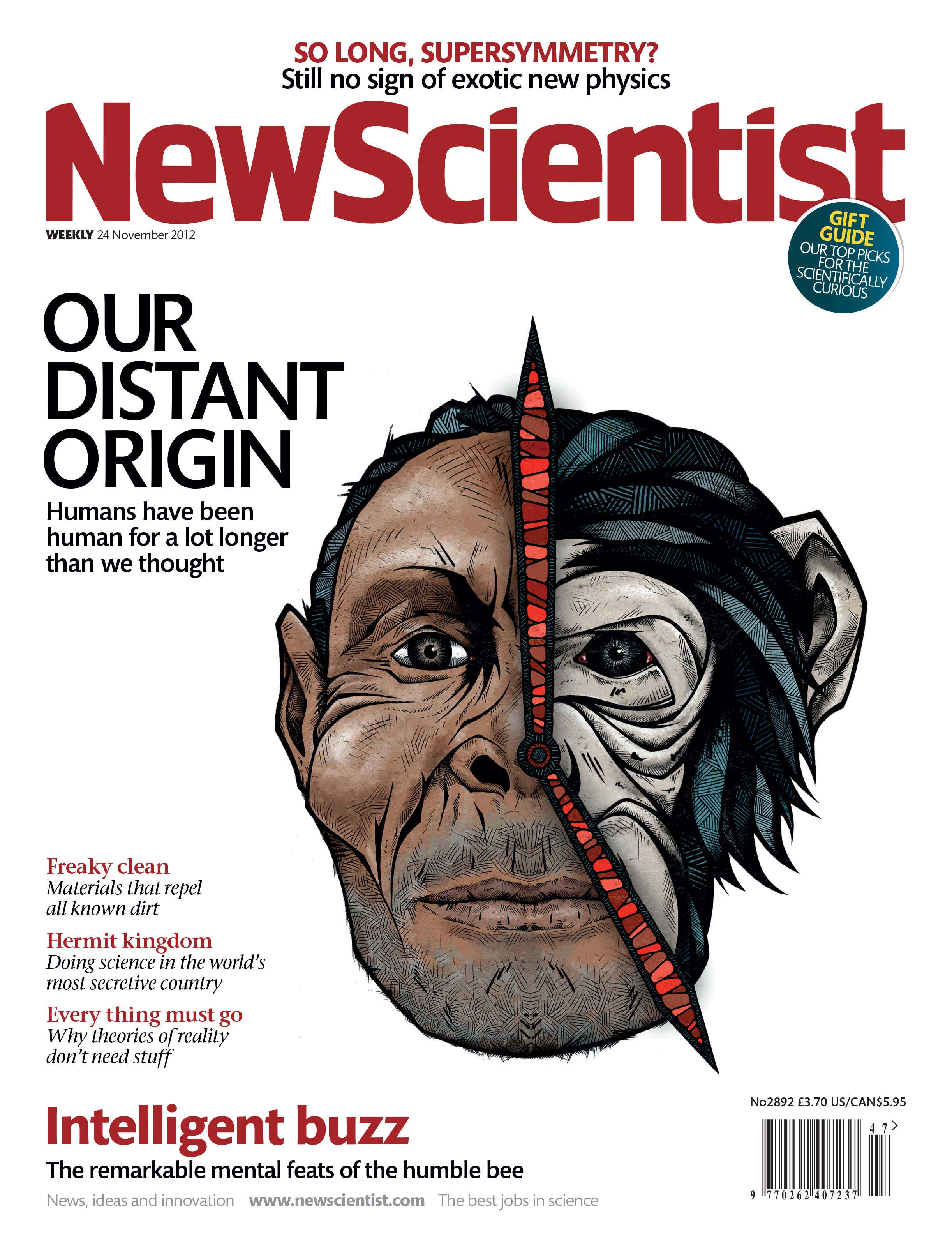
Issue no. 2892 published 24 November 2012

Sign up to our weekly newsletter

Receive a weekly dose of discovery in your inbox. We'll also keep you up to date with New Scientist events and special offers.

Sign up
Piano Exit Overlay Banner Mobile Piano Exit Overlay Banner Desktop