Subscribe now

Letters archive

Join the conversation in New Scientist's Letters section, where readers can share their thoughts and opinions on articles and see responses from experts and enthusiasts across a range of science topics. To submit a letter, please see our terms and email letters@newscientist.com


12 December 2012

Maize controversy

From Cathie Martin, John Innes Centre group leader, and editor-in-chief of The Plant Cell

The study by Gilles-Eric Séralini and colleagues at the University of Caen in France linking cancer tumours in rats with maize modified to resist the herbicide Roundup, has been judged by the European Food Safety Authority to be scientifically unsound because of inadequacies in its design, reporting and analysis (8 December, p 7) . As …

12 December 2012

Human fork

From Robert Jackson

Catherine Brahic's discussion of fresh efforts to pin down when humans split from chimps (24 November, p 34) is a nice example of the contribution of quantitative genetics to understanding evolution, but there is another strand to the story of the emergence of humans – the significant qualitative difference between humans and chimpanzees. Humans have …

12 December 2012

Taxing times

From Tine Thorup

Marion Nestle writes that the Danish fat tax, now being dropped after a year, brought in $216 million and that "Danes will now face higher income taxes to make up for the loss of the fat tax" (24 November, p 28) . One of the reasons for the unpopularity of the fat tax was that …

12 December 2012

LHC reality check

From Tommy Ohlsson, KTH Royal Institute of Technology

The editorial and cover story in your 10 November issue (p 3 and p 34) discuss the aftermath of this year's grandest scientific finding – the discovery of a new boson, most likely the Higgs – along with a possible successor to the Large Hadron Collider (LHC). First, we must clarify beyond doubt that the …

12 December 2012

Birds and bees

From Peter Greaves

In his recent letter, Gavin Lawrence asked if advances in modelling bee flight had been used in the design of wind turbines (1 December, p 31) . The answer is sort of. Vertical axis turbines in gustier areas are more effective if the blade is designed to be like a small bird's wings, exploiting the …

12 December 2012

Revised wisdom

From Brian Tagg

Your article on the growing use of genetic markers to eliminate confounding factors in clinical studies, overturning some earlier epidemiological conclusions, gave me a shock: a major contributor to heart health has been eliminated overnight (24 November, p 8) . So good cholesterol has zero direct impact on coronary heart disease? What an extraordinary result …

12 December 2012

Wind fans

From Nick Medic, London, UK

Your online article by Michael Brooks on the UK energy bill asked if British consumers are prepared to shoulder the higher initial costs of energy from renewables ( 26 November ), and touched on some interesting aspects of decision-making theory. His view seems to be that experts broadly support further decarbonisation, even if it increases …

12 December 2012

Wax pioneer

From Guy Cox, Australian Centre for Microscopy & Microanalysis, University of Sydney

In your article on omniphobic materials, you credit Christoph Neinhuis and Wilhelm Barthlott with the discovery of the water-repellent properties of plant epicuticular waxes in 1997 (24 November, p 46) . Without in any way detracting from their work, I would point out that Barrie Juniper's pioneering electron microscope work on epicuticular waxes at Oxford …
12 December 2012

Error message

From Richard Suyeda

In your feature on technological progress, anthropologist Dietrich Stout suggests that the march of innovation may result from copying errors, in a manner analogous to genetic mutations in evolution (29 September, p 30) . This reminds me of the programmer's saying: "It's not a bug, it's a feature." From William Hughes-Games The observation that Tasmanians' …

12 December 2012

Moving New York

From Alan Hayward

Superstorm Sandy emphasised that New York is a trillion-dollar sitting duck with embedded feet at the mercy of the elements (10 November, p 6) . So maybe a phased retreat from endangered areas is the way forward. A safe site must be well-planned for Nova York, to cope with the outflux. Private investment would cater …

12 December 2012

No food for thought

From Anthony O'Brien

Fifty years ago I discovered the benefit of periodic fasting (17 November, p 46) . Initially this was a way to settle my stomach, but I soon found it also cleared my head for writing and exams. For anyone thinking of fasting, it is easier if you start with a good lunch. Then you'll be …

12 December 2012

Random beginning

From Bob Holland

Philosophers and theologians of a traditional kind might be interested in your article on cosmic origins (1 December, p 32) which acknowledges the universe must have had a beginning, even though we might not know when that might have been. And as all theories must have existed before this event, I should like to congratulate …

12 December 2012

Sweet reason

From Victoria Richardson

Regarding the correlation between chocolate consumption and the number of Nobel laureates per capita (3 November, p 56) , surely a country that can afford more confectionary will be able to afford facilities for potential Nobel laureate research.

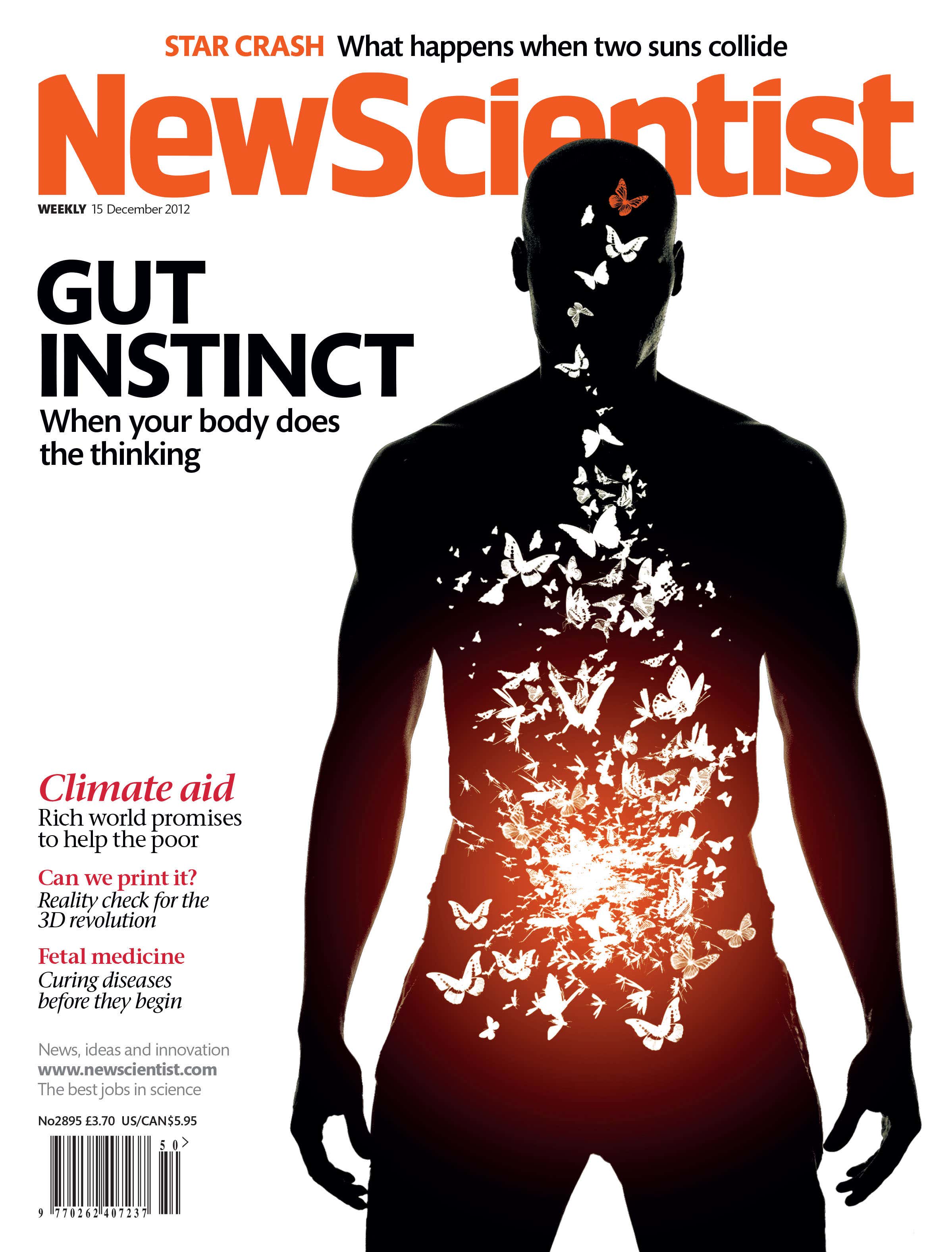
Issue no. 2895 published 15 December 2012

Sign up to our weekly newsletter

Receive a weekly dose of discovery in your inbox. We'll also keep you up to date with New Scientist events and special offers.

Sign up
Piano Exit Overlay Banner Mobile Piano Exit Overlay Banner Desktop