Subscribe now

Letters archive

Join the conversation in New Scientist's Letters section, where readers can share their thoughts and opinions on articles and see responses from experts and enthusiasts across a range of science topics. To submit a letter, please see our terms and email letters@newscientist.com


30 January 2013

Quantum flip

From Ian Stewart, Emeritus professor of mathematics, University of Warwick

Reality may not be quite as inscrutable as Anil Ananthaswamy suggests in his look at quantum wave-particle duality (5 January, p 36) . Instead of abandoning "any pretence of understanding the outcome" of the interferometer experiments he describes, we can pay attention to a neglected aspect of quantum observations, namely the measuring apparatus. We don't …

30 January 2013

War of words

From Geoff Pullum, Professor of general linguistics, University of Edinburgh

David Robson's feature "'Sno myth" was subtitled: "Eskimos really do have at least 50 words for snow" (22/29 December 2012, p 72) . He wrote that anthropologist Franz Boas "sparked off the claim" about Eskimoan languages having numerous snow words; that "most linguists considered it an urban legend"; and that Smithsonian researcher Igor Krupnik and …

30 January 2013

Juicy incentive

From Brian Farrington

It was good to read Reg Platt's case for the use of wind power based on research (19 January, p 26) . As he says, "the concerns of people who do not want wind power on their doorsteps need to be taken into account", but this should not be allowed to prevent the development of …

30 January 2013

No cheers

From Edward Hitchcock

Minimum alcohol pricing may not reduce consumption among those who see heavy drinking as an essential part of social activity, and who have disposable income (12 January, p 3) . But the pricing may reward retailers, and punish poorer people who drink a little. Perhaps restrictions should focus on the types of drinks most often …

30 January 2013

Making the grade

From Ged Green

A negative correlation between economic performance and test scores in mathematics and science subjects, which was highlighted in your look at the gap between the West and Asia, does not surprise me (5 January, p 22) . In a school with a broad international intake it is often the case that the student from a …

30 January 2013

Bug wrapper

From Caroline Herzenberg

Carrie Arnold discusses the idea that symbiotic microbes help drive the evolution of their hosts (12 January, p 30) . Could a collection of microbes in the very distant past, a precursor of our present-day microbiome, have started the whole co-evolutionary process? Perhaps by wrapping itself in a protective outer layer of cohesive cells, it …

30 January 2013

Stepping stone

From Andrew Climo

New Scientist reported possible NASA plans to capture a 7-metre-wide asteroid and place it in the moon's orbit (2 January, newscientist.com) . A great idea, but why not go for a larger rock to have a permanent platform in lunar orbit from which to launch missions? It makes sense to put one in high Earth …

30 January 2013

Turn on, tune out

From Alan Hayward

Video game tournaments as a spectator "sport" provide fodder for the mindless, and attract more to couch-potato land (12 January, p 20) . It is sad that, for these folk, constructive hobbies are being drowned in a sea of sterile entertainment.

30 January 2013

Get beavering

From William Hughes-Games

The news article on climate change suggests that streams and rivers powering European hydroelectric projects will flow more strongly in winter and less so in the summer, causing problems (1 December 2012, p 9) . The answer is beavers. They not only store water in their dams, but also in the raised water table on …
30 January 2013

Beginner's luck?

From John Chubb

Peter Bauer in his letter notes the need for curiosity to overcome established information and experience (19 January, p 31) . In my experience it is when entering a new field, where you don't know the accepted ideas, that useful new approaches often arise.

30 January 2013

For the record

• In our story on new bird-scaring methods for flight paths (19 January, p 22) , we should have said that Technology International is in Laplace, Louisiana. • An ironical misuse of the word had us describing Terry Erwin of the Smithsonian Institution as an etymologist. Since we report his work with insects, we should …

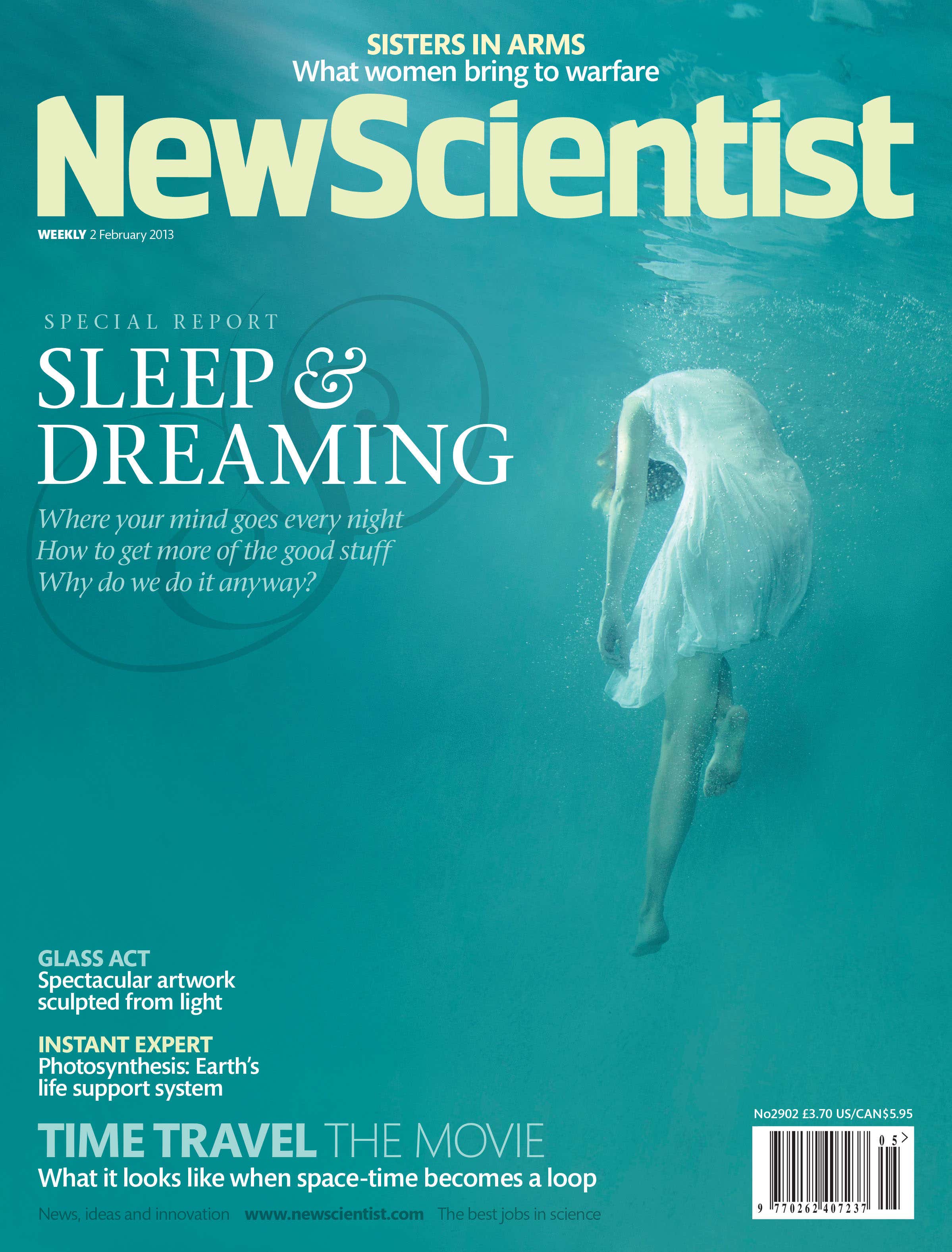
Issue no. 2902 published 2 February 2013

Sign up to our weekly newsletter

Receive a weekly dose of discovery in your inbox. We'll also keep you up to date with New Scientist events and special offers.

Sign up
Piano Exit Overlay Banner Mobile Piano Exit Overlay Banner Desktop