Subscribe now

Letters archive

Join the conversation in New Scientist's Letters section, where readers can share their thoughts and opinions on articles and see responses from experts and enthusiasts across a range of science topics. To submit a letter, please see our terms and email letters@newscientist.com


6 February 2013

State threat

From Stephen Corry, Survival International

Jared Diamond thinks that "traditional" societies sometimes do nasty things, and that state governments are a requisite for peace (12 January, p 26) . His key point is that such societies kill many, be it in "war", infanticide, or the abandonment or murder of the very old. It is of course true that many of …

6 February 2013

Looks familiar

From Andrew Lockley

Joe Kloc misses a possible explanation for the uncanny valley – the feeling of unease when seeing a robot with a strong human likeness (12 January, p 35) . Perhaps because early humans could not easily breed with other hominins, this would have caused an evolutionary pressure to shun those we saw as almost human. …

6 February 2013

Guns galore

From Roger Taylor

It will be interesting to see what the Centers for Disease Control and Prevention can come up with in its research into gun violence in the US (26 January, p 6) , but I doubt it will provide any solace to those who think that gun control laws hold the answer to reducing the violence. …

6 February 2013

Scientific SOS

From Jim Al-Khalili, Professor of physics, University of Surrey

I would like to add my voice to Nobel laureate Harry Kroto's rallying call to ensure the survival of the UK's Royal Institution (26 January, p 27) . Many of us in the science community are well aware of the financial pressures it has been under, which are more than simply a reflection of the …
6 February 2013

Cooler climate

From Nicholas Lewis

Several fair points are made in your assessment of the leaked draft of the Intergovernmental Panel on Climate Change's (IPCC) Fifth Assessment Report (22/29 December 2012, p 8) . However, saying that we now have a gloomier picture of the extent to which human-made aerosols reduce global warming is wrong. The draft says the cooling …

6 February 2013

Feel the buzz?

From Ted Lovesey

A buzzing steering wheel to guide dazzled drivers is unlikely to work (19 January, p 20) . Several years ago, the US military tried a similar device in a pilot's helmet to alert them to danger, but with no success. When a person is stressed, as a dazzled driver is, they will concentrate on their …

6 February 2013

Hold the milk

From Ellis Pritchard

In response to Donald A. Sands's letter (19 January, p 31) , while transport of goods is a major contributor to carbon dioxide emissions, it is only a small part of the carbon footprint of an average cup of coffee. According to Mike Berners-Lee's book How Bad are Bananas? , a cup of black coffee …

6 February 2013

Bugs 'n' birth

From David Harris

Carrie Arnold's article on how microbes inside us help shape our evolution emphasised the link between our microbiome and health (12 January, p 30) . However, there is a growing trend in developed countries away from natural childbirth and towards caesarean birth. A baby travelling down the birth canal is exposed to the mother's biota …

6 February 2013

Count in colour

From Noreen Weighell

I was intrigued that letter writer Amy S. Bouska associates 9 with the colour yellow (19 January, p 30) . For me, 9 is always a cool blue; 5 is yellow; 7 a sinister black; and 4 my favourite pink. I am not a synaesthete, but in kindergarten I learned to associate 1 to 10 …

6 February 2013

Clear now

From Eric Kvaalen

In your article on "ghostly galaxies", you state that "about 300,000 years after the big bang, the charged hydrogen that filled the universe became neutral and opaque, creating a cosmic fog that blotted out visible light for a billion years" (19 January, p 16) . This is incorrect. When the hydrogen became neutral, it ceased …

6 February 2013

Font-ology

From Marie L. Rabouhans

While I would not wish to be typecast, I found myself agreeing with Sally Adee that there is a lot more to typography than meets the eye (22/29 December 2012, p 68) . My professional persona manifests itself in Times New Roman (except in emails) whereas jottings for friends and the odd poetic outburst find …

6 February 2013

An average driver?

From Mark Harvey

I see that the question has arisen over whether driverless vehicles must perform "merely as well as an average human" (22/29 December 2012, p 34) . Given that, as I am led to understand, most men in the UK think of themselves as far better than average behind the wheel, this might prove a tricky …

6 February 2013

ET gone phishing

From Martin Ystenes

Letter writer Martin Ellis seems concerned that a single evil civilisation will take over the universe (12 January, p 28) . But such a civilisation would probably spam the intergalactic internet. So as long as we don't respond to messages saying: "You have inherited a galaxy in the Crap Nebula", we should be safe.

6 February 2013

All you can pump

From Gregory Sams

One can only imagine the horror of any all-you-can-eat-restaurant owner when the first customer arrives sporting the new weight-loss device consisting of a through-the-abdomen, surgically fitted stomach pump, recently patented by Aspire Bariatrics ( 12 January, p 19 ).

6 February 2013

Truth will out

From Allan Jones

In your look at digital mapping (19 January, p 44) , Pat Seed, a mapping historian, is quoted as saying: "There aren't universal truths." That sounds like one.

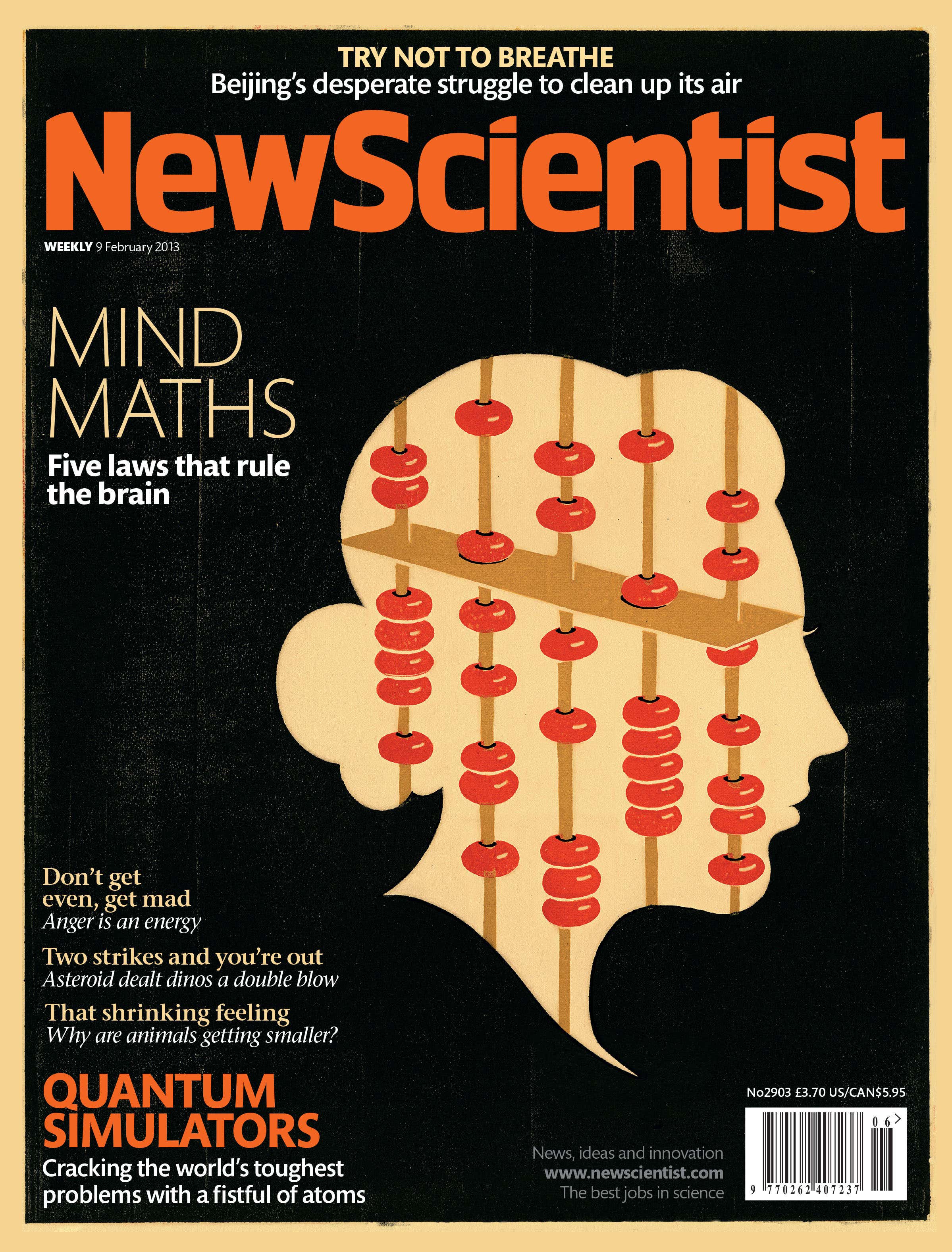
Issue no. 2903 published 9 February 2013

Sign up to our weekly newsletter

Receive a weekly dose of discovery in your inbox. We'll also keep you up to date with New Scientist events and special offers.

Sign up
Piano Exit Overlay Banner Mobile Piano Exit Overlay Banner Desktop