Subscribe now

Letters archive

Join the conversation in New Scientist's Letters section, where readers can share their thoughts and opinions on articles and see responses from experts and enthusiasts across a range of science topics. To submit a letter, please see our terms and email letters@newscientist.com


28 August 2013

Not as we know us

From Alec Cawley

Douglas Heaven suggests that modern artificial intelligence is a form of intelligence we have never encountered before (10 August, p 32) . I suggest that we may well have done so – every time we meet a fellow human. We don't know how our intelligence works, and it is plausible that it works in exactly …
28 August 2013

Not as we know us

From Oscar Heath

Is it not possible that we in fact think like our robots? We think we take logical steps in observing that cats are carnivores, carnivores eat meat, therefore cats eat meat. But aren't these mere statistical associations? Philosopher David Hume argued similarly in the 18th century. London, UK

28 August 2013

Not as we know us

From Ian MacDonald

Our brains are fed vast amounts of information through our senses, much as AIs are fed information from the internet. Our subconscious brain must process and filter this and relate it to prior input – as AIs do for Google or Amazon. It then deposits usable output into our conscious mind as "news headlines" which …

28 August 2013

Not as we know us

From Robin Wilson

You describe statistical methods generating unexplainable, but interesting, results. I have encountered some inexplicable results myself: after ordering Jared Diamond's book about social collapse I was told that I would also be interested in the autobiography of a footballer called Wayne Rooney. I don't much mind people (or machines) believing I am a fan of …

28 August 2013

Modest alien search

From Alan Penny, UK SETI Research Network Your report on the UK SETI Research Network was a bit overenthusiastic (13 July, p 6) . This informal network was formed to promote UK academic activity in the search for extraterrestrial intelligence through meetings and possible collaborations. Our discussions have not yet produced an actual proposal for …

28 August 2013

Keeping time

From William Murphy

Anil Ananthaswamy wonders whether space, time, both or neither form the basis of reality (15 June, p 34) . Worryingly, he points out that one candidate for a theory of everything, loop quantum gravity, indicates that time and space are emergent entities of a deeper reality rather than fundamental elements. Here's hoping for an approach …

28 August 2013

Many wrongs?

From Carl Zetie

Reality, relativity, causality and free will. You ask "which one is wrong?" (3 August, p 32) . It might have been better to say "at least one of them is wrong". At a minimum, our understanding of both reality and causality is hindered by a long-standing mental block in interpretations of quantum mechanics, namely the …

28 August 2013

From Wilken Sporys

Who is to say our understanding of any of them is right? Certainly, relativity tells us that time and space are not quite as we perceive them. Any object travelling at the speed of light will arrive at the same instant that it left, without travelling any distance at all. Time and space only emerge …

28 August 2013

Mars bars

From Richard Gammache

Articles about colonising Mars continue to gloss over the temperature and composition of its atmosphere (13 July, p 42) . It seems disingenuous to act as though people can actually discuss living out a significant part of their lives in spacesuits and pressurised hulls. There is no precedent; even extended submarine patrols and International Space …

28 August 2013

Mars bars

From Tim Stevenson

You mention that "one of the mooted Martian settlement projects has proposed funding the trip using a reality TV show" (27 July, p 5) . Will there be evictions? Great Missenden, Buckinghamshire, UK

28 August 2013

Glutamate booster

From John Sill

Glutamate, the king of neurotransmitters, provides the primary means whereby brain cells communicate. As so clearly discussed by Samantha Murphy (27 July, p 34) , it is also a likely but elusive culprit in depression. Beyond the cumbersome general anaesthetic ketamine, means to manipulate glutamate pathways are few. The system remains inaccessible to conventional antidepressant …

28 August 2013

Open access fields

From Darwyn Sumner

Feedback is concerned about open access publishing, noting that "someone has to pay... the researcher, whose livelihood depends on being published somewhere" (27 July) . This may well apply to the commercial and academic science sectors. It does not apply in the substantial sector serviced by museums and "volunteers" in the "poor" areas of biodiversity, …

28 August 2013

Obey the odds

From Sadie Williams

Tim Johnson suggests that we can "move the odds a bit in favour of free will" by positing that, as happens with events in the quantum world, our human behaviour is not just subject to the scientific laws of causality but is also subject to the laws of probability (13 July, p 32) . Whether …

28 August 2013

Picnic of fear

From Mike Stovold

Your article on the influence of fear on prey species and the consequent ecological impacts of their resulting behaviour was fascinating (1 June, p 36) . A few years ago I visited a waterfall in Shimba Hills National Reserve, Kenya, with a family group. We walked down to the waterfall in an excited garrulous group …

28 August 2013

Needs must

From Ed Subitzky

I noticed that two recent readers' letters referred to the saying "Necessity is the mother of invention" ( 20 July, p 28 , and 3 August, p 30 ). In an age when we are so dependent on smartphones and other gadgets, perhaps this should be amended to: "Invention is the mother of necessity." New …

28 August 2013

For the record

• To refer to the "eradication" of river blindness in Colombia (10 August, p 6) was overambitious: its removal from just one region is "elimination" • We should have made it clear that software analysis of DNA from the scene of the murder of Meredith Kercher indicated only that Amanda Knox's DNA was not present …

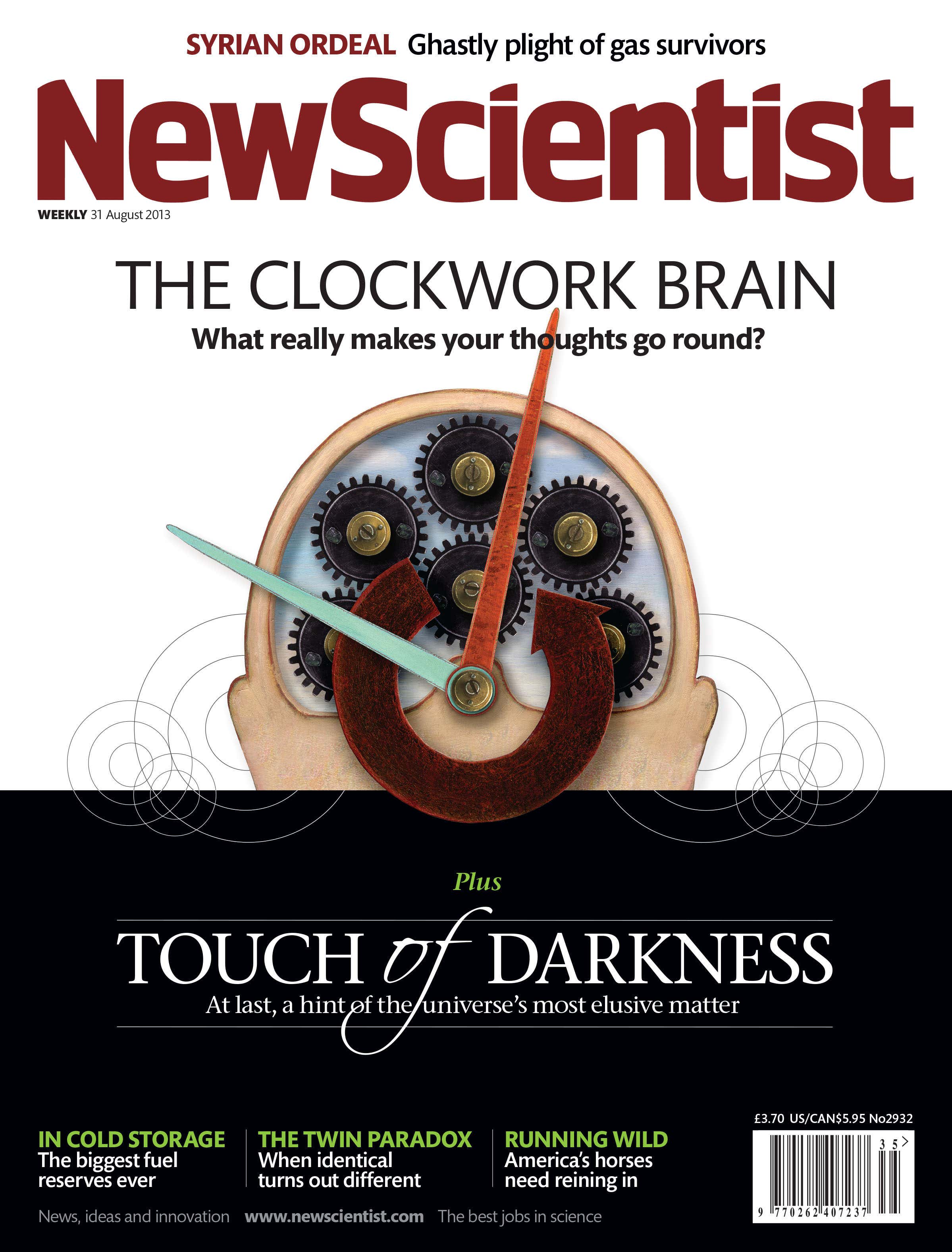
Issue no. 2932 published 31 August 2013

Sign up to our weekly newsletter

Receive a weekly dose of discovery in your inbox. We'll also keep you up to date with New Scientist events and special offers.

Sign up
Piano Exit Overlay Banner Mobile Piano Exit Overlay Banner Desktop