Subscribe now

Letters archive

Join the conversation in New Scientist's Letters section, where readers can share their thoughts and opinions on articles and see responses from experts and enthusiasts across a range of science topics. To submit a letter, please see our terms and email letters@newscientist.com


18 September 2013

Infinity's end

From Peter Lavers

Amanda Gefter's exploration of infinity, mathematics and physics (17 August, p 32) arouses my bewilderment that people believe mathematical constructs like infinity are realised in the world. Where theory predicts infinite density, I see a breakdown of the theory. Mathematical concepts don't need to be part of physical reality. I can conceive of always being …
18 September 2013

Infinity's end

From John Butcher

Infinity does not have to defy imagination as Gefter suggests. It is sometimes possible to see the beginning and the end of an infinity at the same time, as in the infinity of the number of numbers between 1 and 2. Now let us ask how many minuscule "pieces" make up a length of 1 …

18 September 2013

Infinity's end

From Eddie Crouch

Gefter deals with two different things: on the one hand, classical concepts of number and geometry; and on the other, the reality that physicists attempt to explain. There may well be only a finite number of objects in the universe, but a mental construct, namely the mathematical concept of integers, allows an infinite sequence of …

18 September 2013

Loony names

From Jim Lovell

I agree with the views of my fellow Apollo 8 crew member William Anders on the naming of lunar landmarks (14 September, p 30) . The International Astronomical Union (IAU) disregarded his suggestion, even though we discovered them on the far side of the moon. On the near side of the moon, on the shore …

18 September 2013

Vaccine bonus

From John Grange

Vaccines influence the immune system in more ways than Michael Brooks describes (17 August, p 38) . They can give a useful degree of protection against certain cancers. Studies in several countries have demonstrated that the tuberculosis vaccine BCG, when given early in life, confers some protection against acute leukaemia ( Journal of the Royal …

18 September 2013

Stem cell worries

From Simon Goodman

Peter Aldhous's article discusses US restrictions on patients being given treatments based on their own stem cells (10 August, p 42) , but it is worth noting that ordinary cells are touchy about being manipulated, and stem cells especially so. They are designed to match the environment in which they find themselves, and once removed …

18 September 2013

Third twin

From Sally Stokes

I read with interest Helen Pilcher's report on different "identical" twins (31 August, p 44) , and was surprised that she did not allude to the possibility that the twin born with two vaginas, two colons and a split spinal cord might have absorbed a third fetus. Some form of fetal resorption is, according to …

18 September 2013

Hot tip

From Dean Crawford

The valiant efforts of the Syracuse University Lava Project researchers to understand and control lava flows (3 August, p 40) might benefit from a look at what happens inside an industrial smelter. Integrated steelworks produce lots of slag, a waste product of smelting ore. As the researchers know, slags are not so different from lava …

18 September 2013

Angry eyes

From Jennie Kermode

Martin Van Raay says he would like the computers he uses to be able to recognise anger (24 August, p 30) . He may be interested to note that Google recently patented a system that observes pupil dilation in the users of Google Glass-type devices to gauge their emotional reactions to what they see . …

18 September 2013

The threat remains

From Ian Glendon

Our world appears fairly benign, according to Nicholas Humphrey (3 August, p 28) . He argues that "placebos at large", constructed by big government and religion, help us overcome our overcautious nature, which evolved when big threats were more common. However, I'd argue that for many people substantial threats do remain, even if our innate …

18 September 2013

Dark life

From John Darlington

Robert Adler reports that in the hunt for dark matter some researchers are considering the possible existence of dark atoms, dark chemistry and even dark stars and planets (31 August, p 36) . If so, there may equally well be dark aliens living ever unseen and undetectable alongside us, and who are puzzled by the …

18 September 2013

Logged off

From John Stirrup

Facebook founder Mark Zuckerberg seems to think that there is a human right to internet connectivity (31 August, p 22) . Here in rural Somerset, 11 miles from Bristol, we have had no access to cyberspace for two weeks because of a cabling fault. Could I take the telecoms company to court for infringing my …

18 September 2013

Silver lining

From Peter Lapsley

Your article on the legacy of acid rain points out that measures to combat the problem have led to rivers in the eastern US becoming too alkaline (31 August, p 7) . Although there may be a downside, such as the overgrowth of algae, might the alkalinity of these rivers not help ease the problem …

18 September 2013

I will be free

From Liam O

I agree with reader Sadie Williams that "whether I am obeying laws of probability or causality, or both, I am still not free" (31 August, p 31) . But I am complex enough for my behaviour to be ultimately unpredictable, which is good enough. Peaslake, Surrey, UK

18 September 2013

For the record

• We added a dash too much salt to our feature on the use of methane hydrates as a fuel source (31 August, p 40) ; freshwater Lake Baikal does not contain sea life. • The demon worm Halicephalobus mephisto seen haunting our feature on deep life (27 April, p 36) was discovered by Gaetan …

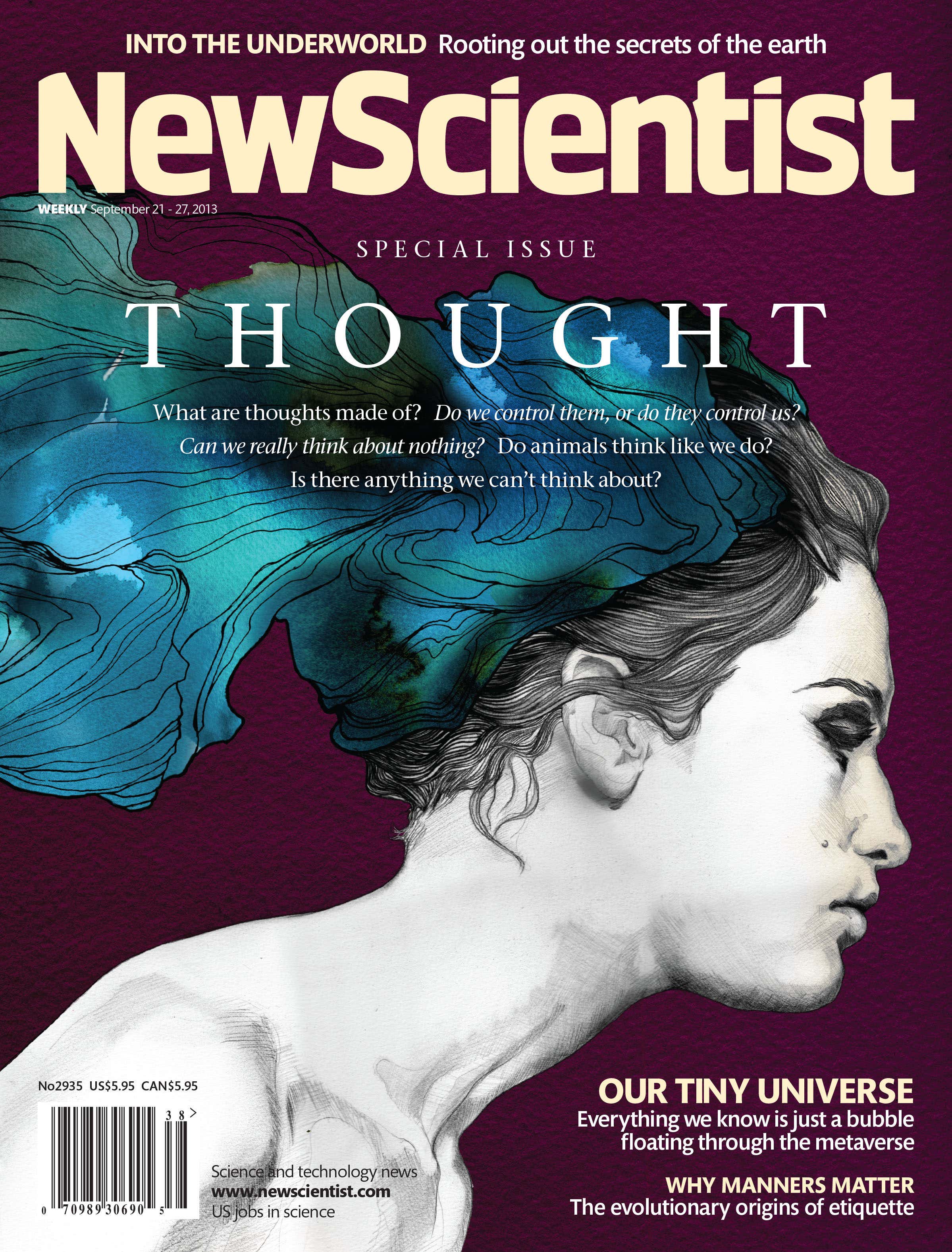
Issue no. 2935 published 21 September 2013

Sign up to our weekly newsletter

Receive a weekly dose of discovery in your inbox. We'll also keep you up to date with New Scientist events and special offers.

Sign up
Piano Exit Overlay Banner Mobile Piano Exit Overlay Banner Desktop