Subscribe now

Letters archive

Join the conversation in New Scientist's Letters section, where readers can share their thoughts and opinions on articles and see responses from experts and enthusiasts across a range of science topics. To submit a letter, please see our terms and email letters@newscientist.com


2 October 2013

Premature anti-age

From Tom Vulliamy

You report a study which found that telomere length increased in a group of 10 men with prostate cancer, who followed a healthy-living regime including a meat-free diet, exercise and yoga (21 September, p 14) . But it is important to highlight the limits of these results. It was a small pilot study and the …
2 October 2013

Me medicine

From John Cantellow

Donna Dickenson writes about the threat to communal health measures posed by the growing demand to fund personalised medicine (14 September, p 26) . Most patients expect that the medicine the doctor prescribed will treat the condition they are diagnosed with. The reality is, however, that the effectiveness of many licensed pharmaceuticals is measured in …

2 October 2013

Unlearned Abbott

From Jock Webb

Alas, your mention of our new Australian prime minister Tony Abbott does not even scratch the surface of his scientific ignorance (14 September, p 6) . As well as his notorious comment that "the climate change argument is absolute crap", he has suggested that carbon dioxide is weightless and thus very hard to measure. He …

2 October 2013

Indo-European roots

From Dewi Jones

Russell Gray and Quentin Atkinson propose that a proto-Indo-European language arose in Anatolia 9000 years ago and spread out from there together with farming (7 September, p 32) . I don't really understand their method, but there are one or two points I can raise from what I know of the history of Indo-European languages. …

2 October 2013

Unconscious wishes

From Richard Jones

I found Sara Reardon's article on accessing the mind of someone with severe brain injury utterly terrifying (24 August, p 14) . It is a significant but tiny step to discover that patients who are minimally conscious or in a persistent vegetative state still recognise their names. But how can anyone with the slightest touch …

2 October 2013

Just like us

From Charles Merfield

I was puzzled by the idea that the machine-learning approach to artificial intelligence based on statistical analysis of big data sets was "not like us" (10 August, p 32) . If there is a form of AI that is not like us, I would say it is the logical rule-based system, which appears to be …

2 October 2013

Smoked out

From Nicholas Taylor

There is a simple solution to issues raised by a possible Europe-wide ban on the sale of e-cigarettes from 2016, unless they have been approved as pharmaceuticals (14 September, p 6) . We could ban smoking in all public places now; ban the public sale of cigarettes within six months (allowing mail order under plain …

2 October 2013

Precise time

From G

Thank you for the report on the new, more precise atomic clock using emissions from ytterbium atoms (31 August, p 15) . Readers may be interested to know which technical advance made such a level of stability possible. For some time now the performance of the very best atomic clocks has been limited, not by …

2 October 2013

Refugee record

From Will Podmore

You quoted the UN High Commissioner for Refugees as saying that the war in Syria was generating the "biggest displacement crisis of all time" (14 September, p 8) . This is untrue. In 1945, when the Nazi regime was defeated, the number of its former forced labourers exceeded 6 million. Another 4 million people were …

2 October 2013

The editor writes:

• Also, estimates of the number of people displaced in the partition of British India in 1947 range from 10 to 15 million.

2 October 2013

Photons in flatland

From Christopher Dean

I have also thought along the same lines as reader Lerida Arnold, that entangled photons aren't in some sense actually divided, even though we view them as such (17 August, p 30) . But it is not necessary to invoke extra dimensions on their behalf. Imagine that we coalesce the Cartesian x , y , …

2 October 2013

Light comes first

From Dave Howells

In his letter, Wilken Sporys reflects on the idea that for an object "travelling" at the speed of light, space and time are effectively zero (31 August, p 31) . Sporys concludes that time and space only emerge as an object slows below the speed of light. That thought poses questions, such as what do …

2 October 2013

Family planning

From Frank Siegrist

The argument that people in developed countries who desire more children will become more numerous with each generation, although making sense superficially, seems a bit naive (14 September, p 31) . Grass with legs could run away from cows; all grass should have legs by now; yet I still haven't seen grass with legs. People …

2 October 2013

Warning: humour

From Alan Carter

Surely, in the interests of health and safety, signs like the one highlighted by Feedback on the Australian beach reading "WARNING: Water" (13 July) should have an adjacent sign reading: "WARNING: delegating your ability to assess risk to writers of warning signs can be bad for your health". Aberdeen, UK

2 October 2013

Ave Maria!

From Liesel Smith

You referred to "the smaller Ligeia and Punga mares" on Titan (2 March, p 19) . Clearly you intend a plural of mare , Latin for "sea". But the Latin plural is maria and this word isn't even half-Anglicised. If perchance our aliens speak Latin, they would feel quite at home among the maria . …

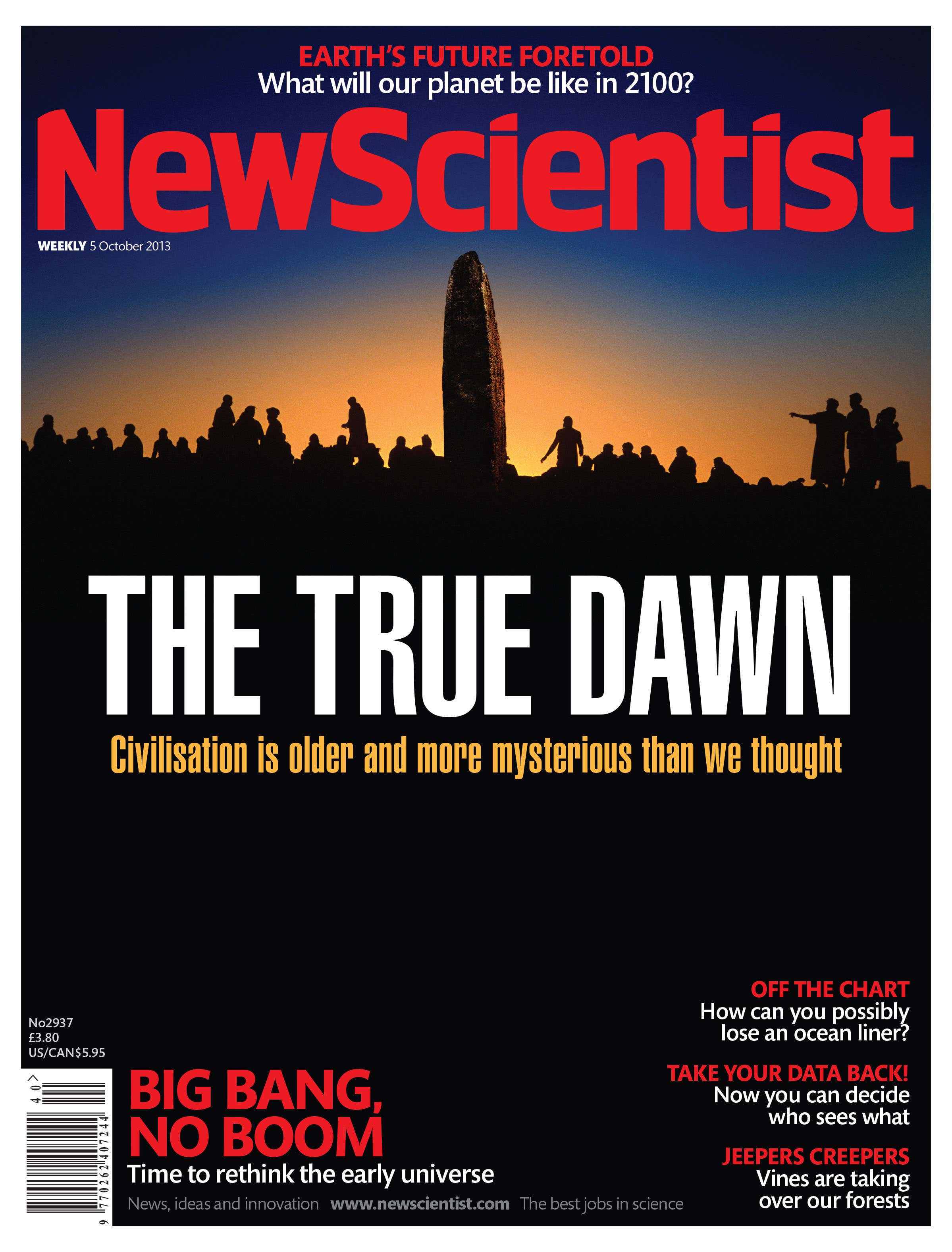
Issue no. 2937 published 5 October 2013

Sign up to our weekly newsletter

Receive a weekly dose of discovery in your inbox. We'll also keep you up to date with New Scientist events and special offers.

Sign up
Piano Exit Overlay Banner Mobile Piano Exit Overlay Banner Desktop