Subscribe now

Letters archive

Join the conversation in New Scientist's Letters section, where readers can share their thoughts and opinions on articles and see responses from experts and enthusiasts across a range of science topics. To submit a letter, please see our terms and email letters@newscientist.com


16 October 2013

God and Obamacare

From Rev Dr Derek Suchard

In his review of Ara Norenzayan's Big Gods: How religion transformed cooperation and conflict (28 September, p 52) , Michael Bond wonders why the US, one of the most economically developed countries, is still among the most religious. This contrasts with the fact that the world's most secure countries tend to be the least religious. …
16 October 2013

God and Obamacare

From Quentin de la B

Bond's review has it that "true believers think atheists cannot be expected to behave morally". This is wrong. Orthodox Christianity teaches explicitly that every rational person can recognise moral obligation. The mystery lies in how an atheist squares this obligation with a wholly materialistic universe. London, UK

16 October 2013

Latin dance

From Guy Cox

In her look at the relationship between manners and disgust, Valerie Curtis raises some interesting points (21 September, p 28) but does not address the huge differences between cultures. For example, why does the concept of personal space vary? A social anthropologist friend of mine described how, at a conference in Brazil, every conversation between …

16 October 2013

Art first

From Anthony O

In an otherwise fascinating exploration of civilisation's true beginning (5 October, p 32) , David Robson states that art has its roots 8300 years ago. However, there are earlier examples as exemplified by the recent Ice Age Art exhibition at the British Museum in London. Then there is the incomparable art of the Chauvet cave …

16 October 2013

Cuts both ways

From David Marjot

In your special issue on thought, you list Occam's razor as a tool for easier thinking, as follows: "Don't invent a complicated explanation for something if a simpler one will do" (21 September, p 38) . It is also useful in medicine: do not make two or more diagnoses when one will explain the symptoms. …

16 October 2013

Climate talk

From Dave Neale

Adam Corner discusses the ineffective way in which some scientists communicate the predicted effects of climate change (28 September, p 28) , a problem which makes me despair. For example, tell British people about a 2°C rise in temperature, and the usual reaction will be: "Oh, that'll be nice. We could do with some better …

16 October 2013

Climate talk

From Jon Atack

I am writing in response to Corner's take on the ineffective communication of climate science. We are all subject to confirmation bias, whereby we favour evidence that supports our existing feelings. Further, when strongly held views are challenged, cognitive dissonance is invoked – a feeling of mental discomfort that discourages a change of heart. It …

16 October 2013

Bullet proof

From Thomas Groves

Given that gun lovers in the US seem impervious to moral or rational argument (28 September, p 30) , I suggest that the only remaining hope is to make their weapons useless. One way would be to produce bullet-proof clothing which is both wearable on a casual basis and cheap enough to become ubiquitous. A …

16 October 2013

Life on Mars

From Barry DiGregorio

The Mars rover Curiosity reports that methane is not present in the atmosphere (28 September, p 19) . Chlorinated methane derivatives such as chloromethane have been detected in experiments with Curiosity's sample analyser at least twice. We are told they are possibly the result of contaminants brought from Earth. This issue is unresolved, and so …

16 October 2013

Deadly lake

From Holly Pinkart

I suspect the birds that die in Lake Natron in Tanzania (28 September, p 26) are found as they are because they become coated with carbonate and dry out. Often birds will go into these lakes because the water facilitates removal of their surface parasites. Some spend too long in it. The water strips the …

16 October 2013

You scratch my back

From Giuseppe Sollazzo

In your look at the true nature of cats (14 September, p 44) , you miss one of their most peculiar behaviours: that of giving their "owners" dead mice as a present. It has happened to me a couple of times, and it always felt (very unscientifically) as a genuine act of friendliness, perhaps in …

16 October 2013

Kill switch

From Paul O

You ponder legal dilemmas of the future (14 September, p 40) . Perhaps the most interesting one facing the legal system and society as a whole will be machine consciousness. Will switching off a self-aware robot be murder? Manchester, UK

16 October 2013

Bang goes the future

From Alan Heasman

It was interesting to read about the outcomes predicted by climate models for the year 2100 based on crucial decisions we make now, ranging from starting large-scale geoengineering to continued addiction to fossil fuels (5 October, p 8) . I do, however, believe it is somewhat naive of the modellers to have omitted that in …

16 October 2013

Early influence

From Anthony Buckley

Your recent article about the importance of birth order credited Francis Galton with the idea of prising apart the influences of nature and nurture (7 September, p 40) . However, Shakespeare uses it in The Tempest Act IV Scene I, where Prospero describes Caliban as "A devil, a born devil, on whose nature/Nurture can never …

16 October 2013

Missing matter

From Chad McDonald

Robert Adler reported on dark matter (31 August, p 36) , and John Darlington hypothesised that "dark aliens" exist and are searching for their missing 15 per cent of matter (21 September, p 31) . I can confirm the existence of these one-footed monsters. The cheeky blighters are recovering their 15 per cent of matter …

16 October 2013

For the record

• We got carried away in our report on floods in Colorado (21 September, p 7). We should have said 18,000 homes were damaged, not destroyed.

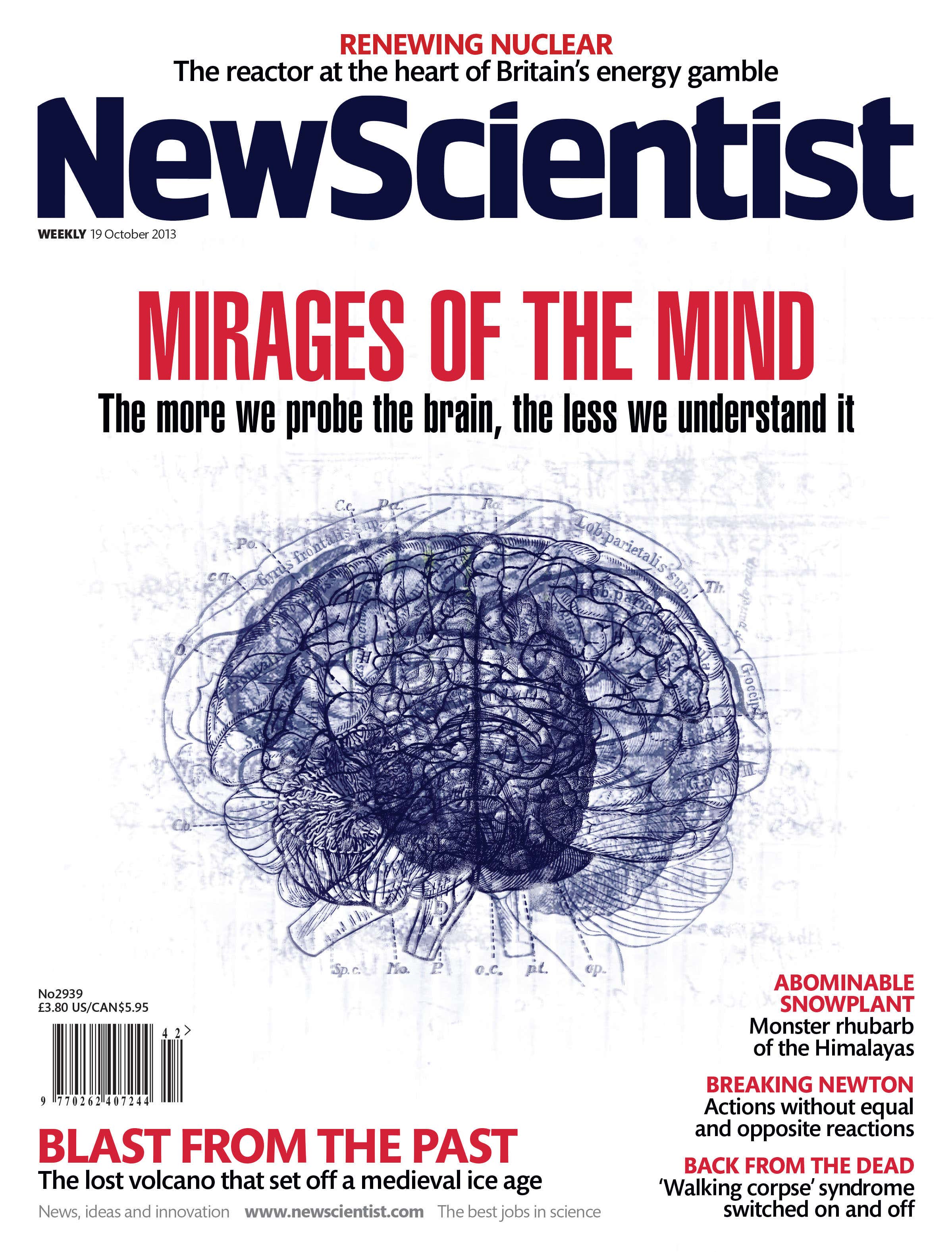
Issue no. 2939 published 19 October 2013

Sign up to our weekly newsletter

Receive a weekly dose of discovery in your inbox. We'll also keep you up to date with New Scientist events and special offers.

Sign up
Piano Exit Overlay Banner Mobile Piano Exit Overlay Banner Desktop