Subscribe now

Letters archive

Join the conversation in New Scientist's Letters section, where readers can share their thoughts and opinions on articles and see responses from experts and enthusiasts across a range of science topics. To submit a letter, please see our terms and email letters@newscientist.com


23 October 2013

Free to object

From Sean Burns

Sceptical environmentalist Bjørn Lomborg says some of the world's leading economists are optimistic about the state of the planet (12 October, p 26) . That's no surprise really, because the optimistic view, as Lomborg states, believes in the infallibility of the markets. However, only when real action is taken on climate change will I be …
23 October 2013

From Ruth Ashbee

Lomborg states that "pessimists build their case on overpopulation, starvation and depletion of resources. Optimists stand for the infallibility of the market economy". I am sure there are many people who are optimistic about the state of the world but reject the free market. I, for example, am optimistic because I observe, in parts of …

23 October 2013

Nobel joy

From Tara Shears

I'm so excited that this year's Nobel prize in physics has been awarded for the Brout-Englert-Higgs mechanism, and that British physicist Peter Higgs and his Belgian counterpart François Englert have been recognised for devising it (12 October, p 6) . Predicting, and then discovering, the Higgs boson is one of the very greatest achievements of …

23 October 2013

Leave no trace

From Erik Luc Decker

Further to the idea of a personal digital guardian such as openPDS for smartphones and computers (5 October, p 20) , there should be a third choice besides allowing or not allowing third-party access to your data. I call this option "fake": setting my location to a cave in Afghanistan or, better still, the US …

23 October 2013

The dark side

From Ron Gibson

The efforts of some members of the Texas State Board of Education to mandate the teaching of creationism is the latest chapter in the ongoing struggle between science and religion in the US (5 October, p 7) . I taught evolution for 42 years, and in that time saw little progress on the part of …

23 October 2013

Break the cycle

From Noel Hodson

Peter Turchin's model predicting outbursts of political collapse and social violence, which follow economic cycles in history, is undoubtedly correct. It also has more frightening implications now than in earlier eras, as the global population reaches 7 billion, and a greater glut of workers outnumber jobs and inequality soars (12 October, p 8) . But …

23 October 2013

The real deal

From Neil Sorensen

We appreciate attempts by the European consultancy Ecofys to investigate the opaque process of land acquisitions in developing countries by foreign companies (12 October, p 7) . It used the Land Matrix, an online public database that tracks large-scale land deals, which the International Land Coalition helps run. This is under continuous improvement. In June …

23 October 2013

Second opinion

From Eric Kvaalen

Your article on multiple personality disorder (MPD) takes the perhaps thinly veiled position that it is not a valid diagnosis (28 September, p 46) . However, a few years ago you published an article on MPD that cited the case of a German woman in 1791 who suddenly began having episodes in which she acted …

23 October 2013

Give Gaia a chance

From William Hughes-Games

The Intergovernmental Panel on Climate Change's assessment was expected to say that "global warming is irreversible without massive geoengineering of the atmosphere's chemistry" (28 September, p 6) . This statement is worth questioning. Carbon dioxide levels rise by 8 parts per million (ppm) and fall by 6ppm annually – showing how powerful natural processes such …

23 October 2013

Money for nothing

From J

Eldar Shafir's research suggests that the worry of poverty makes it harder to think clearly and make good decisions (7 September, p 17) . However, the opposite is also possible – bad decision-making helps to cause poverty. This could perhaps be shown by giving lots of money to people who are relatively poor. A natural …

23 October 2013

Ivory sale

From Stanley Schaetzel

Since when did biologists become arbiters of the laws of supply and demand? The proposed destruction of confiscated ivory described by Richard Ruggiero of the US Fish and Wildlife Service would be an act of foolishness (5 October, p 27) . It would simply increase the black market price of ivory, and thus encourage criminals …

23 October 2013

Sticky subject

From Marco Overdale

Lambros Malafouris states that the use of tools by animals, such as a chimp using a stick to extract an item of food from a hole, is fundamentally different from human tool use (7 September, p 28) . His point, comparing a blind person's stick to the chimp's, was that the human uses tools as …

23 October 2013

Third time lucky?

From Paul Bethel

Frank Siegrist suggests that third children are usually an accident (5 October, p 31) , but in my English middle-class environment, all the families with three children have the oldest two of the same sex, but the third child is the opposite sex. So maybe it is a deliberate attempt to have a child of …

23 October 2013

For the record

• More than £75,000, rather than $75,000, has been raised by the developers of brewing robot Brewbot on Kickstarter (12 October, p 21) , • You may have experienced a feeling of déjà vu when attempting Engima 1770 ( 12 October, p 30 ). It was an earlier puzzle republished in error. Entries will be …

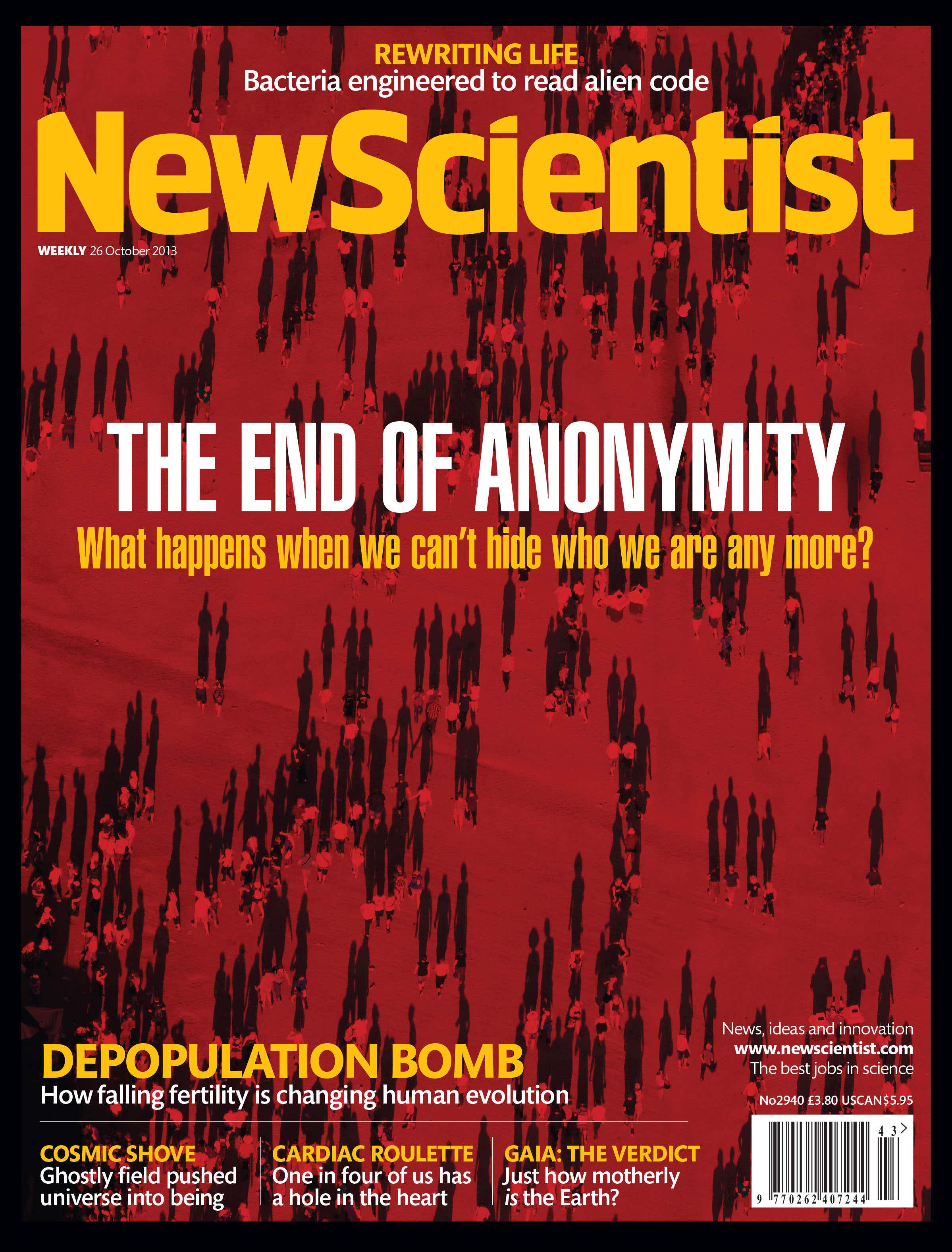
Issue no. 2940 published 26 October 2013

Sign up to our weekly newsletter

Receive a weekly dose of discovery in your inbox. We'll also keep you up to date with New Scientist events and special offers.

Sign up
Piano Exit Overlay Banner Mobile Piano Exit Overlay Banner Desktop