Subscribe now

Letters archive

Join the conversation in New Scientist's Letters section, where readers can share their thoughts and opinions on articles and see responses from experts and enthusiasts across a range of science topics. To submit a letter, please see our terms and email letters@newscientist.com


30 October 2013

Widen the search

From Roger Carpenter

The problem with functional MRI in neuroscience is only partly the flakiness of its results (19 October, p 33) . More fundamentally, the phrenological way of looking at the brain – for example, identifying the area for fear, or the area for doing up one's shoelaces – embodies a simplistic approach long abandoned in genetics; …
30 October 2013

Carbon camps

From Jonathan Seagrave

Geoengineering by planting trees on unused farmland to capture carbon is immediately practical (12 October, p 10) , but Olive Heffernan's article on greening of the Arctic in the same issue (p 40) points to an additional approach. The northward spread of the boreal forest is far slower than the rise in temperature in the …

30 October 2013

The editor writes:

• There is a caveat to such ideas. Extra trees in such areas will suck in some CO 2 , but that will be more than cancelled out by the change in albedo. By contrast, extra trees in temperate and tropical regions will cool the planet.

30 October 2013

Sleep mode

From Hugh Newbury

Paul O'Connell, reflecting on future legal dilemmas, asks if switching off a self-aware robot would be considered murder (19 October, p 31) . The answer is no. It's more like giving a general anaesthetic; you can always revive it by switching it on again. Evershot, Dorset, UK

30 October 2013

Counting the cost

From Martin Islam

Bjørn Lomborg's assessment of the state of the world with a GDP-based approach (12 October, p 26) illustrates why economics has been attacked as fundamentally unscientific. Richard Horton , editor of The Lancet , last year tweeted: "Rationality, for the economist, means subjecting every thought/decision to a cost-benefit analysis. A wholly narrow view of humanity." …

30 October 2013

Counting the cost

From Stephen Rothery

Lomborg paints a generally favourable outlook for humanity up to 2050. The inclusion of all the usual suspects and the weighted analysis is valid, but the increasing threat of nuclear proliferation is omitted. This alone could undo everything. Clitheroe, Lancashire, UK

30 October 2013

People power

From Bryn Glover

Debora MacKenzie's erudite review of three books about the pursuit of happiness amid increasing inequality and overconsumption was welcome (5 October, p 48) . Any political analysis needs to be carefully judged and delicately balanced to avoid accusations of bias. Perhaps that is why MacKenzie left her most explosive notion to the final sentence: "Levelling …

30 October 2013

Zombies all

From Brian Reffin Smith

Alan Worsley finds it intriguing to imagine machines dubbed "zombies", which are intelligent entities like us in every respect except consciousness, discussing consciousness (14 September, p 30) . However, I don't believe that human "consciousness" deserves special status. The consciousness so precious to those who think there must be something that makes humans special is …

30 October 2013

Super worms

From Peter Mills-Baker

According to chaos theory, the flap of a butterfly's wings can start a hurricane. But this feat is trivial compared to worms stopping the tectonic plates grinding to a halt, as suggested in your look at what would become of a lifeless Earth (28 September, p 38) . Stratford upon Avon, Warwickshire, UK

30 October 2013

Life or death

From Sandra Craigie

I have read David Robson's article on the dawn of civilisation several times, especially the part on Klaus Schmidt's excavations around Göbekli Tepe (5 October, p 32) . While hesitating to contradict an experienced archaeologist, Schmidt's descriptions remind me far more of an open-air cemetery than a site of pilgrimage or anything else. Plenty of …

30 October 2013

Life or death

From Sue Macrae

The original motivation for gathering at sites such as Göbekli Tepe would surely have been for mating, to ensure genetic diversity. Organised religion would have been the bogeyman needed to keep all those raging hormones under some sort of control. Wonga, Queensland, Australia

30 October 2013

Life or death

From Sam Gibbs

Your report on civilisation's true dawn was interesting. However, the graphic about monuments seems to suggest that Stonehenge was only built 2000 years ago, rather than the estimated 4000. Reading, Berkshire, UK

30 October 2013

Cool it

From Andy Grove

Feedback reports surprise at a technical detail for the manufacture of the WoodMiser, a metal mesh said to improve the efficiency of a woodburner (5 October) . Whether it works to increase burning efficiency I don't know. However, what seemed to be the focus of your attention was that its construction involves "fast-cooling special metal …

30 October 2013

Shake on it

From Rob Sheldon

In his letter (12 October, p 31) , Lawrence D'Oliveiro suggests that a handshake quashes Valerie Curtis's idea that manners in part evolved to avoid spreading disease (21 September, p 28) , because such contact helps spread influenza. But it is worth noting that handshaking keeps a potential influenza victim at two arms' lengths, roughly …

30 October 2013

No sale

From Keith Lindsay

Those such as Stanley Schaetzel (26 October, p 33) who favour the "market forces" approach to wildlife conservation – arguing that sustained legal ivory sales can release funds to benefit conservation and undercut the illegal trade – ignore two key points made by Richard Ruggiero of the US Fish and Wildlife Service (5 October, p …

30 October 2013

Spooky action

From Ross Gayler

In the article "pop-up universe" (5 October, p 38) , which looks at unexpected similarities between distant parts of the universe, there is, courtesy of a typographical error, a reference to the Australian town of Narromine . Meanwhile, in the letters section that week (p 30) , there is a letter from Narromine. Is this …

30 October 2013

Size matters

From David Gold

Your report on the possible formation of diamonds in Saturn and Jupiter (19 October, p 17) , states that the gems could grow to cinematic sizes. A single-screen art house or a multiplex? It needs to be crystal clear, bearing in mind the object described. Torquay, Devon, UK

30 October 2013

Digital deities

From Liz Berry

Stephen Welch writes that computers are like the gods of old in our digital surveillance society (12 October, p 31) . However, when it comes to encouraging a moral society, one could never be sure which side they were on. Lydbrook, Gloucestershire, UK

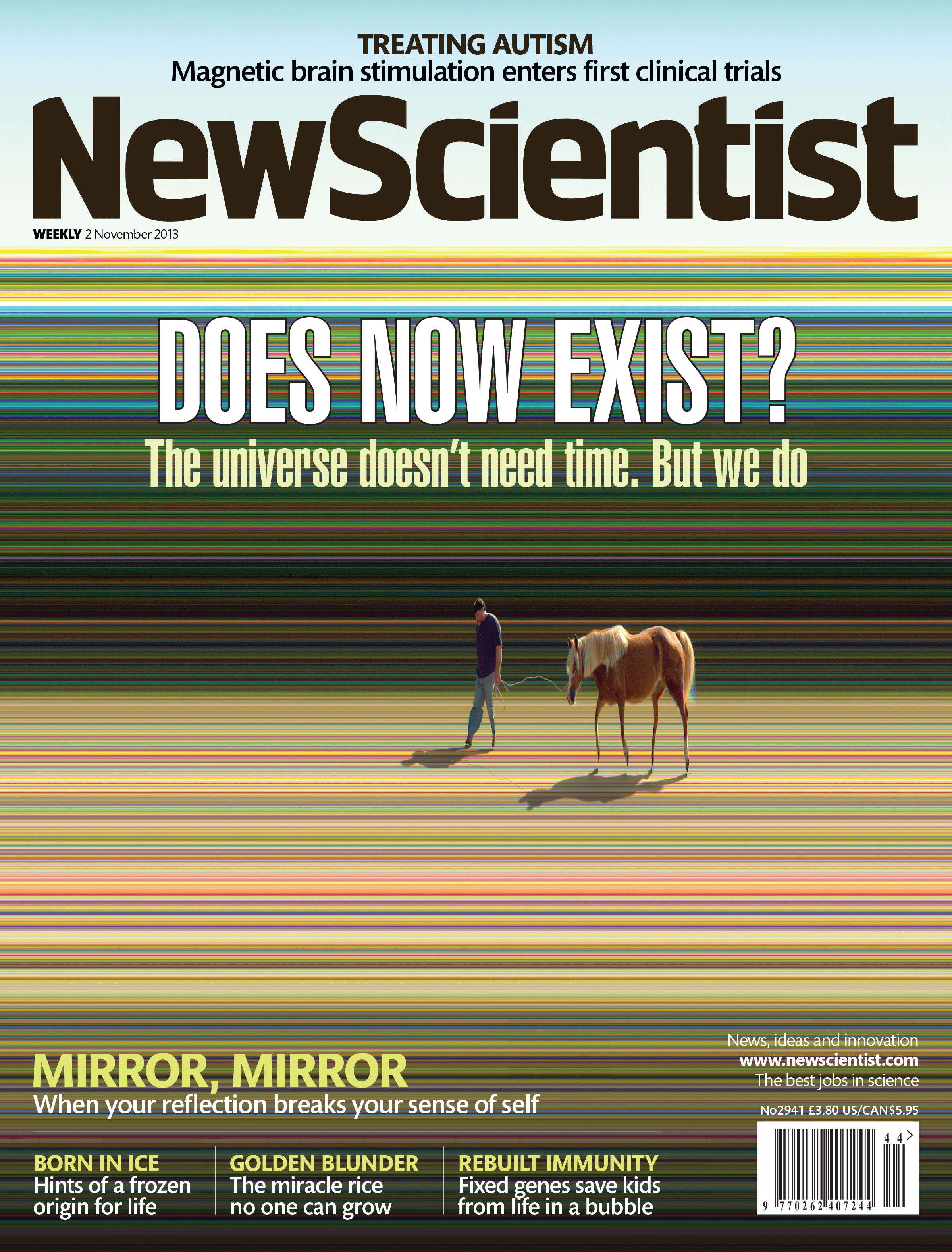
Issue no. 2941 published 2 November 2013

Sign up to our weekly newsletter

Receive a weekly dose of discovery in your inbox. We'll also keep you up to date with New Scientist events and special offers.

Sign up
Piano Exit Overlay Banner Mobile Piano Exit Overlay Banner Desktop