Subscribe now

Letters archive

Join the conversation in New Scientist's Letters section, where readers can share their thoughts and opinions on articles and see responses from experts and enthusiasts across a range of science topics. To submit a letter, please see our terms and email letters@newscientist.com


27 November 2013

Less haste

From Martin Savage

You reported on the proposal for a US hypersonic uncrewed aircraft – Lockheed Martin's SR-72 equipped with a Mach-3 busting scramjet with built-in jet engines (9 November, p 4) . It's easy to make an aircraft go faster by putting bigger engines on it. What wasn't mentioned in the article are the real obstacles to …
27 November 2013

Feeding debate

From Susan Jebb

You wrote about the launch of a pilot scheme offering shopping vouchers to mothers who breastfeed their babies for the first six months (16 November, p 5) . We know that breastfeeding has long-term benefits for the baby, and most mothers in the UK have now heard the "breast is best" message loud and clear. …

27 November 2013

The editor writes:

• Turn to page 29 to read an interview with Mary Renfrew, the architect of the vouchers-for-breastfeeding study.

27 November 2013

Death row

From Charles Sawyer

The US state of Ohio plans to execute a murderer with an untested combination of drugs (2 November, p 7) . In contrast, you reported a humane method of rendering chickens irreversibly unconscious before slaughter in an altitude chamber in Arkansas (9 November, p 14) . It makes you wonder, is Arkansas more humane with …

27 November 2013

Death row

From Gregory Sams

I read of the crisis in the US penal system arising from the difficulty of obtaining supplies for lethal injections. Although no advocate of the death penalty, I am appalled by the inability to consider readily available morphine, presumably because of the risk that a criminal might die with a smile. London, UK

27 November 2013

Dump down under

From John Crowhurst

Your report on the search for a solution to nuclear waste cited the Australian government's refusal in 1999 to accept foreign nuclear waste (2 November, p 42) . However, we have had several changes of government since, and, as explained in your article, there are now more ways of encapsulating nuclear waste for storage than …

27 November 2013

Historic health

From J

Emma Young dates the oldest known tumour in the human ancestral line – a fibrous dysplastic neoplasm in a Neanderthal rib bone – to 120,000 years ago (9 November, p 36) . There is, however, evidence for a much older human tumour. In 2003, a German group described a meningioma in the Steinheim man ( …

27 November 2013

Historic health

From Jan Horton

In her look at the prevalence of "modern" diseases in ancient populations, Young included researchers who speculate on the extent of disorders such as autism. I'd like to add my own speculation. It seems possible that those with Asperger's syndrome could have proved crucial to the rise of monastic life in earlier eras. Such religious …

27 November 2013

Play's the thing

From Brett Gibson

David Whitebread and Sue Bingham's article on the school starting age in England was both interesting and concerning (16 November, p 28) . I suspect I am not alone in thinking that it warrants a full exploration of the research and discussion of practical measures that parents of young children in this country can take …

27 November 2013

Play's the thing

From Peter Nelson

In Jonathon Keats's review of Play, Playfulness, Creativity and Innovation by Patrick Bateson and Paul Martin (7 September, p 44) , he mentions a 2006 study involving 10 and 11-year-old children in a play-based art class, whose originality, fluency and flexibility increased compared with those in a control group. Apparently in Finland, children do nothing …

27 November 2013

Quantum catch

From A

Geoff Stanley writes in his letter that "superposition of quantum states is only determined by observation... (and this may be the) ultimate example of top-down causation" (12 October, p 31) . This is offered as an example of the macroscopic world impinging on the microscopic. This would be true only if the "decision" to observe …

27 November 2013

Life's lottery

From Simon Goodman

Letter writer Jörg Michael says it is "widely accepted" that people who come into large sums of money lose it all within a few years. He cites lottery winners as a model for bad decision-making causing poverty (26 October, p 33) . This wrong conclusion derives from choosing an inappropriate sample population. Lottery winners are …

27 November 2013

Squaring the circle

From Matt Billingham

Chris Rogers writes to explain that he, as an atheist, squares moral obligation with a wholly materialistic universe by ethics, compassion and self-respect (9 November, p 31) . This led me to wonder how atheists square ethics, compassion and self-respect with a wholly materialist universe. Now I'm concerned that I may be attempting to square …

27 November 2013

Take the stairs

From Kathleen Smart

Your article on a slowdown in the increase in global emissions of greenhouse gases cites energy efficiency as a key reason (9 November, p 6) . It lists fuel savings in factories, more fuel-efficient trucks and the growing adoption of low-energy light bulbs as examples. Sweeping away unnecessary building regulations could help further, such as …

27 November 2013

Three-legged race

From Harold Hackworthy

You report that parents can now choose their baby's traits by selecting eggs or sperm with certain DNA sequences (12 October, p 6) . It will not be long before gold medals will be won at the Olympics by competitors who have body features suspiciously well suited to their sport. The ancient games lasted more …

27 November 2013

Cashing in

From Bryn Glover

Feedback asks: "As for Arctic melting being beneficial... to whom?" (2 November) . Well come on, surely 'tis plain and obvious. Without all that inconvenient ice in the way, cable-laying ships can put in place a direct optical link along the great circle between New York and Tokyo, shaving precious microseconds off arbitrage deals on …

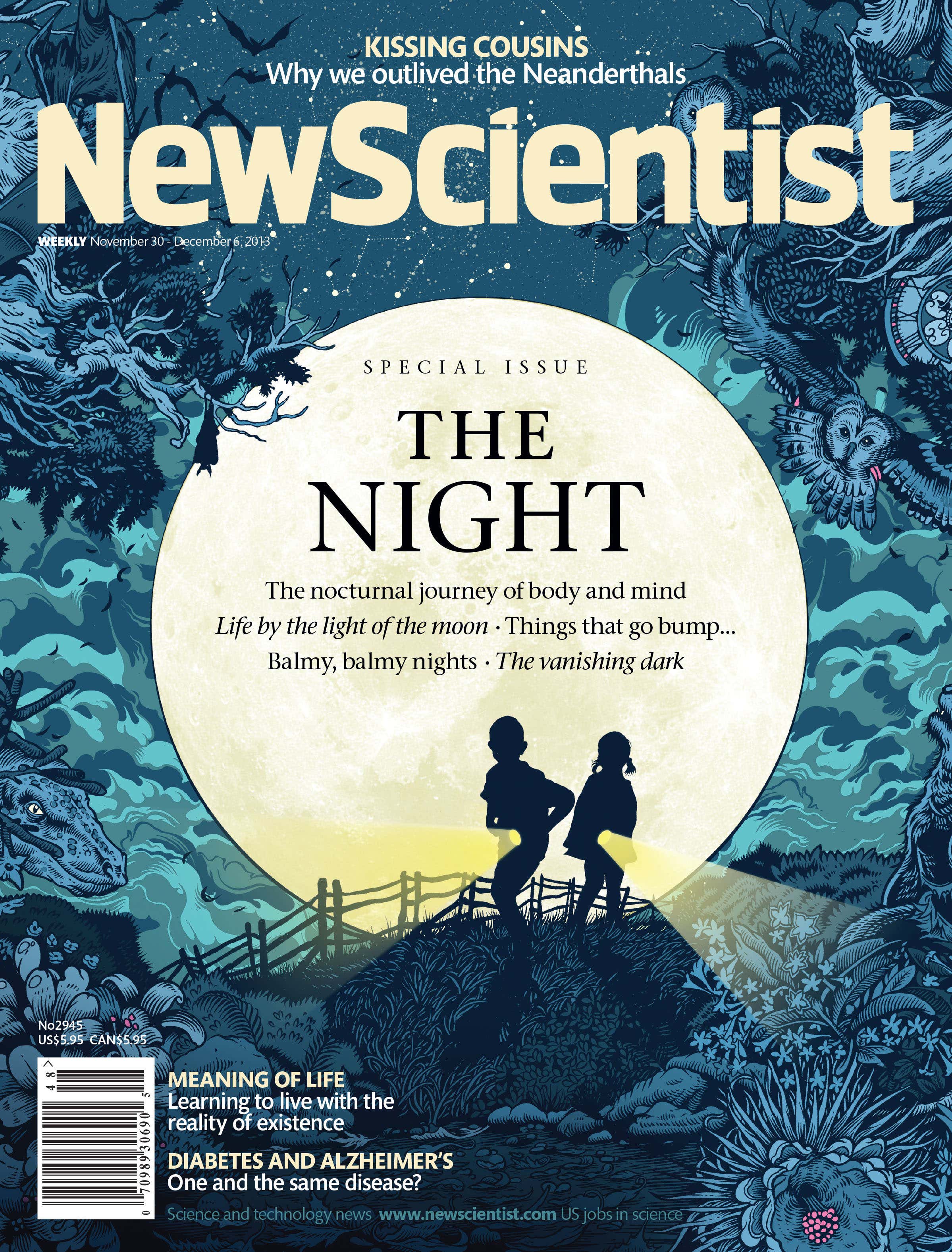
Issue no. 2945 published 30 November 2013

Sign up to our weekly newsletter

Receive a weekly dose of discovery in your inbox. We'll also keep you up to date with New Scientist events and special offers.

Sign up
Piano Exit Overlay Banner Mobile Piano Exit Overlay Banner Desktop