Subscribe now

Letters archive

Join the conversation in New Scientist's Letters section, where readers can share their thoughts and opinions on articles and see responses from experts and enthusiasts across a range of science topics. To submit a letter, please see our terms and email letters@newscientist.com


15 January 2014

Down the wire

From Ken Endacott

Australia had barbed-wire telephone lines that served many farms up to the late 1960s, just like those you describe in the rural US in the early 20th century (21/28 December 2013, p 76) . The granddaddy of them all was a 700-kilometre-long line in Western Australia. This was a single galvanised iron fencing wire on …
15 January 2014

Agile thoughts

From Peter Sheppard Sk

Michael Brooks is right that we need to produce agile thinkers, not just more and more science and engineering graduates, to drive an innovation economy (21/28 December 2013, p 38) . We should all aspire to a tireless variety of thinking and creativity. The arts and humanities must stop apologising in the face of the …

15 January 2014

Agile thoughts

From Dave McGlade

In 1978, a friend of mine graduated in philosophy and took a job in IT, where she had a successful career precisely because of the mental agility her degree required. In my experience people with similar degrees these days don't even make the shortlist for such jobs. A mediocre qualification in a science subject seems …

15 January 2014

Just eat less

From Andy Taylor

Caroline Williams reports on attempts to perfect low-fat chocolate (21/28 December, 2013, p 53) . Why do we persist in trying to replace perfectly wholesome foods with products that should probably remain in the lab? Butter being replaced by margarine and other low-fat spreads is probably the most notorious example. We should focus more attention …

15 January 2014

Born to run

From John O

Linda Geddes reports on the discovery of intergenerational memory transfer in mice (7 December 2013, p 10) . There may be other examples of the genetic transmission of acquired information. US researcher Joe Hutto raised 14 wild turkeys, from egg incubation to adulthood (24/31 December 2011, p 37) . Despite having no contact with other …

15 January 2014

Group discussion

From Bill Summers

In your interview with Richard Dawkins (21/28 December 2013, p 40) he says: "I think people want altruism to be a kind of driving force; there's no such thing as a driving force. They want altruism to be fundamental whereas I want it to be explained." Quite so, but the only way to do that …

15 January 2014

Group discussion

From Terry Klumpp

If Jesus Christ lived today and was educated in a liberal, democratic environment, I think he would be well on board with Dawkins and others of a like mind. Instead of preaching from the Bible, he would choose Unweaving the Rainbow by Dawkins and The Good Book by philosopher A. C. Grayling as examples of …

15 January 2014

Ancient ritual

From Alan Watson

The letter from Howard Barnes about applying the label "religious" to unexplained ancient buildings (7 December 2013, p 33) brings to mind British archaeologist Mortimer Wheeler. In the 1950s TV show Animal, Vegetable or Mineral? Wheeler was asked to explain what a "ritual object" was. He replied that it was a term used by archaeologists …

15 January 2014

Prove it

From Philip Colfox

In his letter, Bruce Dinham does economics a disservice when extolling the definability and measurability of science while alleging the reverse for economics (21/28 December 2013, p 45) . The truth is nearer to a reality where nothing is certain, not even nothing. There is no such proof as scientific proof, and even mathematical proof …

15 January 2014

Hanging out

From Guy Cox

The mathematics of urinal etiquette would have been incomprehensible 50 years ago (21/28 December 2013, p 58) . Back then, if you walked into the toilets with a friend you automatically peed in a urinal next to each other, so that nobody could interrupt your conversation. If it was a trough urinal, a newcomer would …

15 January 2014

It takes three

From Nathaniel Hellerstein

Your article on using mitochondrial donation to create a "three-parent baby" to avoid inherited disease (21/28 December 2013, p 32) provides a solution to an old literary conundrum. In the Epic of Gilgamesh , the titular anti-hero is described as two-thirds divine. How could this be? The answer, I speculate, is that the goddess Ninsun …

15 January 2014

For the record

• Even names can get mangled by the mighty gravity of collapsed stars. Adam Brown is the Stanford University researcher following up William Unruh's thought experiment on hastening the death of a black hole (7 December 2013, p 14) .

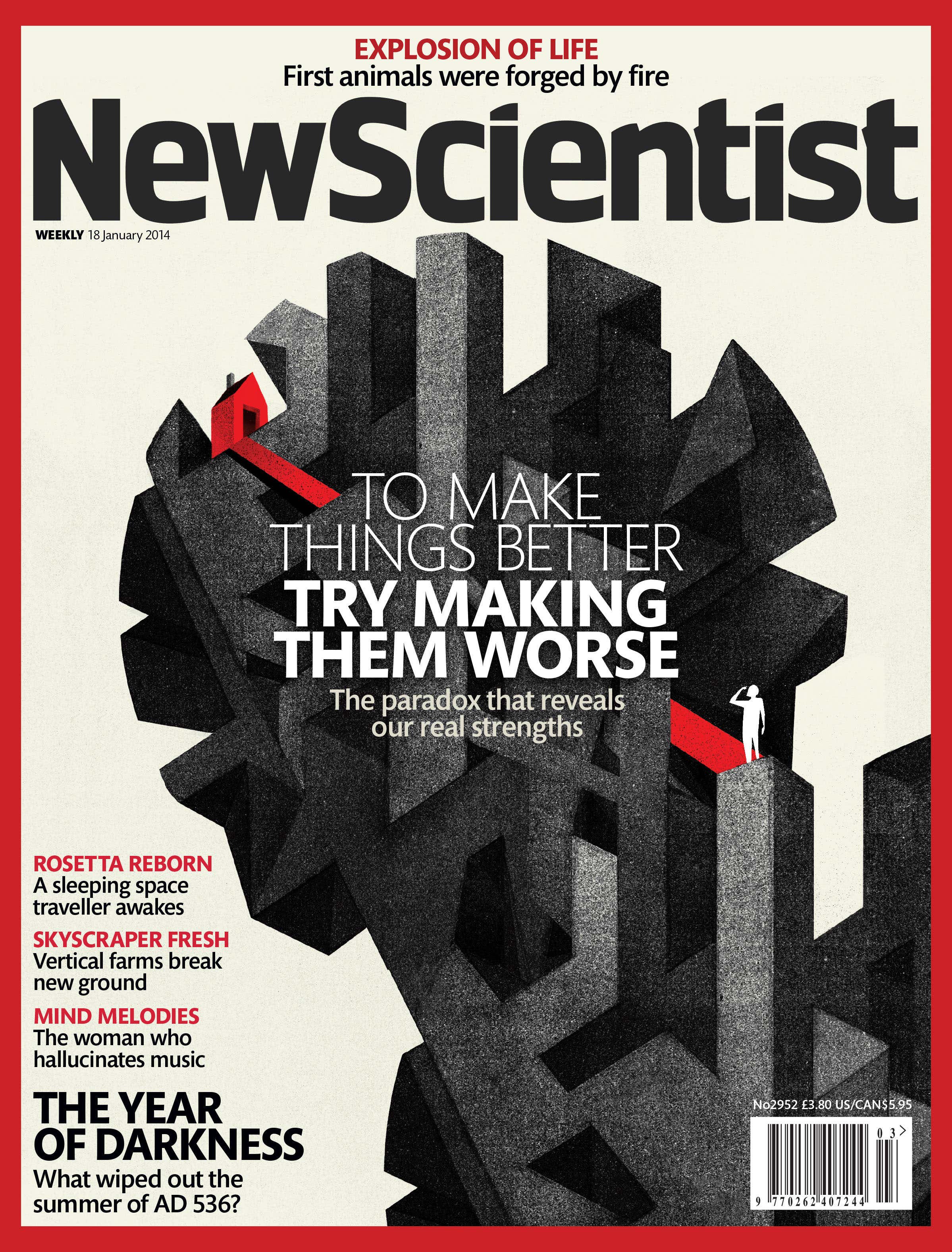
Issue no. 2952 published 18 January 2014

Sign up to our weekly newsletter

Receive a weekly dose of discovery in your inbox. We'll also keep you up to date with New Scientist events and special offers.

Sign up
Piano Exit Overlay Banner Mobile Piano Exit Overlay Banner Desktop