Subscribe now

Letters archive

Join the conversation in New Scientist's Letters section, where readers can share their thoughts and opinions on articles and see responses from experts and enthusiasts across a range of science topics. To submit a letter, please see our terms and email letters@newscientist.com


22 January 2014

Get a shave

From Andrew Storeck

Why persist in the belief that a Stonehenge man must have sported a beard as "there were no razors then" (11 January, p 49) ? There is sufficient cave art evidence of beardless men from early Neolithic times, let alone 5500 years ago in settlements near Stonehenge. Fleas, lice and so on would abound and …
22 January 2014

On the wagon

From Doug Astill

I spotted a flaw in your report on the health benefits of avoiding alcohol for a month in a study suggested by and involving New Scientist staff (4 January, p 6) . An average reduction of blood glucose level from 5.1 to 4.3 millimoles per litre isn't 23 per cent as you stated; it is …

22 January 2014

On the wagon

From Health writer Andy Coghlan writes

• You are correct, and I apologise for miscalculating the percentage. But at nearly 16 per cent, it is still substantial, much higher than anticipated, and supports the experiment's other results.

22 January 2014

Odd affections

From Gemma King

Chris Thomas's take on the evolution and extinction of species was wonderful (11 January, p 28) . When considering the effect of invasive species and climate change, he states that "good and bad is irrelevant", which is, of course, a brilliantly scientific way of looking at it. However, the fact that invasive species may eventually …

22 January 2014

Long lived

From Richard Williams

Jacob Aron's article suggests that microbes could have emerged during a life-friendly epoch of a few million years, starting about 15 million years after the big bang (14 December 2013, p 14) . I find it plausible to go further and propose that unicellular life has permeated the universe ever since, surviving for 10 billion …

22 January 2014

Meaning of art

From Betty Finn

In Alison George's article on human intelligence (23 November 2013, p 36) , the photo of dots and grids in the El Castillo cave in Spain reminds me strongly of those in caves in Zimbabwe. Zimbabwean archaeologist and rock art expert Peter Garlake persuaded the surviving San hunter-gatherers to divulge their interpretations. He discovered that …

22 January 2014

It's good to talk

From Ruth Haas

Luís Bettencourt's vision of the next great urban revolution (14 December 2013, p 30) brings to mind science fiction movies in which physical contact and space are reduced to a minimum and there is extensive mind control. We are already on our way to the first state. What the internet, emails and texting provide is …

22 January 2014

Diverse abilities

From Tony Richardson

You report research as showing a strong link between intelligence and academic achievement in school (21/28 December 2013, p 12) . However, there is no clear undisputed link here. Anyone who has taught in schools can tell you how intelligent "non-academic" children can be. I could offer examples such as pupils with little academic achievement …

22 January 2014

Moral origin?

From Eric Kvaalen

Joshua Greene tells us that morality is "essentially a suite of psychological mechanisms that enable us to cooperate" and that came about by evolution (7 December, p 30) . But then he goes on to tell us that we should think and behave differently – implicitly claiming that there is a higher morality than that …

22 January 2014

Boggy territory

From Peter Vujakovic

The editorial in the Christmas edition credits a scientist with naming the moon as the eighth continent (21/28 December 2013, p 5) . By the conventions of precedent it is at best the ninth. In his 19th-century Ingoldsby Legends , Thomas Ingoldsby (pen name of the clergyman Richard Barham) identified Romney Marshes in Kent, UK, …

22 January 2014

No to Dawkins

From Dan Hochberg

I'm not sure why I and my co-religionists find Richard Dawkins so irritating. Certainly there are plenty of people critical of Christianity who don't provoke such ire. Perhaps it is his use of phrases such as "medieval superstition" (21/28 December 2013, p 40) . And of course he is wrong. He has a tendency to …

22 January 2014

Cancer cause?

From Steve Dalton

I was fascinated by the idea that a fever might help defeat cancer (4 January, p 26) . Could the incidence of cancer in the 20th century be, in part, a result of fewer fever-inducing pathogens in our environment and the greater availability and use of fever-suppressing drugs? Chipstead, Kent, UK

22 January 2014

Ripping, old-style

From John Edgington

Jon Cartwright, in his look at the use of quantum properties in a new wave of computers, compared current technology to Colossus, an early computer used to crack Nazi codes 70 years ago (11 January, p 40) . Paper tape was used to input data, not punched cards, as stated in the article. In the …

22 January 2014

Dump here

From Phillip Graham

In her letter on the issue of storing long-lived nuclear waste, Ailsa Mathiessen says the Australian outback, home to indigenous people, shouldn't be a dumping ground for waste of any sort (4 January, p 28) . But the outback is littered with the waste from mining. Check out Google Earth if you don't believe me. …

22 January 2014

Vintage defences

From Alan Coulson

Paul Marks reports on the European SAVELEC consortium's system to disable the cars of uncooperative drivers by firing radio pulses at them, scrambling on-board electronics (14 December, p 24) . Marks says the group is releasing few details of its system "in order to prevent people from developing countermeasures". I think I already have one. …

22 January 2014

For the record

• In our preview of books for 2014 (4 January, p 48) we missed a publisher's title update. Superintelligence: The coming machine intelligence revolution should be Superintelligence: Paths, Dangers, Strategies . The author's name, however, was always Nick Bostrom not Bostrum. • The last ice age was 12,000 years ago, not 1200 years as stated …

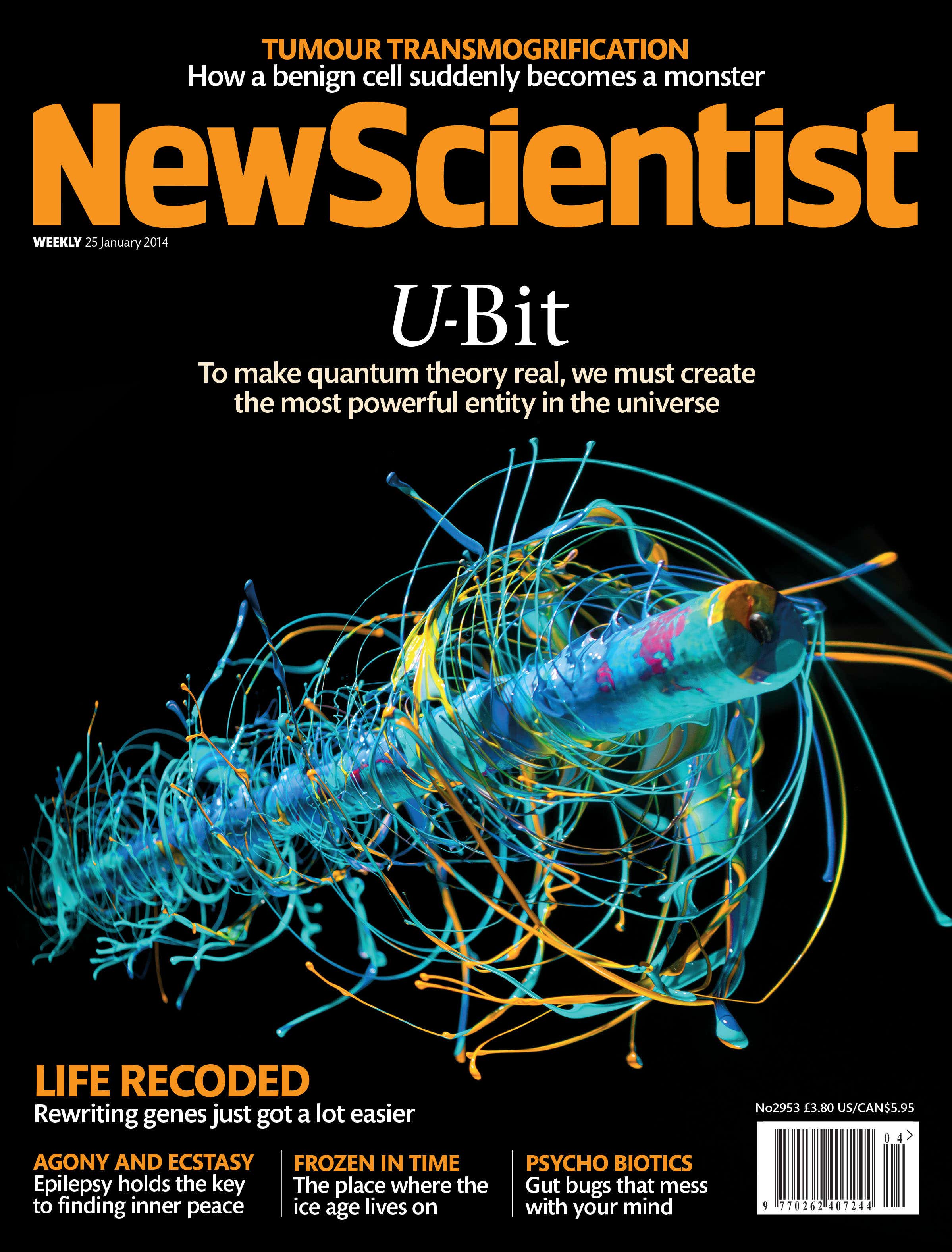
Issue no. 2953 published 25 January 2014

Sign up to our weekly newsletter

Receive a weekly dose of discovery in your inbox. We'll also keep you up to date with New Scientist events and special offers.

Sign up
Piano Exit Overlay Banner Mobile Piano Exit Overlay Banner Desktop