Subscribe now

Letters archive

Join the conversation in New Scientist's Letters section, where readers can share their thoughts and opinions on articles and see responses from experts and enthusiasts across a range of science topics. To submit a letter, please see our terms and email letters@newscientist.com


19 March 2014

Male rape hidden

From Rick Bradford

I applaud the work of Jo Lusi in treating women who have been raped in conflict situations in the Democratic Republic of the Congo (1 March, p 29) . The appallingly high rate of sexual violence affects not only women: 24 per cent of men in eastern DR Congo also reported being attacked. Male rape …
19 March 2014

Water damage

From Malcolm Shute

Your article exploring the long-term impact of flooding on people's health (22 February, p 7) was welcome. It seems that reporters flock in while houses are in the process of being flooded, but as soon as the water starts to recede, so do the journalists. There is no newsworthiness in the aftermath, and viewers and …

19 March 2014

Water damage

From Shaun Machale

In light of the constant onslaught of weather systems battering the UK in the past few months, the government may have to think outside the box. Clay has impressive water-retention, but accessing this underground geological sponge may require us to drill down to a seam. This practice has the advantage of not only absorbing floodwater, …

19 March 2014

Carbon trap

From Mark Barrett

You report that carbon capture and storage (CCS) will soon be carried out on a commercial scale at a Canadian power plant (8 March, p 8) , but the technique's own footprint should not be overlooked. CCS increases the fuel needed to produce a unit of electricity by 15 to 40 per cent, and therefore …

19 March 2014

Carbon trap

From Philip Roberts

A better option than CCS would be to invest in refined renewable fuels, like methane, biodiesel and bioethanol on a large scale. With regard to the argument over food versus fuel production, it must be said that without energy to make fertiliser and heat greenhouses, there would be much less food. Furthermore, if sugar is …

19 March 2014

Class act

From Edward Winfield

Of course it helps to be clever if you want to be successful (8 March, p 30) , but knowing stuff only gets you a little way up the greasy pole. Basic cunning and knowing how to use the system to your best advantage are more helpful. It follows that the children of wealthy and …

19 March 2014

Class act

From Jim Penman

You left out one route to success: lowering testosterone. A multitude of studies have associated lower testosterone with success at work, as well as reduced levels of criminal and risk-taking behaviour. One way to put this into practice might be to restrict sexual activity in adolescence, a technique that has been shown to lower testosterone …

19 March 2014

Infinitely confusing

From Mary Midgley

Your article on cosmic conundrums surely reasons from a very slender base (8 March, p 26) . It may indeed be that our visible universe is "part of a larger space-time of infinite volume" in which there may be "an infinity" of similar occupied patches. But how does anyone get from this use of the …

19 March 2014

Infinitely confusing

From Andrew Howe

We're told that in an infinite multiverse, "everything that can happen will happen, infinitely many times". This is traditionally exemplified by the idea that there will not only be another exact "you" somewhere, but also a "you" who is king or queen, president, Superman, riding a unicorn, and so on. However, take the much simpler …

19 March 2014

Aping Darwin

From Mike Martin

Further to David Robson's article (1 March, p 34) about making stone tools and the journey from ape to thinking human, I'm reminded of an article by Friedrich Engels, "The part played by labour in the transition from ape to man". Written in 1876, it suggests that by working with their hands and interacting with …

19 March 2014

Aping Darwin

From Michael Paine

Your cover story on the role of stone tools in our evolution was very interesting, and brings to mind a quote from Douglas Adams's The Hitchhiker's Guide to the Galaxy : "We'll be saying a big hello to all intelligent life forms everywhere. And to everyone else out there, the secret is to bang the …

19 March 2014

Tuber tangle

From Gwynne Williams

I was saddened to read that a significant advance in countering late potato blight will be contrary to Europe's strict rules on genetically modified crops (22 February, p 6) . Although the disease-resistant potato you reported is considered GM, the beneficial gene it carries is in the natural potato gene pool – in this case …

19 March 2014

Power point

From Antony Clarke

When we need a battery to store electrical energy from an intermittent supply, the physical size of the battery is not the most important consideration (8 March, p 20) . It is more important that it should not lose charge and should be cheap to build relative to the amount of energy it can store. …

19 March 2014

Pole power

From Peter Murray

As I read your article on electric vehicles that charge while parked (25 January, p 20) , I recalled that when I was in Switzerland in 1996, I saw buses that spun up a flywheel using an electric motor powered by contact with a pole at the bus stop. The bus then used the flywheel …

19 March 2014

Love is deaf

From Katrina Murray

In regards to the proposed medicinal "cure for love" (15 February, p 26) , one possible target for treatment would be the thousands of fans who believe they are in love with a celebrity whom they are unlikely ever to meet, let alone speak to. This might seriously hurt the music industry once fans start …

19 March 2014

Faith in tolerance

From Arthur Krueger

In his defence of Richard Dawkins, Iain Gibson claims Dawkins's atheism is an antidote to violence perpetrated by religious practitioners (22 February, p 32) . Certainly Mao, Stalin, Pol Pot, et al., have proved that atheists are at least as capable as religious leaders in this department. Cruelty can emerge from any belief system. Tolerance …

19 March 2014

For the record

• Moose can cause an elk of a confusion. In our story on reviving ecosystems (1 March, p 40) our usage of the US name elk for the species also known as the wapiti could have muddled people, considering the article also featured moose (known as elk in Europe). • In having our two cents …

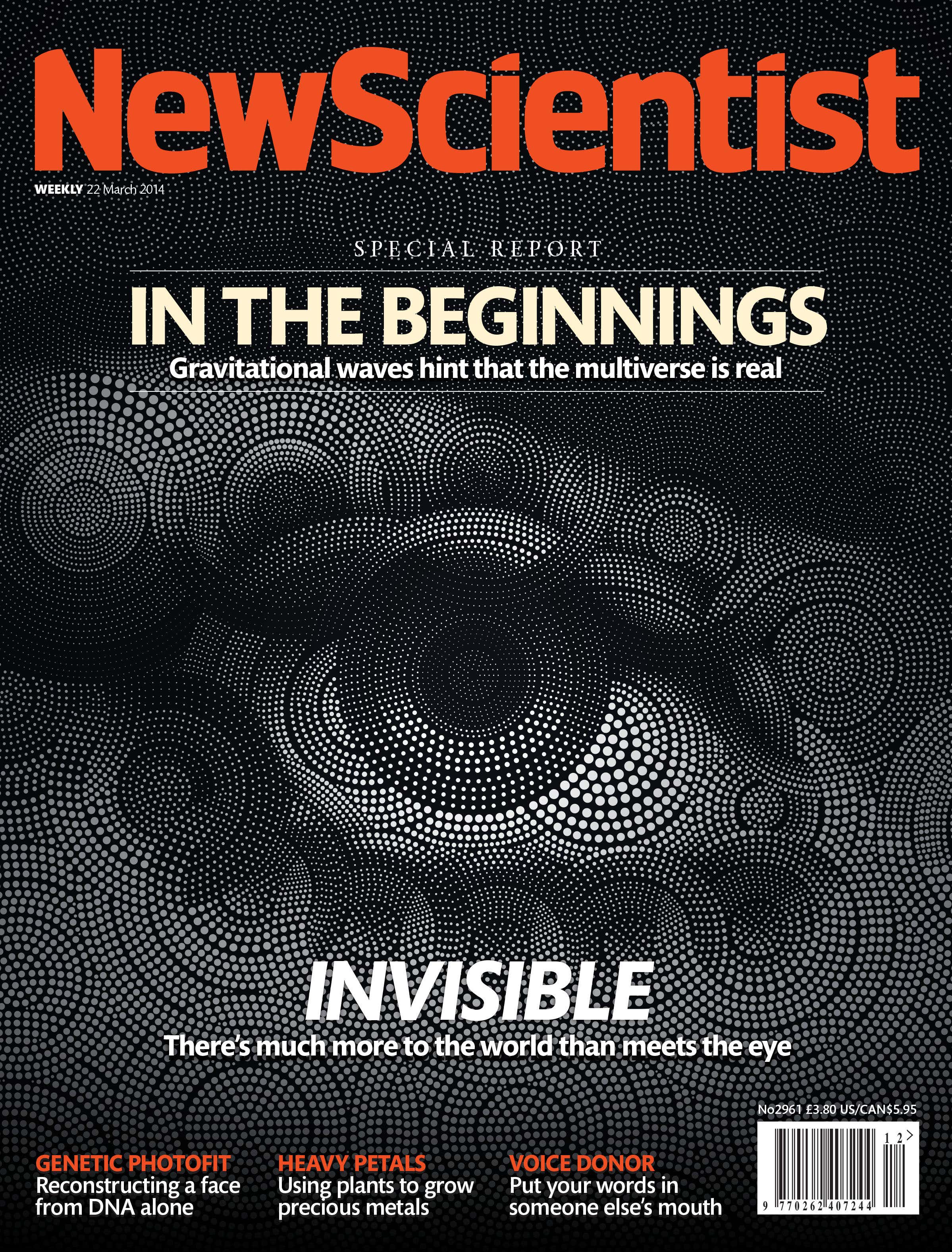
Issue no. 2961 published 22 March 2014

Sign up to our weekly newsletter

Receive a weekly dose of discovery in your inbox. We'll also keep you up to date with New Scientist events and special offers.

Sign up
Piano Exit Overlay Banner Mobile Piano Exit Overlay Banner Desktop