Subscribe now

Letters archive

Join the conversation in New Scientist's Letters section, where readers can share their thoughts and opinions on articles and see responses from experts and enthusiasts across a range of science topics. To submit a letter, please see our terms and email letters@newscientist.com


26 March 2014

Standards of success

From Maureen Norrie

The overall thrust of Michael Bond's feature on how to succeed (8 March, p 30) seems to be that success is related to high positions in socially prestigious occupations, and to world-changing deeds, such as those recognised by the Nobel committee. Linking such positions and achievements with intelligence relegates those roles on which we rely …
26 March 2014

Standards of success

From Charles T

When it comes to judging the achievements of those in education, the one-size-fits-all approach of exams and league tables is convenient for administrators and politicians, so we are unlikely to see much change any time soon. However, the internet will constructively destroy the existing education behemoth. Distance learning and freely available online courses are the …

26 March 2014

Slow life

From Peter Inkpen

Michael Slezak reports that the tools for cellular fusion may have been co-opted from viruses (1 March, p 16) . Why then did it take around 2.7 billion years for cells to incorporate and adapt these viral genes for their own use? This Precambrian period is an unimaginably vast span of time representing many trillions …

26 March 2014

Off radar

From Harry Hopkins

The disappearance of Malaysia Airlines flight MH370 (15 March, p 6) brings the disadvantage of secondary radar to the fore, which is that the aircraft has to be "cooperating" to be seen. Primary radar is primitive, but it gives a picture of everything in the air around. The nuisance of the primary radar beam reflecting …

26 March 2014

Cave calendar

From J

Reading a book on Stonehenge and other prehistoric structures by Gerald S. Hawkins, I came across some doodle-like patterns that resembled the ones shown in Alison George's article on cave art and the origins of intelligence (23 November 2013, p 36) . The examples from caves in Canchal de Mahoma and La Pileta in Spain …

26 March 2014

Green bills

From Paul Sax

I am surprised to see an important point missed in Reg Platt's discussion of energy-saving policies (15 March, p 28) . The more consumers save energy, the less profit that private energy companies would make, therefore prices would rise to maintain profit levels. That is just one reason these companies sabotage those government-led energy-saving policies …

26 March 2014

Welcome weed

From Bill Alexander

Your article on New Zealand's shake-up of its drug laws showed how it is leading the way on drug prohibition (8 March, p 40) . If only the country would decriminalise people growing marijuana plants for their own use, as several parts of Australia have done. It used to grow wild on the roadsides in …

26 March 2014

Vanishing brains

From Guy Cox

The topic of Boltzmann brains is raised once again in Joseph Silk's look at the philosophical challenges facing modern cosmology (8 March, p 26) . But he doesn't mention that in Boltzmann's time the universe was seen as static. In such a universe, with infinite time, any interaction can take place. We now know that …

26 March 2014

Vanishing brains

From Adrian Ellis

Silk's article mentions both the fine-tuning problem and Boltzmann's "well-ordered universe" problem. There is a logical conclusion that resolves both these problems: that the universe is a construction. This answer may look to be a theistic cop-out, but it does seem scientifically sound. Hampton, London, UK

26 March 2014

Stock movement

From Steve Dalton

I struggled to see anything novel in Lisa Grossman's story on how Brownian motion can describe stock market movements (8 March, p 11) . In 1973, Fischer Black and Myron Scholes published what is now known as the Black-Scholes-Merton model, whose central assumption is that stock prices are driven by a Brownian motion stochastic process. …

26 March 2014

Giraffe autopsy

From Rohan Chadwick I cannot avoid responding to Peter Monck's letter regarding the cull of the giraffe in Copenhagen Zoo (8 March, p 28) . I personally think the zoo did an excellent job of ensuring that the best was made of an unfortunate situation. The meat wasn't wasted, and the public autopsy was a …

26 March 2014

Giraffe autopsy

From Peter Hohmann

When I die I would donate my body to science where it could be dissected to train the next generation of doctors, benefiting my species. So perhaps the giraffe dissection should have been performed in front of veterinarian students, because interacting with live giraffes would be more likely to inspire young children. Thornlie, Western Australia

26 March 2014

Fusion fuel

From Eric Kvaalen

Clive Semmens is right that current fusion reactions require the production of tritium fuel (15 March, p 32) . The hope is that most of the tritium can be produced from the neutrons given off during the reaction, but some would need to be produced in fission reactors. However, there are other options, including deuterium-deuterium …

26 March 2014

Worrying lines

From Katrina Murray

Your review of John Brockman's book What Should We Be Worried About? made me think it would be a very interesting read (1 March, p 53) . But I think most people have quite enough on their plates without more to think about. I suggest a slightly more optimistic topic for his next book, What …

26 March 2014

Open minds

From Ian Gammie

Further to the discussion about whether other countries should mimic free-thinking schools in Venezuela in letters by Jonathan Fanning (1 March, p 32) and Derek Williams (1 February, p 32) . The conundrum is surely that the protesting students of San Cristóbal, some of whom have been shot down in the streets, are presumably the …

26 March 2014

No war

From Ian Gregory

You have confirmed my suspicion that there may be no quick and easy solution to the crisis in Ukraine (8 March, p 6) . Certainly no reasonable Ukrainian will want us to get into a shooting match with Russia just for the sake of sovereignty. That would be like setting a car on fire in …

26 March 2014

Tater trials

From Andrew Sanderson

The Sarpo potato varieties that Frank Fahy recommends may be sold as blight-resistant, (8 March, p 28) , but that does not tell the whole story. Following many years of being plagued by blight, I planted Sarpo Una and Sarpo Mira, and was given some Kestrel by a friend. That year I suffered from blight …

26 March 2014

Emergency lights

From Nich Woolf

As a New Scientist reader who often works at music festivals, I found my imagination blending together two articles in the same issue. One mentioned an app that turns a phone into a Wi-Fi beacon that can broadcast an SOS message in an emergency (1 March, p 22) . The other was about a festival …

26 March 2014

For the record

• We dropped the ball in our article on gravitational waves (15 March, p 15) . The team leader was Ivette Fuentes at the University of Nottingham.

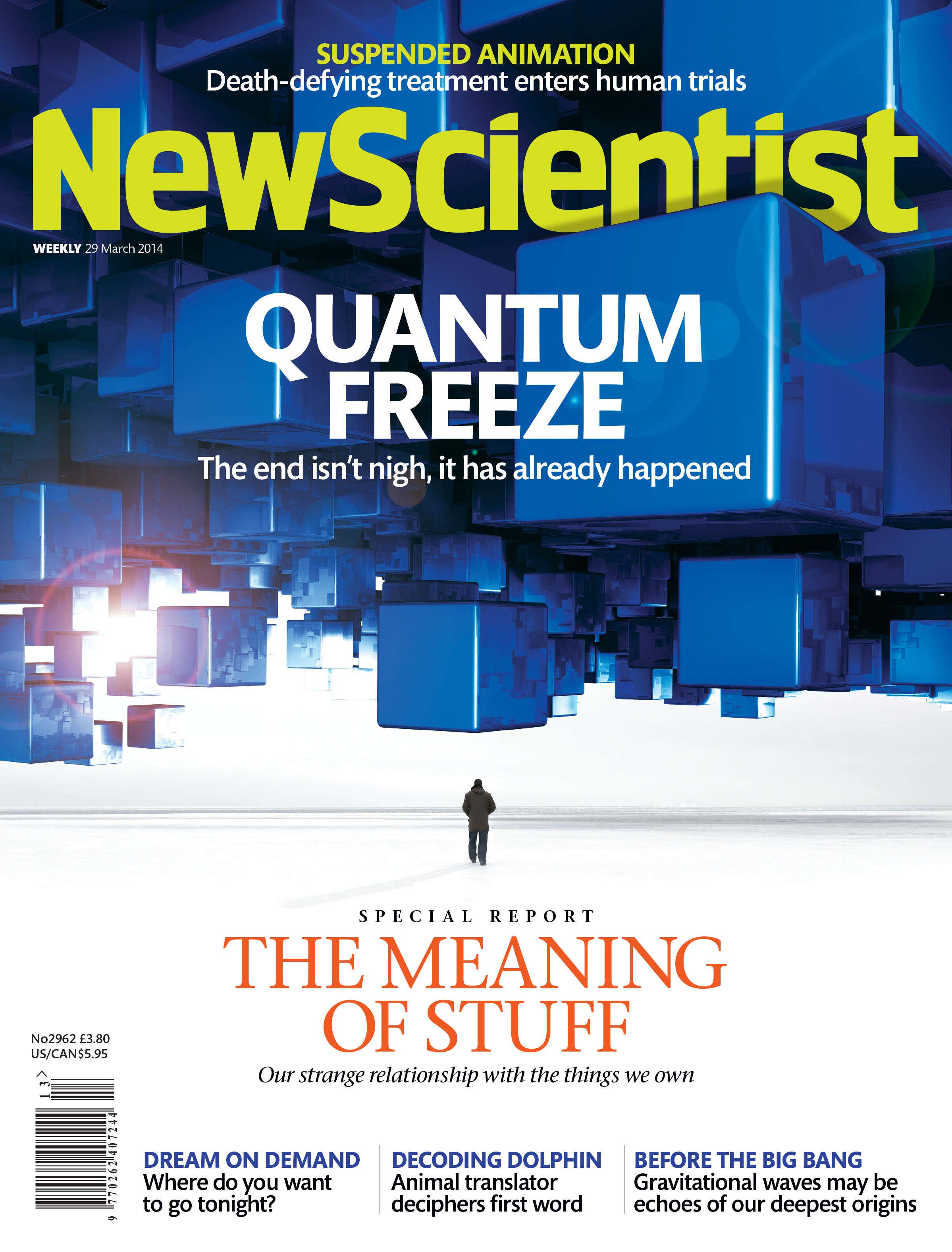
Issue no. 2962 published 29 March 2014

Sign up to our weekly newsletter

Receive a weekly dose of discovery in your inbox. We'll also keep you up to date with New Scientist events and special offers.

Sign up
Piano Exit Overlay Banner Mobile Piano Exit Overlay Banner Desktop