Subscribe now

Letters archive

Join the conversation in New Scientist's Letters section, where readers can share their thoughts and opinions on articles and see responses from experts and enthusiasts across a range of science topics. To submit a letter, please see our terms and email letters@newscientist.com


2 April 2014

Musseling in

From Bob Butler

Martin J. Greenwood's tale of the mussel-choked inlet at a gas plant (15 March, p 32) , reminded me of working at Carmarthen Bay Power Station in the late 1950s, where one of my jobs was monitoring chlorine levels in the turbine cooling systems. The coolant was seawater, drawn in through screens to catch large …
2 April 2014

We have ignition

From John Feather

In discussing underground coal gasification (15 February, p 36) , Fred Pearce misrepresents the process used to manufacture town gas from coal half a century ago. He says that people used to ignite coal, producing carbon dioxide and enough heat for the CO 2 to react with steam to form carbon monoxide, methane and hydrogen. …

2 April 2014

True colours

From David H

In his article on disruptive camouflage (22 March, p 38) , Ed Yong states that the dazzle painting on allied ships during both world wars was black-and-white geometric patterns. This is not entirely true. Dazzle camouflage came in a whole range of colours including blue, green and buff. London's Imperial War Museum holds a number …

2 April 2014

Babies still booming

From Eric Kvaalen

Wang Feng argues that China's one-child policy "will go down in history as a textbook example of bad science combined with bad politics" (22 March, p 26) . It may be an example of dictatorial tyranny, but it wasn't an example of bad science. It is not scientific for him to claim that "populations and …

2 April 2014

Savings racket

From Nick Hunn

Further to Reg Platt's discussion of what he claims is the rising cost of energy, and whether this makes tackling emissions unaffordable, (15 March, p 28) , we should realise that cutting domestic energy use has become a massive industry. Last year in the US, almost $7 billion was spent on energy efficiency schemes, covering …

2 April 2014

Twin heresies

From Nigel Henbest

Thanks for a great article by Colin Stuart (15 March, p 38) on habitable planets. I keep telling people the idea of the habitable zone is outdated, and this feature sums it up brilliantly. But I was a bit perturbed that it kicks off with a couple of historical mistakes. Galileo was never tried for …

2 April 2014

Game not over

From Tony Park

As a computer gamer and hobbyist computer-game author, I was disappointed to see video gaming included in a list of apparently self-evidently bad things in your article on evolutionary traps (15 March, p 43) . You might just as well have included fish-keeping or railway modelling. Playing board games is generally considered a wholesome family …

2 April 2014

Enjoyed the trip?

Michael Slezak writes (8 March, p 40) that in New Zealand's assessment of harm from novel drugs, reports of "cramp, unconsciousness or hallucinations score 2; coma, paralysis or deafness score 3. Any product that accumulates a score of more than 2 per 20,000 units sold is taken off the market". For some drugs, failing to …

2 April 2014

Cosmic potage

From Tim Stevenson

Joseph Silk's article on cosmic conundrums (8 March, p 26) has me pondering on the concepts of causality and explanation. Classical causality relates a known precondition, an established regularity of nature, to the outcome: the apple became unsupported, there is a Newtonian force between masses causing acceleration, the apple fell. Causality 2, if you will, …

2 April 2014

Cosmic potage

From Ken Pettett

To all those people out there who, like me, don't like the idea of a multiverse, a solution is at hand. If every possible universe is included, then one of them must be a universe which is not part of a multiverse and perhaps this is the one we inhabit. All credit for this solution …

2 April 2014

Room for intolerance

From Wayne Gould

Arthur Krueger needs to clarify his definitions of tolerance (22 March, p 31) . Mao, Stalin and Pol Pot may well have been atheist but their brutality was not committed in the name of intolerant atheism. Contrary to what Krueger is implying, atheism is not a belief system: to call it so is tantamount to …

2 April 2014

No nukes please

From Steve Pickering

You quote Wernher von Braun in Feedback (1 March) , who argued that space exploration would become a means for human advancement, as "wars, which had somewhat similar 'rallying' effects, are no longer feasible". If we accept that the UK doesn't really need a nuclear weapons programme, but does need good jobs for talented scientists …

2 April 2014

Bitter truth

From Alex Cruickshank

Andy Coghlan's discussion of giving up alcohol for a month as part of New Scientist 's experiment (4 January, p 6) contains a seemingly throwaway comment: "The only negative was that people reported less social contact." That's a big negative. It seems that people are willing to accept alcohol's detrimental health effects if drinking increases …

2 April 2014

Bitter truth

From Chris Wilkinson

Kit Devine (1 March, p 33) suggests drinking soda water, lime and bitters as a grown-up alternative to alcoholic drinks. However, my bottle of bitters shows an alcohol content of 44.7 per cent by volume. That's why bitters are kept behind the counter at the shop, otherwise they'd be shoplifted by underage teenagers looking for …

2 April 2014

Unlikely odds

From Karl Carmichael

In his review of The Improbability Principle (15 March, p 51) , Jonathon Keats discusses the mathematics behind the Bulgarian lottery which drew the same winning numbers on two consecutive occasions. An even simpler way of looking at this, if you are as lazy and as bad at maths as I am, is that the …

2 April 2014

Unlikely odds

From Tony Lacy

I was taken by Fred Pearce's epithet of "a simple conceit" applied to the title of David Sedlak's book Water 4.0 (15 March, p 50) . I even looked up this phrase as I had not come across it before. Imagine my surprise when, on the next page, reviewer Jonathon Keats describes the title of …

2 April 2014

Shocking discovery

From Terry Klumpp

When I was an apprentice electrician many years ago, my finger strayed across live positive and negative terminals, and I cursed myself for being so careless. However, I suddenly realised that my raging hangover had vanished. Given how well the voltage cure has worked for some (22 February, p 34) , I now believe that …

2 April 2014

For the record

• We weren't quite up to speed with cosmic inflation (29 March, p 10). The universe's early expansion was faster than light, not slower.

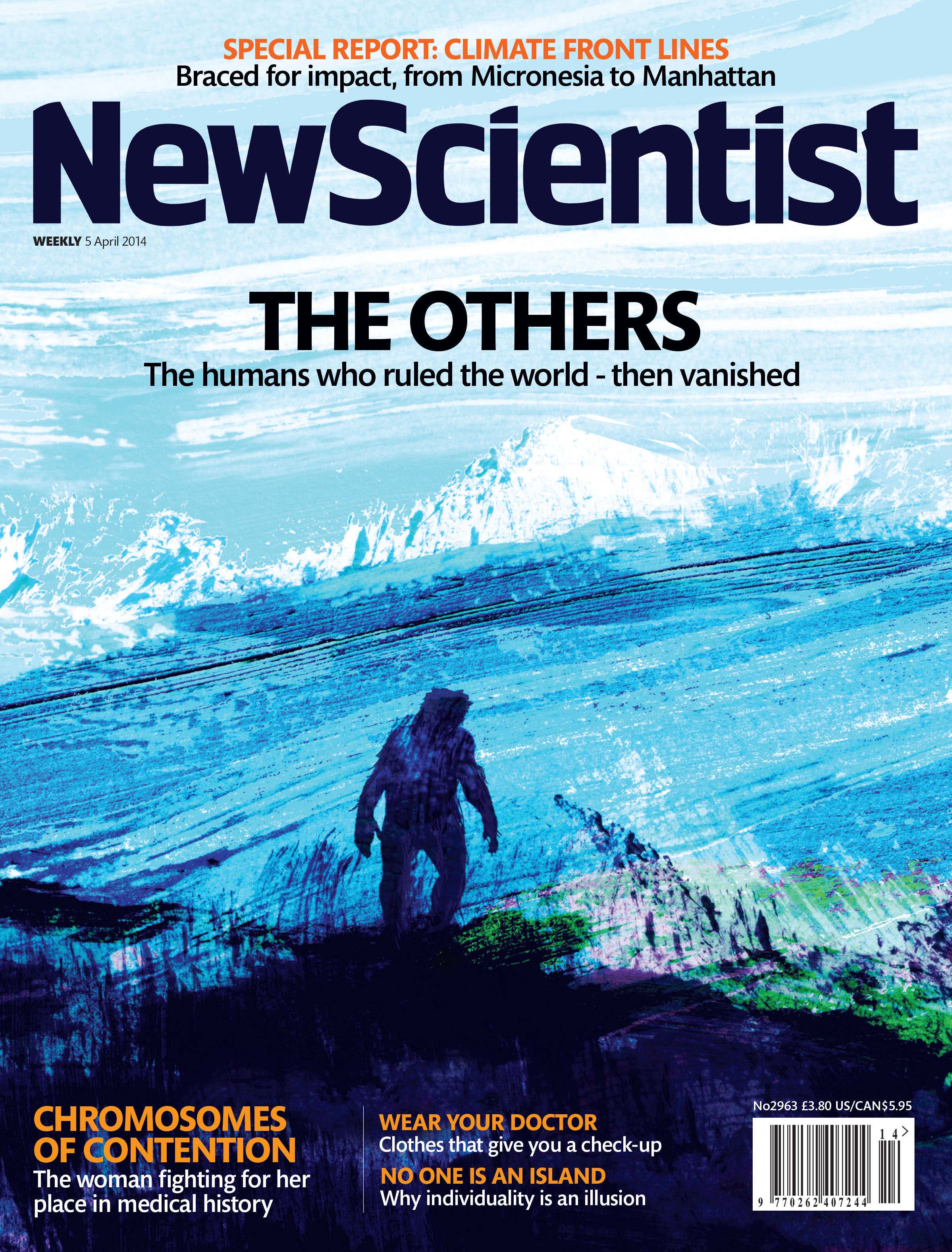
Issue no. 2963 published 5 April 2014

Sign up to our weekly newsletter

Receive a weekly dose of discovery in your inbox. We'll also keep you up to date with New Scientist events and special offers.

Sign up
Piano Exit Overlay Banner Mobile Piano Exit Overlay Banner Desktop