Subscribe now

Letters archive

Join the conversation in New Scientist's Letters section, where readers can share their thoughts and opinions on articles and see responses from experts and enthusiasts across a range of science topics. To submit a letter, please see our terms and email letters@newscientist.com


15 April 2014

BBC balance

From Ceri Thomas

Bob Ward writes that the BBC is vital to the public debate on climate change but that we are sacrificing accuracy for impartiality in our coverage (newscientist.com/article/dn25353) . The BBC covers the issue of climate change comprehensively and we do our utmost to report on this complex subject as clearly and accurately as possible. The …
15 April 2014

No smoke without ire

From Gerry Stimson

Sally Davies, the chief medical officer for England, is wrong on e-cigarettes (5 April, p 29) . If the marketing of these devices is "often aimed at children", as Davies suggests, then it has been a spectacular failure. E-cigarette use is rare among young people, and confined mostly to those who have smoked cigarettes. E-cigarettes …

15 April 2014

From Graham Saxby

I have something to add to Alan Larman's experience of seeing ultraviolet (15 March, p 33) . I underwent a cataract operation involving eye lens replacements. Some time later I visited a research lab at the University of Cambridge. The team had just taken delivery of a UV laser emitting a beam with a wavelength …

15 April 2014

From Graham Saxby

From Dale Johnston

There are widely reported inaccuracies about human colour vision. The absolute range of retinal sensitivity extends from near-ultraviolet to near-infrared. Strong, and possibly harmful, illumination is necessary to see these extremes. As we age there is increasing absorption of near-UV light by the eye's lens, and so it becomes harder to perceive. A child can …

15 April 2014

Nuclear plant

From Geoffrey Withington

In your article on metal-eating plants, Katia Moskvitch writes that phytomining – using plants to extract metal from the ground – is for the moment mainly focused on the uptake of nickel by some Alyssum species (22 March, p 46) . This is good news for those of us who worry we are leaving a …

15 April 2014

Nuclear plant

From David Ray

One theme that ran through Katia Moskvitch's feature is that commercial exploitation of phytomining technology is expected to take off when key patents expire. This underlines the importance for researchers to distinguish between the real and perceived impact of patents on the intellectual property. César Milstein and the University of Cambridge are consistently criticised for …

15 April 2014

Population problem

From Helen Haran

It was good to see the full detail of how China's unpleasant one-child policy worked and its ineffectiveness compared with other factors affecting population such as increased education (22 March, p 26) . Unfortunately China's policy has cast a shadow over the whole idea of any country having a policy on population control. And that's …

15 April 2014

Potato pests

From David Shaw, Sárvári Research Trust If the disease Andrew Sanderson observed (29 March, p 31) on his blight-resistant Sarpo potato varieties (but not on his blight-susceptible Kestrel variety) really was late blight caused by Phytophthora infestans , it might indicate that the Sarpos' resistance had been eroded by genetic change in the pathogen. On …

15 April 2014

Shakes and ladders

From Jon Hinwood

I suffer a milder fear of heights than Jessica Hamzelou (15 March, p 34) but her article's opening picture was nevertheless enough to trigger increased heart rate, tension and a morbid urge to look again. I have found gradual exposure to be very effective but not long-lasting. Over many years I occasionally pruned some tall …

15 April 2014

Buzz off

From Gerald Legg

Stripes disrupt a zebra's outline, making it more difficult for large predators to see them (22 March, p 38) . This is certainly true but they may well have other purposes hidden from our visual system. Insects such as the tsetse fly, which goes after big game, can see ultraviolet light. They are attracted to …

15 April 2014

Earth shattering

From Don Michels

Colin Stuart's article on what makes planets ideal homes (15 March, p 38) could have included another important feature of Earth – tectonics. Renewing mountain ranges after the levelling by weather redistributes the elements and sustains the geochemical cycling. Without tectonic cycling, our planet would become stagnant and close to homogeneous, with few niches for …

15 April 2014

Plural possessive

From Ian Simmons

As the father of two daughters, I would dispute something in Linda Geddes's article on the first signs of human possessiveness. Susan Gelman is quoted as saying that a 3-year-old protesting about another child's toy being taken does not involve self-interest (March 29, p 40) . On the contrary, it is all about self-interest. They …

15 April 2014

Anti-gravity

From Stephen Robinson

In discussing gravitational waves (22 March, p 8) , Lisa Grossman quotes Alan Guth of MIT as saying "Inflation depends on a kind of material that turns gravity on its head and causes it to be repulsive." Could this be cavorite, the material dreamed up by H. G. Wells, which astronauts used to propel their …

15 April 2014

Warning signs

From John Richmond

I always wondered why smokers ignored "No Smoking" signs at the entrance to London Waterloo Station. It seems the reason can be found in your invisibility special (22 March, p 32) : the prohibition signs prompt smokers to smoke! Worcester Park, Surrey, UK

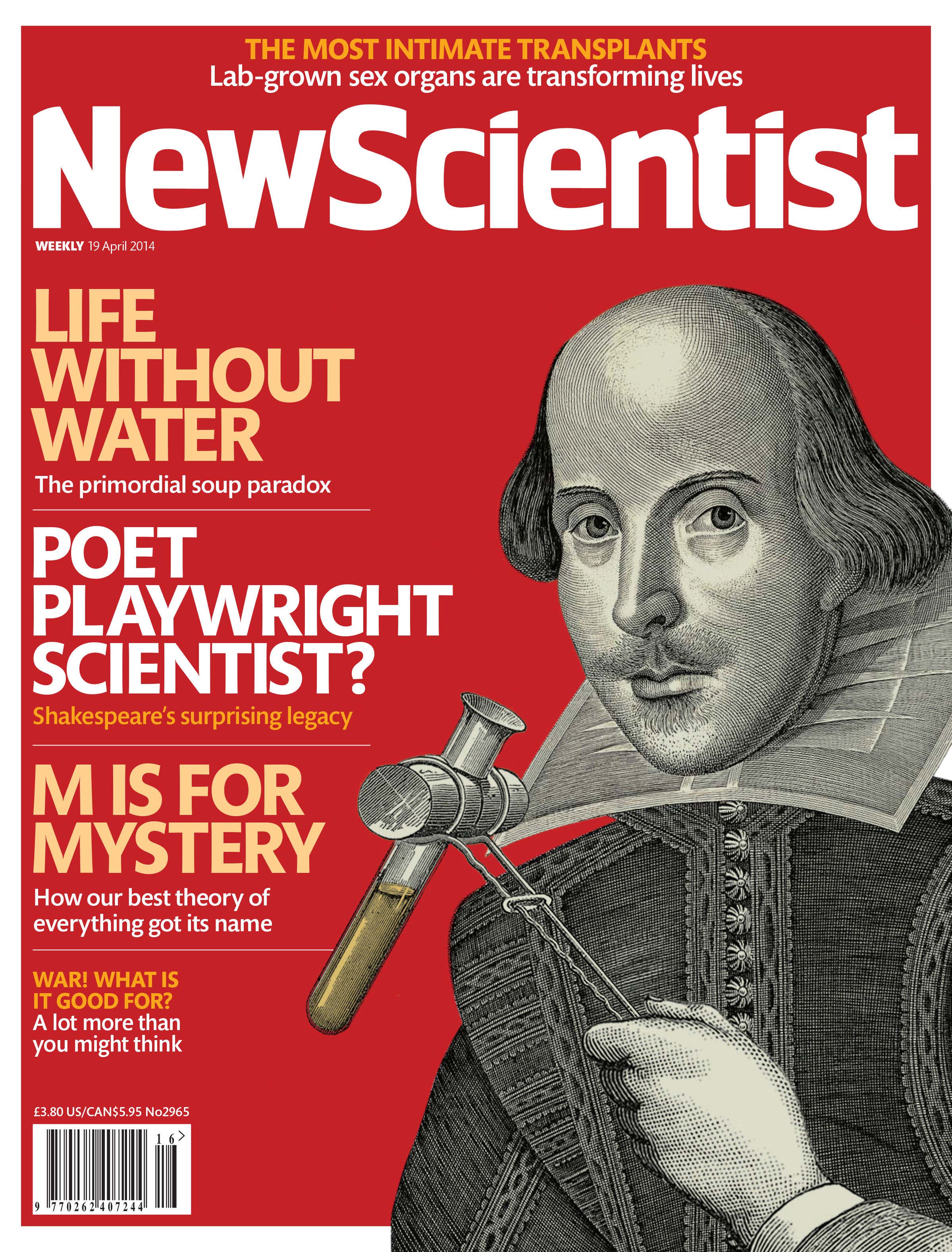
Issue no. 2965 published 19 April 2014

Sign up to our weekly newsletter

Receive a weekly dose of discovery in your inbox. We'll also keep you up to date with New Scientist events and special offers.

Sign up
Piano Exit Overlay Banner Mobile Piano Exit Overlay Banner Desktop