Subscribe now

Letters archive

Join the conversation in New Scientist's Letters section, where readers can share their thoughts and opinions on articles and see responses from experts and enthusiasts across a range of science topics. To submit a letter, please see our terms and email letters@newscientist.com


14 May 2014

War and peace

From Robert Eales

We should be able to test Ian Morris's hypothesis that war has created a more peaceful, and hence prosperous world by creating larger, unified societies (19 April, p 28) . Yet since 1900 and perhaps earlier, no war I can think of seems to fit. Since then no military invasion has succeeded in its objectives, …
14 May 2014

War and peace

From Ian Morris writes

• Robert Eales takes on the argument about what's happened globally over the past 10,000 years by looking at what's happened locally in the last 100 years, and he often focuses on still shorter timescales. This, I think, leads him to misunderstand the effects of the world wars. Like a lot of modern historians, I …

14 May 2014

Pass it on

From Tim Stevenson

Andy Coghlan's article on the role of microRNAs in the inheritance of epigenetic characteristics was fascinating (19 April, p 14) . But a hasty reading of it could give the impression that he is describing an evil mechanism that perpetuates the negative results of stress in future generations. Surely, this is more likely to be …

14 May 2014

Caveman cross

From Freya Smith

Ella Been suggests that Australopithecus sediba did not exist (12 April, p 11) . If so, it does not necessarily follow that the hominin fossils found at Malapa, South Africa, are from four individuals. They may show Australopithecus and Homo characteristics because of interbreeding between the two genera. The adult skeleton may well be that …

14 May 2014

Cogs in the machine

From Bryn Glover

Interviewed about the automation of work, Andrew McAfee comes across as either naïve or evasive (26 April, p 28) . The question of what will happen to all the workers displaced by encroaching technology was put to him in several different ways, and McAfee either ignored the point or answered obliquely. History teaches us that …

14 May 2014

Wet life

From Michael Paine

Colin Barras (19 April, p 36) describes the possibility that life originated in water-free conditions on Mars, before being transferred to Earth via an asteroid impact. He questions whether dry life from Mars could colonise a wet Earth, but there is ample opportunity for life on Mars to have evolved to inhabit wet locations before …

14 May 2014

Killing, warts and all

From Rod Tranchant

Michael Slezak needs to consider the importance of what is yucky, as well as humane, when discussing ways to kill pest species (26 April, p 40) . Killing a cane toad by running it over or hitting it with a golf club is humane because it is quick but has a high yuck factor. How …

14 May 2014

The last cut

From Celia Berrell

Gareth Jones wants medical schools to stop using unclaimed bodies for dissection (19 April, p 26) . When I die, I will no longer have any use for my body. If I have surviving family who express their respect or emotional attachment for me in some way that prevents my body being used for anatomical …

14 May 2014

Ethical highs

From Brendan Woodford-Robinson

One major issue absent from your report on New Zealand's drug liberalisation (8 March, p 40) is that novel drugs which need to be proved safe will be tested on animals, including experiments to determine a lethal dose. Understandably, the public backlash here in New Zealand has been huge, with nationwide protests on the streets. …

14 May 2014

Poor reception

From Liegh White

I don't know how Ceri Thomas, head of programmes at BBC News, has the brass neck to argue that their coverage of the science around climate change is impartial and balanced (19 April, p 33) . I've lost count of the number of times Nigel Lawson, chairman of the political think tank The Global Warming …

14 May 2014

Just like us

From Jo Spencely

Assigning medical diagnoses to Shakespeare's characters seems to miss the point (19 April, p 43) . Labelling his characters as "other" – differently wired or disabled – allows us to distance ourselves from them, whereas Shakespeare's genius was to show us how similar we are to them. Their flaws are our own, just magnified. By …

14 May 2014

Moral education

From Anthony Richardson

I can only guess at where, and in which decade, Danny Colyer had his school science education (26 April, p 30) , but I would like to assure him that many science teachers were already doing what he prescribes – encouraging a culture of honesty. We explored with pupils precisely how scientists, as fallible humans, …

14 May 2014

Moral education

From Jonathan Arch

Reading about the manipulation of school science practicals reminded me of when, as an undergraduate, I and many of my classmates failed miserably in our quest to make p-nitroacetanilide – a chemical intermediate for some dyes. One day, somebody pointed out that the real stuff bears a remarkable resemblance to powdered milk. How easily the …

14 May 2014

Eaten alive

From Tony Warren

I read your article on cannibal tadpoles (19 April, p 16) . At the Open University in the 1970s we were taught that frogs over-reproduced so that all the tadpoles could strip the food source when the going was good. When the source was depleted, the ablest simply ate the rest to reach maturity. Shorwell, …

14 May 2014

Hot-headed

From Perry Bebbington

Lawrence D'Oliveiro suggests in his letter that memory is a result of increasing entropy (12 April, p 33) . I am known by my friends as someone with a poor memory, although I can't remember why. Could it be that in my head entropy is decreasing? Kimberley, Nottinghamshire, UK

14 May 2014

Unnecessary pain

From Ken Pease

You report on an attempt to show that mice are less stressed by the sweat of female handlers than that exuded by male ones (3 May, p 14) . Pain-inducing injections were given to anaesthetised mice and rats, and "when the animals awoke, the team recorded their facial grimaces, a measure of pain intensity". Pain …

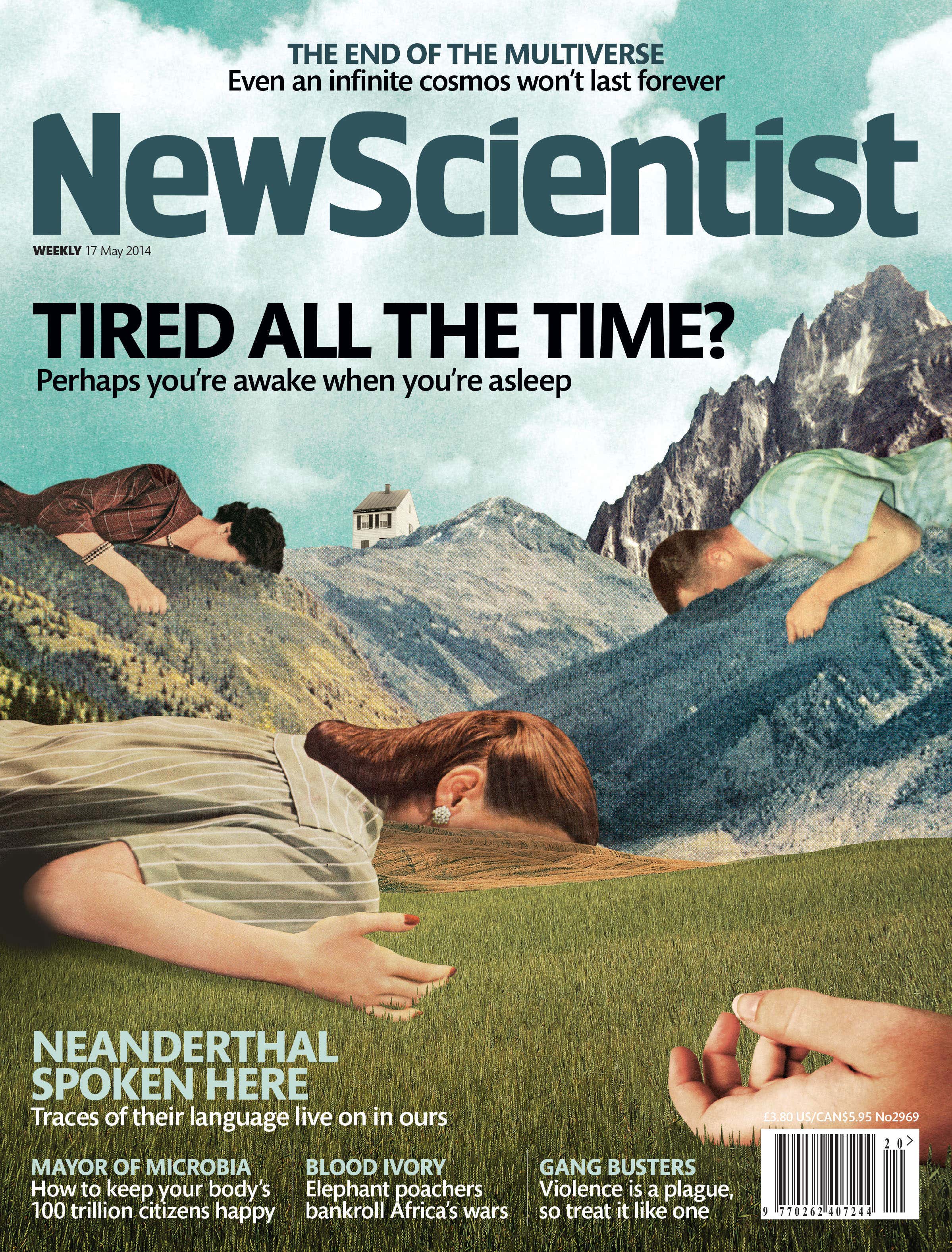
Issue no. 2969 published 17 May 2014

Sign up to our weekly newsletter

Receive a weekly dose of discovery in your inbox. We'll also keep you up to date with New Scientist events and special offers.

Sign up
Piano Exit Overlay Banner Mobile Piano Exit Overlay Banner Desktop