Subscribe now

Letters archive

Join the conversation in New Scientist's Letters section, where readers can share their thoughts and opinions on articles and see responses from experts and enthusiasts across a range of science topics. To submit a letter, please see our terms and email letters@newscientist.com


21 May 2014

Religious reduction

From David Flint

Graham Lawton presents some fascinating facts and theories about the advance of secularism (3 May, p 30) . Although his proposed explanations may all be true, his numbers imply a loss of about one billion believers in a decade – far more than could be explained by such gradual processes. This collapse must be explained …
21 May 2014

Religious reduction

From Mark McArdle

The economic boom in Ireland may have fuelled atheism, but two other forces were also at play. First, child abuse revelations relating to the clergy came thick and fast during this period. Second, while Ireland was under British rule, the services provided by the state existed mainly for the small British-leaning part of the population. …

21 May 2014

Religious reduction

From Stephen Welch

There are two other major factors driving decline in religiosity that Lawton did not mention. The internet has allowed people, especially young people, to access and discuss ideas and customs that are outside their own society. In addition, the worldwide publicity of the New Atheist movement has made it much more socially acceptable to be …

21 May 2014

Religious reduction

From Jon Atack

It would be interesting to extend Lawton's excellent piece to consider belief in the supernatural as well as belief in god. As he says, while there is a decline in conventional religious belief, many people hold tightly to magical thinking, without seeking rational justification. There is every need to apply scientific empiricism to the study …

21 May 2014

Religious reduction

From Dan Conine

There is an argument for a fifth type of atheism in addition to those you listed: utilitarian. This is a system that stimulates useful behaviours in a community. The non-religious Sunday Assembly seems to fall into this category, and I submit that nearly all religion does when sensible people are given a chance to admit …

21 May 2014

Religious reduction

From Rev

Thank you for a great article on the global decline in religious belief. It is good to bring numbers and analysis to the subject. However, though religion may have grown from angst and vulnerability, there is no mention in your feature of awe and wonder. I am now 68 and have spent my life in …

21 May 2014

Science, not sexism

From Rick Bradford

Elizabeth Carrey has dragged gender into an issue where it is irrelevant in questioning the treatment of Haruko Obokata, the Japanese stem cell researcher who was found guilty of misconduct by her research institute (10 May, p 30) . Had Obokata been male, would the story have unfolded any differently? No, it would not. Carrey …

21 May 2014

British bees

From Margie Ramsay

There is certainly a problem with beekeeping here in the UK, as Andrew Beattie says (3 May, p 29) . In fact, more than 95 per cent of beekeepers in the British Isles do not keep the native European dark bee ( Apis mellifera mellifera ), but foreign varieties. For the past 100 years, there …

21 May 2014

Rocky chemistry

From Chris Evans

Caroline Williams's article about the mysterious lights that appear over Hessdalen in Norway was interesting, but disappointingly vague about their hypothetical power source (10 May, p 40) . "Rocks rich in iron and zinc" and "rocks rich in copper" could indeed possibly form a natural battery, but rocks rich in metallic zinc and iron are …

21 May 2014

Evolving minds

From Eric Kvaalen

Philip Cunliffe's letter trying to explain the beginnings of consciousness misses the point (10 May, p 30) . Of course an animal benefits if it can correlate information received from its senses, and use memory to aid in interpreting it. But that can be done by a computer. What need is there of actual consciousness? …

21 May 2014

Wealth creation

From Lawrence D

Further to previous letters on how intellectual property law affects innovation (10 May, p 30) , I note that there was no copyright in Shakespeare's day. He copied from others, and others copied from him. And yet he became very wealthy, as can be seen from his will. Some people are fond of insisting that, …

21 May 2014

Birdbrained

From James Fradgley

Kirsten Weir's article discussed the intelligence of pigeons (3 May, p 40) . In my experience, wood pigeons have some counting skill. I was brought up on a farm where pigeons were persecuted mercilessly, but they were smart enough to steer clear of danger. If someone hid in the bushes, the pigeons would stay away …

21 May 2014

Birdbrained

From Valerie Moyses

If pigeons are so smart, why do they still make kamikaze flights into my bedroom window, leaving messy corpses on my patio for the foxes to dine on? Bloxham, Oxfordshire, UK

21 May 2014

Cut and thrust

From Francois Duminy

I enjoyed the revelation that sailfish use their bills as swords to slash at their prey (26 April, p 17) . It seems to me that their very large dorsal fin is a lateral stabiliser for the animals' incredibly fast swordplay. Could we infer that other billfish, such as marlins and swordfish, also fence with …

21 May 2014

Dead certainty

From Chris Skillern

Gareth Jones questions the use of unclaimed bodies for medical science, and is a perfect example of why it has become so difficult, and at times impossible, to get anything of any importance done (19 April, p 26) . One would have to look long and hard to find a more straightforward and sensible use …

21 May 2014

Handy measure

From Michael Fett

Samantha Murphy's feature on the health benefits of obesity included discussion of how best to quantify excess weight (3 May, p 44) . In my clinical experience, roughly gauging abdominal flab by grabbing a handful gives a great view of "fatness" that discounts body frame and muscularity. Manuka, ACT, Australia

21 May 2014

For the record

• Our feature on treating schizophrenia without drugs (8 February, p 32), reported the results of a trial that compared "people who stopped taking antipsychotics with those who continued their treatment". We should have made it clearer that although the aim was to wean people off their drugs, few of those in what the trial …

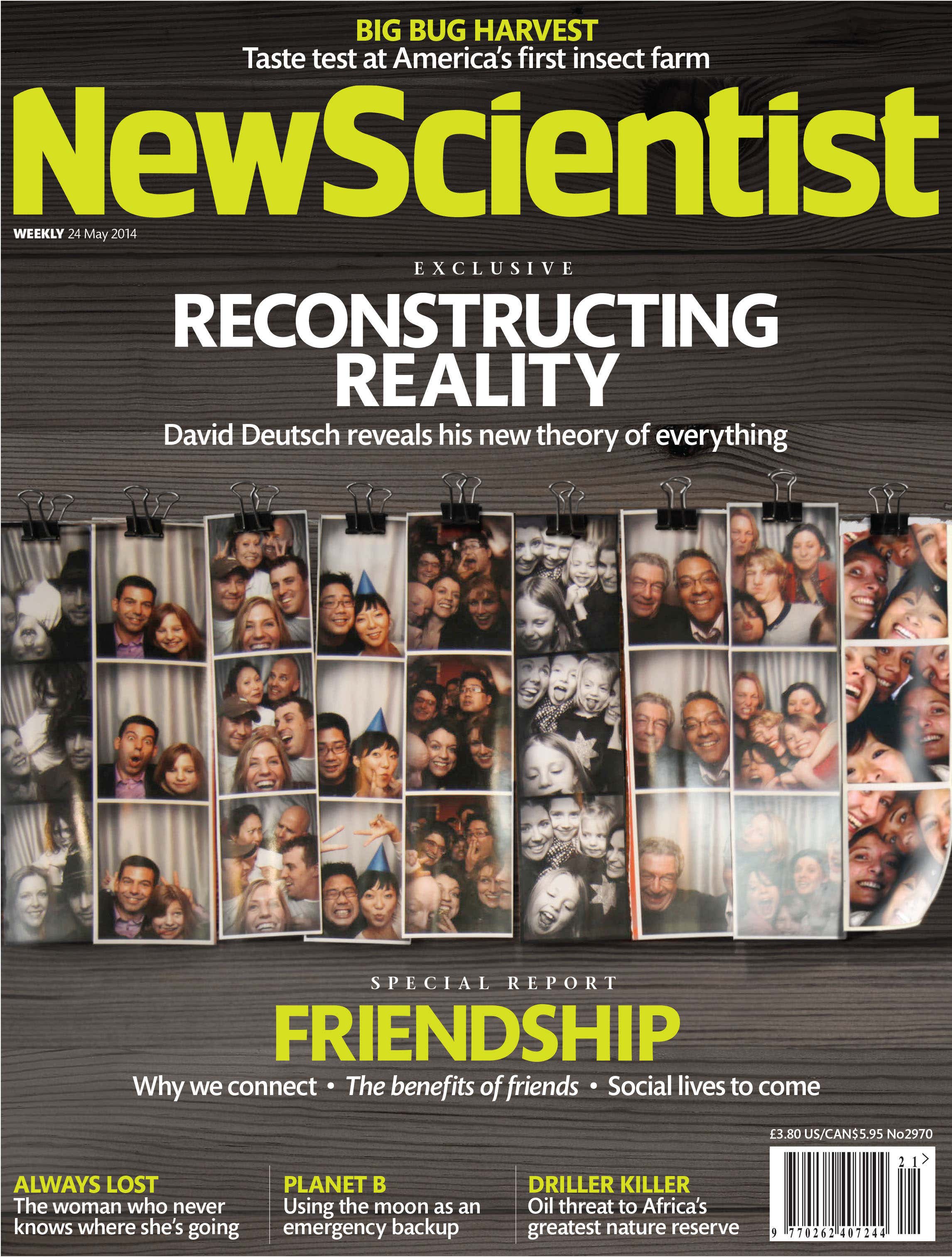
Issue no. 2970 published 24 May 2014

Sign up to our weekly newsletter

Receive a weekly dose of discovery in your inbox. We'll also keep you up to date with New Scientist events and special offers.

Sign up
Piano Exit Overlay Banner Mobile Piano Exit Overlay Banner Desktop