Subscribe now

Letters archive

Join the conversation in New Scientist's Letters section, where readers can share their thoughts and opinions on articles and see responses from experts and enthusiasts across a range of science topics. To submit a letter, please see our terms and email letters@newscientist.com


25 June 2014

Science and UKIP

From Roger Plenty

Howard Koch of the UK Independence Party (UKIP) claims his party is pro-science, but I don't think this extends to climate change (14 June, p 32) . Christopher Monckton, one-time president of UKIP in Scotland, told an audience in the US that the aim of a proposed UN treaty on climate change was to "impose …
25 June 2014

By the numbers

From David Plews

I was pleased to see that your article on paracetamol included the number needed to treat (NNT), which calculates the effectiveness of a medicine by counting the number of patients who need a specific treatment to prevent one additional bad outcome (31 May, p 34) . I wish organisations such as the UK National Institute …

25 June 2014

Molecular mealtime

From Charles Merfield

While I don't begrudge Pierre Gagnarie and his fellow molecular gastronauts their innovation, I concur with Richard Young of the UK Sustainable Food Trust, that molecular gastronomy is at best a red herring, and at worst a failure of holistic thinking when it comes to sustainability (7 June, p 10) . Only once the molecular …

25 June 2014

Molecular mealtime

From Anton Fletcher

While reading Helen Thomson's discussion of synthetic foods I was amused by the reference to food substitute Soylent. One hopes this Soylent creation is similar in name only to its literary forebear, and there is no need for the shocking secret ingredient. Droitwich, Worcestershire, UK

25 June 2014

Conception concerns

From Mahdi Lamb

I was glad to read your article on the debate about legislation regarding so-called three-parent babies (14 June, p 28) . One of the concerns Donna Dickenson and Marcy Darnovsky raised was that it could lead to changes in the law allowing for germ-line modification, DNA changes that are inheritable. I would argue that the …

25 June 2014

Fire extinguisher

From Richard Mountford

Mark Heinicke suggests that nuclear power can help to combat global warming (7 June, p 31) . However, nuclear and other alternative energy sources will only prevent climate change if they lead to significant quantities of coal, oil and gas remaining in the ground. Sadly, the growth of the economy and the population, as well …

25 June 2014

Watery planet

From Ralf Biernacki

The discovery of an ocean of water locked in our planet's mantle also has relevance to other planets (21 June, p 17) . The existence of similar reservoirs of hydrated ringwoodite on Mars or Venus would have a major impact on the prospects of terraforming these planets. Much of the rover exploration on Mars is …

25 June 2014

Pyramid scheme

From Joshua Schwieso

Your special on Scottish independence argues that without continued immigration from Europe and beyond, Scotland will find it difficult to support an ageing population (31 May, p 12) . The same claim has been advanced by Europhiles with regard to other Western European societies, in the wake of growing support for political parties hostile to …

25 June 2014

Brain workout

From Robin McKellar

Learning a second language has been shown to slow mental decline (7 June, p 14) . However, I suspect that other mental challenges can serve a similar function. My mother regularly devoured a stimulating magazine during her stay in a nursing home. She remained cognisant to the end. The magazine in question was, of course, …

25 June 2014

Twist in the tail

From Sam McGinnis

Katia Moskvitch's interview with biologist Michael Levin begins with an error: lizards cannot regenerate lost limbs as claimed (31 May, p 30) . Some can grow a pseudo-tail segment if the tail's end portion is broken off. It contains no vertebrae as the original did, but instead has a fibrocartilage rod for support and is …

25 June 2014

Colour changer

From Audrey Berrie

Chlamydomonas nivalis , the "watermelon snow" described by Lisa Grossman in her article on extreme life (14 June, p 13) , is not a type of red algae but a green alga in the Chlorophyta phylum. As well as the usual green pigment chlorophyll, it has an additional carotenoid pigment, giving the algae its red …

25 June 2014

Space jockey

From Bryn Glover

You briefly describe a technique in which spacecraft could hitchhike to the far reaches of the solar system on the back of a comet (14 June, p 6) . But if a craft was accelerated to an orbit in which it could catch a comet, surely it could follow this same orbit to the far …

25 June 2014

Space jockey

From The editor replies

When the hitchhiking spacecraft tethers itself to a comet, it acts like a regenerative brake, charging its batteries by slowing the comet slightly. The craft uses this stolen kinetic energy to accelerate to the far reaches of the solar system.

25 June 2014

Bird scarer

From Valerie Moyses

John Stolarski mentions using stickers in the shape of birds of prey to dissuade pigeons from crashing into clear windows (14 June, p 32) . For years now I have been displaying a very large portrait of my Victorian great-grandfather in my window. Seeing as his bald head, whiskers and scowl can't put off suicidal …

25 June 2014

Man's best friend

From Marc Bekoff

I found Robin Dunbar's essay on friendship to be a fascinating read (24 May, p 34) . However, I was surprised to see that he didn't include the social carnivores among the "select group of mammals" that form "true friendship" rather than acquaintances. Ample data show that, like the animals he did include – higher …

25 June 2014

God particle

From Nury Vittachi

In their call for a reorganisation of physics principles, David Deutsch and Chiara Marletto argue that the unit of information is more fundamental than anything, even quantum particles (24 May, p 30) . My colleagues will no doubt pelt me with breakfast items for saying this, but I can't help but be reminded of a …

25 June 2014

For the record

• We got our wires crossed when describing a technique to repair damaged nerves (10 May, p 14) . The alloy used contains gallium, indium and tin. • An elementary error appeared in our feature on the H-bomb curve (7 June, p 42) . Carbon-14 decays to nitrogen-14. • In our story on European migration, …

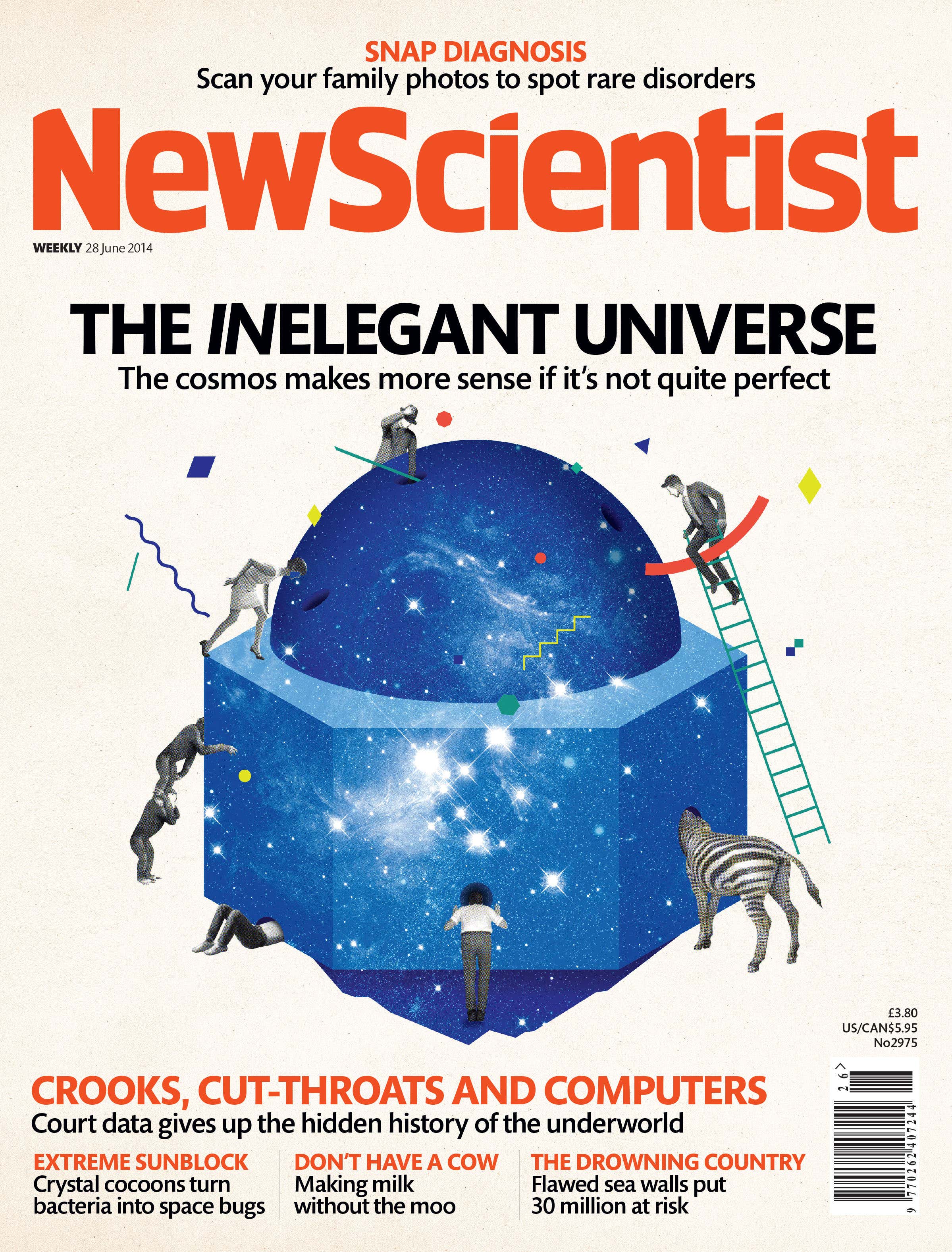
Issue no. 2975 published 28 June 2014

Sign up to our weekly newsletter

Receive a weekly dose of discovery in your inbox. We'll also keep you up to date with New Scientist events and special offers.

Sign up
Piano Exit Overlay Banner Mobile Piano Exit Overlay Banner Desktop