Subscribe now

Letters archive

Join the conversation in New Scientist's Letters section, where readers can share their thoughts and opinions on articles and see responses from experts and enthusiasts across a range of science topics. To submit a letter, please see our terms and email letters@newscientist.com


6 August 2014

Social brains

From Nicholas Humphrey

Alun Anderson describes Robin Dunbar as the "key thinker behind the social brain hypothesis" (19 July, p 48) . But Dunbar was actually a latecomer to the idea, which I and others developed in the 1970s. My 1976 essay "The social function of intellect" was the first of numerous publications on the evolution of brain …
6 August 2014

Intelligent life

From Andrew Brooker

The artificial intelligences we create will lead to an autonomous system that develops technologies "to shape the future of life according to its preferences", writes Nick Bostrom (5 July, p 26) . To have preferences implies consciousness, not a simple weighing of data, however complex and adaptable the rules for weighing. The superintelligence may well …

6 August 2014

Intelligent life

From Phil Smith

Nathaniel Hellerstein claims that "by definition we cannot think up programs superior to our own best thinking" (26 July, p 31) . But surely our very existence demonstrates that intelligence does not have to be brought into being by a superior intelligence. Of course some believe this is what happened, but if so, how did …

6 August 2014

GM's bitter taste

From Johanna Carrie

In discussing genetically modified food, Susan Watts omits two issues that influence public attitudes (26 July, p 26) . In the late 1990s, I attended two large public debates on GM. No one was against the technology itself, as anti-nature, or anti-God. The issues were about who controlled the technology and what risks to the …

6 August 2014

Element of doubt

From Peter Cooke

It's no surprise that the periodic table is not holding up (12 July, p 38) . There are over 3100 nuclides, but the table only displays 100 or so. It can only be an approximation of something greater. Perhaps it needs further axes to contain its properties, for example, a Z-axis so that each element …

6 August 2014

Life unearthed

From Paul Reeve

Lisa Grossman writes that a probe that can drill through kilometres of ice is of interest because vapour plumes on Jupiter's frozen moon Europa suggest there is liquid water underneath (26 July, p 10) . If this unknown ocean contains any biology, won't some of the microorganisms come to the surface with the plumes? It …

6 August 2014

Life unearthed

From The editor replies

• Europa's soaring water plumes are indeed a tempting destination for alien hunters. Earlier this year, we discussed plans to fly spacecraft through the vapour to sample it for signs of life (4 January, p 8) .

6 August 2014

Library cuts

From Guy Cox

Aviva Rutkin writes that libraries in the US are becoming workshops (19 July, p 22) . She credits the famous library of Alexandria as the home of the world's first steam engine, although I think that was built in the adjoining university. The library was notable in another way, though, in that entrants as well …

6 August 2014

Hungary for bread

From Judit Brody

With regard to your article probing the gluten-free debate (12 July, p 28) , when I was a child in Hungary we were taught that Hungarian wheat made the very best bread because it was gluten rich. Gluten was supposed to be good for you. Witney, Oxfordshire, UK

6 August 2014

Shocking discovery?

From Richard Miller

The suggestion that people would rather give themselves electric shocks than sit idly seems to confirm notably cynical observations (12 July, p 12) . For example, it was Bertrand Russell who once quipped, "Most people would sooner die than think; in fact, they do so." London, UK

6 August 2014

For the record

• Don't ditch the panda, as our headline suggested (19 July, p 38) . Even if one were to interpret the Evolutionarily Distinct and Globally Endangered (EDGE) list for mammals as a plea to reduce conservation efforts for some flagship species, which was never its intention, it would still not be a problem for the …

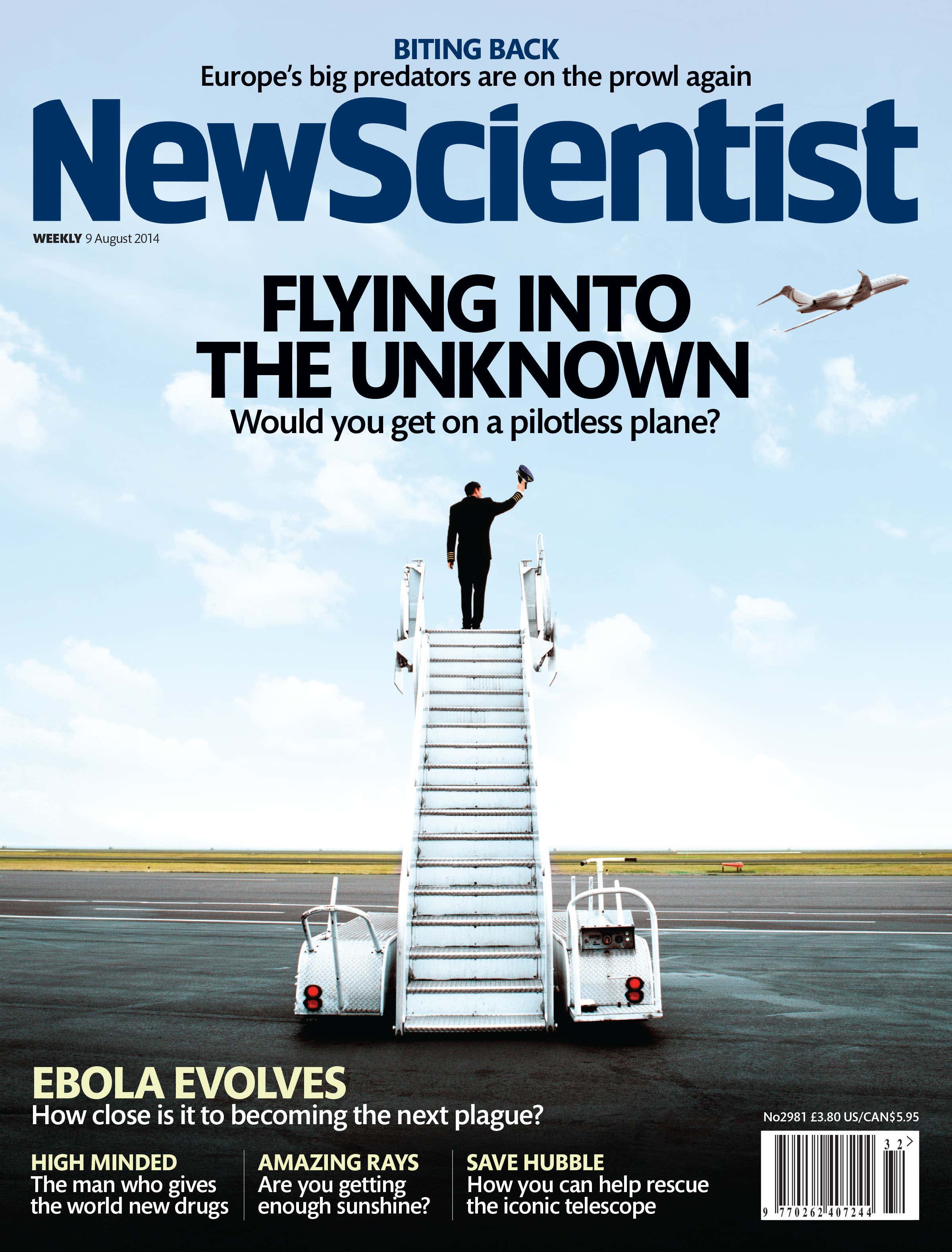
Issue no. 2981 published 9 August 2014

Sign up to our weekly newsletter

Receive a weekly dose of discovery in your inbox. We'll also keep you up to date with New Scientist events and special offers.

Sign up
Piano Exit Overlay Banner Mobile Piano Exit Overlay Banner Desktop