Subscribe now

Letters archive

Join the conversation in New Scientist's Letters section, where readers can share their thoughts and opinions on articles and see responses from experts and enthusiasts across a range of science topics. To submit a letter, please see our terms and email letters@newscientist.com


13 August 2014

Fat lot of good

From Paul Gray

I read Jon White's story on the dietary role of fat with a mixture of despair and amusement (2 August, p 32) . In the 1980s, I spent 10 years of my career at the European Commission in charge of food, refocusing legislation on safety and consumer information – such as nutrition labelling – only …
13 August 2014

Fat lot of good

From Paul Tavener

Research into the effects of dietary fat on disease has suffered from 40 years of distortion and misinterpretation. The establishment of an early consensus on very flimsy evidence, driven by very forceful personalities, has proved disastrous. Take one example, the Multiple Risk Factor Intervention Trial (MRFIT), which involved over 12,000 middle-aged American men with high …

13 August 2014

Too charming to die

From Jonathan Wallace

Tim Vernimmen raises some important questions about how we should allocate conservation resources and which species we should save (19 July, p 38) . The broad thrust of his article is that we could focus on the ecosystems or species with the greatest phylogenetic diversity – put simply, those that are most genetically and behaviourally …

13 August 2014

Keep it above ground

From Rafael Santos

Andy Extance draws attention to an important alternative to conventional geological storage of carbon dioxide, namely in-situ mineral carbonation (19 July, p 30) . The idea is that reacting the dissolved gas with alkaline minerals deep within the Earth's crust allows the carbon to be more safely and permanently stored. Another alternative is ex-situ mineral …

13 August 2014

Alzheimer's drug

From Steven Fowkes

Andy Coghlan's informative and timely article reported that the anti-arthritis drug etanercept showed promise in halting Alzheimer's disease when injected into the bloodstream (19 July, p 10) . But he failed to mention years of clinical, off-label use of the same drug for Alzheimer's, administered by injecting it into the spine. A decade ago, reports …

13 August 2014

It's good to talk

From John Davies

In making comparisons to computer language, perhaps both Thomas Webster (21 June, p 31) and Ian Lewis (12 July, p 27) , underestimate the complexity of learning a foreign language, and thereby its positive effects in arresting mental decline. Both types of language have vocabulary and grammar, but a spoken language also has auditory input …

13 August 2014

Reckless fracking

From Roger Taylor

Earthquakes and contamination of drinking water may well be the "most feared potential consequences of fracking", (2 August, p 6) , but a greater fear should be that of being trodden on by the elephant in the room. Fracking simply means a continuation of blinkered business as usual, namely, the use of finite and non-renewable …

13 August 2014

Let Detroit dribble

From Tom Worthington

You report on concerns that shutting off the water supply to non-paying Detroit homes will inevitably result in a public health disaster (16 July, p 6) . In 2011, Auckland Council in New Zealand decided to limit the water supply for non-payers to 1 litre per minute, a fraction of the 15 litres per minute …

13 August 2014

Free vote, free will

From Philip Welsby

Your recent Last Word page details how different voting systems produce different results without revealing the "best" result – that is, the fairest and most democratic one (26 July) . There are deeper consequences, since the 100,000 billion "voters" that are our brain's neurons and dendrites will likewise produce inconsistent results, and to make decisions …

13 August 2014

Wave ahoy

From Geoffrey Withington

Mariners will beat a path to the door of anybody who can provide warning of imminent danger from freak ocean conditions (26 July, p 42) . However, the key to survival will surely be how much time is left to take evasive action. How far away is the monster wave and how long can it …

13 August 2014

Flush of success

From John Goss

I read with interest Adrian Barnett's review of The Wastewater Gardener (2 August, p 46) . Near where I live there is a wastewater pumping station which, in severe weather run-off conditions, will sometimes flood an adjacent field. Months later, there will be an abundant crop of tasty, succulent tomatoes. The grey sludge has proved …

13 August 2014

Uncertainty principle

From Giuseppe Sollazzo

Ken Pettett writes to complain about the uncertain language used by climate scientists (19 July, p 32) . Specifically, he compares this way of speaking to the strong language of business leaders and politicians, whose careers he says have never been ruined by a long-term prediction failing. Science doesn't work this way. Science is about …

13 August 2014

Bee content

From Karen Stanley

Where are all these statistics on the decline of the bee coming from, and where are all the observations being made (2 August, p 7) ? I am a gardener and we farm 770 acres in the Cotswold hills. Much as we would like to be, we are by no means pesticide-free, yet we have …

13 August 2014

For the record

• We exercised too much artistic licence in our article on William Latham and Stephen Todd. Their evolving images of organic life were designed in the 1980s, a decade later than we claimed (2 August, p 47) .

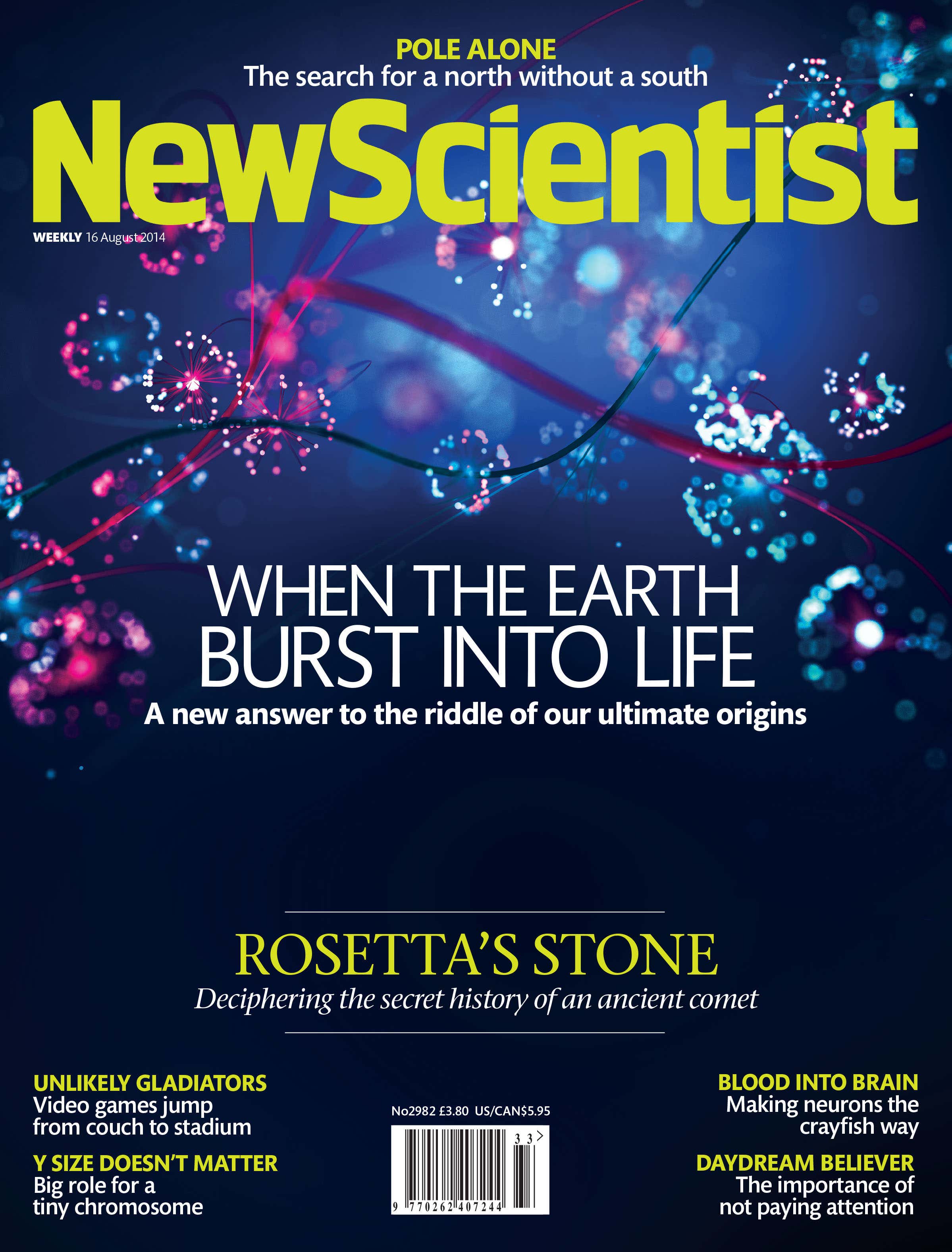
Issue no. 2982 published 16 August 2014

Sign up to our weekly newsletter

Receive a weekly dose of discovery in your inbox. We'll also keep you up to date with New Scientist events and special offers.

Sign up
Piano Exit Overlay Banner Mobile Piano Exit Overlay Banner Desktop