Subscribe now

Letters archive

Join the conversation in New Scientist's Letters section, where readers can share their thoughts and opinions on articles and see responses from experts and enthusiasts across a range of science topics. To submit a letter, please see our terms and email letters@newscientist.com


22 October 2014

Multiple trade-offs

From Paul Turnbull

Rowan Hooper's interesting feature on the multiverse (27 September, p 32) has left me confused and distressed. If I believe in the multiverse, every time something annoying happens to me such as missing a train or stubbing my toe, am I to blame the luckier version of me in another universe? Also being a good, …
22 October 2014

Multiple trade-offs

From Don Andrews

I read with great interest the article about the existence of the multiverse, but still find it rather difficult to believe. Since reading it, I have decided to toss a coin every day to decide whether to relieve myself at work or wait until I get home. Does this mean that every time I toss …

22 October 2014

Multiple trade-offs

From Hazel Findlay

It was courageous of Rowan Hooper to venture into the rarified atmosphere inhabited by quantum physicists and to interpret for the rest of us what at times can seem outright fruitloopery. However, I am left with a picture of theoretical physicist Don Page's supposedly Christian God as some sort of megalomanic maths genius hell-bent on …

22 October 2014

Multiple trade-offs

From W

Surely decisions that hive off a new universe must ultimately derive from the sort of quantum event that decides the fate of Schrödinger's cat, and are rare. Free will aside, the choice of whether to tuck into a sticky bun, for example, will be based on whether you are hungry, gluttonous or sweet-toothed, but not …

22 October 2014

Scare of the dog

From Geof Butterwick

Helen Thompson's article on uncovering the identity of an infant, "Little Albert", who was conditioned to fear animals gives a fascinating insight into one of psychology's murkier corners (4 October, p 10) . But given his reported fear of animals as an adult, if he was indeed William Albert Barger, am I alone in questioning …

22 October 2014

Tied up in knots

From Mark Dennis

I read with interest Leonie Mueck's article on creating and studying knots in various physical systems (4 October, p 42) . This included the work of the groups of William Irvine and Slobodan Zumer as well as my own. However, I feel I should point out that our 2010 paper on creating optical knots was …

22 October 2014

Tied up in knots

From Emil Kucera

Leonie Mueck writes that the stability of knots in light and liquid crystals "makes them promising candidates for creating a long-term, durable way of storing information". They are not the only candidates for this. The ancient Incas had quipus, knotted strings that were used to record everything from taxes to calendar dates. Apparently the Incas …

22 October 2014

Small print

From Charlie Davis

In her article on the future of 3D printing, Aviva Rutkin suggests that cost and difficulty of use are dissuading businesses and individuals from purchasing printers (4 October, p 22) . But the cost of the cheapest 3D printers is no more than that of a desktop computer or a photocopier. Arguably the usefulness of …

22 October 2014

Monkeying around

From Steve Snow

Catherine Brahic writes that chimpanzees in Uganda have learned to use moss to sponge up drinking water after copying one innovative member of the group (4 October, p 9) . She says that a decade ago it was believed only humans had the capacity to imitate in this way. But surely chimpanzees are known for …

22 October 2014

Material claims

From Peter Urben

Biodegradable plastics are more ancient than you credit in your special report on wonder materials ( 11 October, p 36 ). Modified cellulose has been researched much longer than "almost a century". The first thermoplastic, Parkesine, was patented in 1856. The same modification, nitration, had already given us the artificial fibre rayon, first described in …

22 October 2014

Material claims

From Martin Savage

The artwork accompanying your article on aerogels describes them as "solids lighter than air", but this is not borne out by the text. If an aerogel or nanofoam-type material could be made into a spherical shell, capable of supporting an airtight covering against a pressure of one atmosphere, you would have the "holy grail" of …

22 October 2014

Upturned world

From Victor Loughlin

Laura Spinney explores the idea of enactivism – that thinking and feeling arise from how we see and interact with the world (11 October, p 42) . This may help explain the difficulty some doctors have in learning to use an endoscope. When using this device to perform a colonoscopy, a patient is placed on …

22 October 2014

Pension extension

From Tony Williams

In Clare Wilson's article on life-extending drugs (4 October, p 6) , one consequence that wasn't mentioned was the impact on pensions. At present, people work for about 40 years and survive for about a further 15. If they were to live 10 years longer, that would be a 67 per cent increase in the …

22 October 2014

Change of tune

From Paul Goddard

Further to Judith Wallace's observations about sheep responding to her baby's cry (11 October, p 35) , I can add something of my own experience. The land surrounding our cottage on the Isle of Skye is often used for grazing. Once when I was practising on the soprano saxophone, all of the pregnant ewes moved …

22 October 2014

Meaningless lives

From Mike Belton

Nick Bostrom considers the challenge of preparing for artificial intelligence that is superior to us (5 July, p 26) . Why would we want to build such a computer? Surely one of the ways we give meaning to our lives is by searching for new knowledge. If you could find out anything you wanted to …

22 October 2014

Time warped

From Aris Papachristou

Searching through a pile of old New Scientist magazines, I came across Peter Nowak's article about smartphones and TVs with curved screens (31 May, p 24) . In the first paragraph, he says that "rumours continue to swirl that even Apple's forthcoming iPhone 6 will bend to the craze later this year". Given complaints about …

22 October 2014

For the record

• We have got wind of an error in our story about polar influences on the jet stream (4 October, p 16) : the Arctic melt peaks in September. • Status update: after recovering from his illness, Faustino the chimp rose back to beta male in his troop (11 October, p 28) . • We …

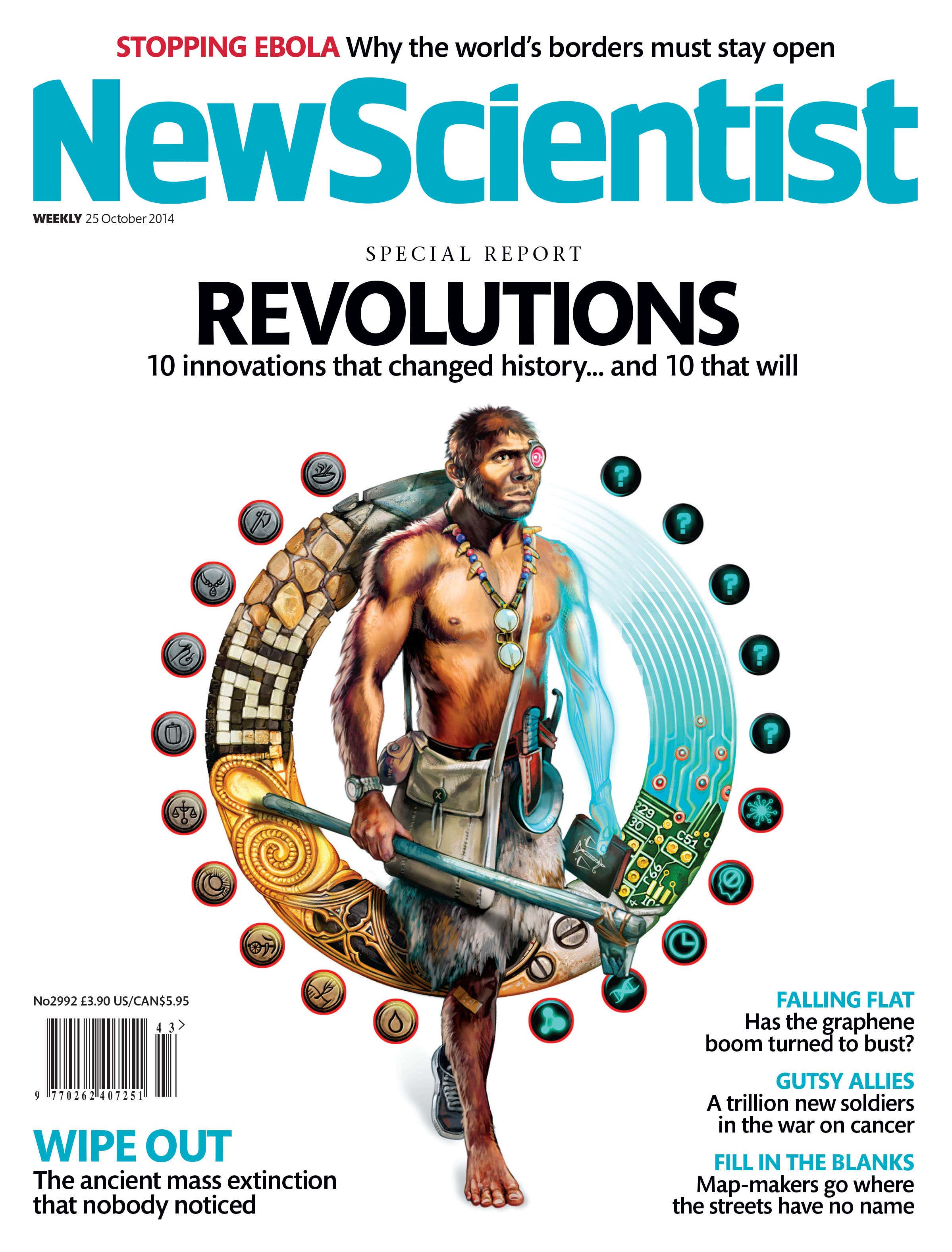
Issue no. 2992 published 25 October 2014

Sign up to our weekly newsletter

Receive a weekly dose of discovery in your inbox. We'll also keep you up to date with New Scientist events and special offers.

Sign up
Piano Exit Overlay Banner Mobile Piano Exit Overlay Banner Desktop