Subscribe now

Letters archive

Join the conversation in New Scientist's Letters section, where readers can share their thoughts and opinions on articles and see responses from experts and enthusiasts across a range of science topics. To submit a letter, please see our terms and email letters@newscientist.com


29 October 2014

If voting changed...

From Guy Cox

Laurence Steinberg presents some very interesting results on voting age and decision-making (11 October, p 30) . But they are fatally compromised because, far from "thinking outside the box", as the headline says, he has defined an arbitrary box called adolescence to dwell inside. Adolescence is a modern construct, less than 100 years old. A …

29 October 2014

If voting changed...

From Phil Maguire

Steinberg says that because the "cold cognition" of adolescents is, by 16, likely to be as mature as that of adults, they should be allowed to vote. I would argue, though, that democracy has less to do with sampling the collective wisdom of the populace and more to do with ensuring the continued diversification of …

29 October 2014

If voting changed...

From Ella Taylor-Smith

Considerations around setting appropriate voting ages need to include the role of voting in creating democratic societies, as well as young people's decision-making faculties. Voting may increase young people's stake in the system, stimulating their further involvement, as well as encouraging politicians to prioritise young people's views and needs in policy-making. Edinburgh, UK

29 October 2014

Tax e-vasion

From Bryn Glover

I read Hal Hodson's article on e-citizenship (18 October, p 24) and your editorial (p 5) with a chill running down my spine. I am aware of the growing movement away from physical nations and geographical citizenship, but one of the most important functions of a nation state is to ensure that the poorest and …

29 October 2014

Fishing Chagos

From Matt Richmond

How the marine protected area (MPA) in the British Indian Ocean Territory came about reads like the makings of a thriller, as described by Fred Pearce (27 September, p 26) . The significance and future value of protecting such vast areas of coral reef and associated marine habitat cannot be overstated. But the rights of …

29 October 2014

Define crime

From Andreas Keller

The "pro-surveillance mantra" you mention – "if you have nothing to hide, you've got nothing to worry about" – is indeed stupid (11 October, p 5) . Governments can redefine what constitutes a crime, and may say this includes holding a certain opinion or belonging to a certain minority. Where I live, 70 years ago …

29 October 2014

Virtual inversion

From Aidan Karley

Laura Spinney writes about perception changes while wearing various types of inverting goggles (11 October, p 42) . I wonder how experiments in this area will change as high-definition virtual-reality headsets like the Oculus Rift become more widely available. For example, "perception" could be switched in an instant, without framing cues; or one eye could …

29 October 2014

Virtual inversion

From Ted Webber

What the article did not mention is that our single-lens ocular system normally and always inverts the image on our retinas. If our sense of up and down depended only on the physical orientation of the retinal image, we would think we were walking on the ceiling. This surely is the most potent reason to …

29 October 2014

Virtual inversion

From Terence Hollingworth

The article calls to mind my daily experience. On first trying on spectacles with progressive lenses, which have a gradient of lens strength, it is difficult to make sense of the tumbling, tilting view of the world, with stairs appearing to move as you look down at them. For most, this soon settles down: the …

29 October 2014

Turbocharge all

From Nathaniel Hellerstein

I approve of Michael Le Page's "Turbocharge our plants" plan to introduce improved photosynthesis genes not only into our food crops, but into wild plants as well (4 October, p 26) . Of course such manipulation will leave chaos in its wake, but that's a given. This is the Anthropocene age; we might as well …
29 October 2014

Survivor tactics

From Eric Kvaalen

There is one group of people who can do a lot to help stop Ebola (18 October, p 10) . They are the survivors. About 50 per cent of those who get the disease survive, and they are then, as far as is known, immune. They should be recruited to take care of those who …

29 October 2014

Mulled multiverse

From Heimo Posamentier

For the last 45 years I have regularly read astrophysics articles, rarely understanding more than 10 per cent, but always fascinated. Now I read that in any game of quantum Russian roulette I would continue to breathe in one universe (27 September, p 32) . Surely this would apply to other potentially fatal situations – …

29 October 2014

Editor's reply to "Mulled multiverse"

• Max Tegmark, who popularised quantum Russian roulette a couple of decades ago, says the thought experiment wouldn't confer immortality on any versions of you, because people don't die as the result of a quantum fluctuation. A gradual death does not, he says, prompt universes to fork. Sorry.

29 October 2014

Plane crazy?

From Russell Jeffords

New Scientist has acclaimed the idea of pilotless planes (9 August, p 30) . Thoughtful attention to the issue of cosmic rays (4 October, p 12) should ground these proposals. What would be the fate of a pilotless plane that experienced data errors due to cosmic rays, as Quantas flight QF72 did in 2008 when …

29 October 2014

Too hot to handle

From Bill Robinson

Discussing waffle-like grids of matter in neutron stars (11 October, p 11) , Hal Hodson mentions that they occurred when a simulated star was "a million times hotter than the sun". Our star has a complex structure with many different temperatures. Do you mean the photosphere, the coronasphere or the core? Slough, Berkshire, UK

29 October 2014

Editor's reply to "Too hot to handle"

• The researchers report a temperature of 1.16 × 10 10 kelvin: two million times our sun's surface temperature of 5778 kelvin. For the purposes of the story, "a million times" conveyed "really very hot".

29 October 2014

Power struggle

From Richard Keyworth

You report that the Sunflower solar collector "should be able to provide 12 kilowatts of electricity and 20 kilowatts of heat from 10 hours of sun" (4 October, p 19) . Is that 12 and 20 kilowatt-hours of energy in a 10-hour sunny day, or 12 and 20 kilowatts of power for 10 sunny hours, …

29 October 2014

Editor's reply to "Power struggle"

• The latter. The Sunflower will generate this power while the sun shines. In the regions of the world in which Airlight hopes to sell the device, it expects 10 hours of sufficient sunshine each day.

29 October 2014

Code cognition

From Brian Wood

Your article on kids coding is the most exciting thing I have read in a long time (6 September, p 38) . At 79, I suggest that such initiatives would benefit the elderly too. I am currently a volunteer in a programme at the Glasgow University Memory Clinic looking at the effect of age on …

29 October 2014

Flipped universe

From Phil Clapham

While my unschooled self secretly thinks that the many-worlds interpretation of quantum physics (27 September, p 32) is patently ridiculous, I'm happy that the piece of toast that my doppelgänger just dropped on the floor in another universe landed buttered side up. Seattle, Washington, US

29 October 2014

For the record

• We should have located Alan Fridlund, who worked on finding research subject "Little Albert", at the University of California, Santa Barbara (4 October, p 10) . • In our account of topological insulators, on one occasion we called them topical insulators (11 October, p 38) . Doh.

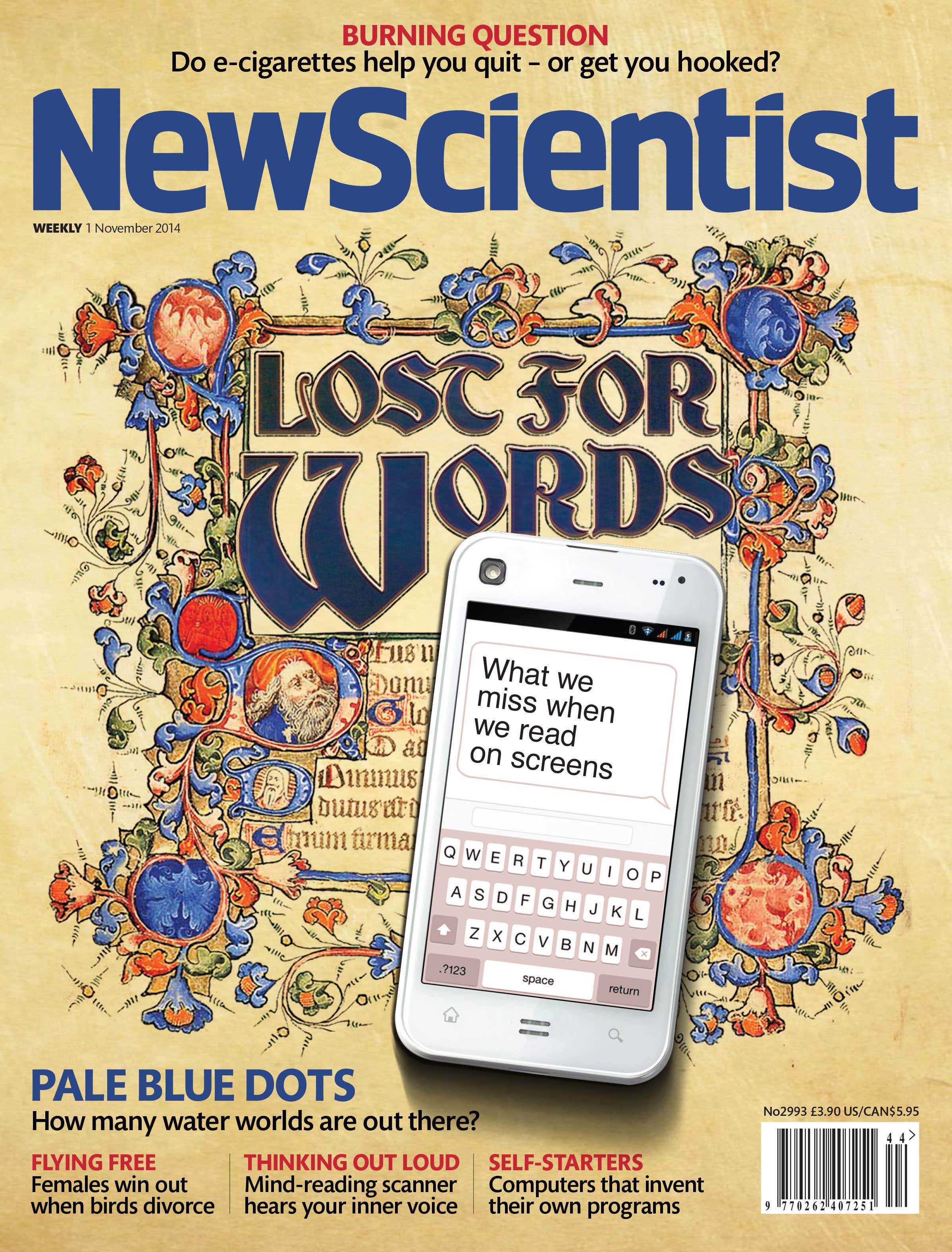
Issue no. 2993 published 1 November 2014

Sign up to our weekly newsletter

Receive a weekly dose of discovery in your inbox. We'll also keep you up to date with New Scientist events and special offers.

Sign up
Piano Exit Overlay Banner Mobile Piano Exit Overlay Banner Desktop