Subscribe now

Letters archive

Join the conversation in New Scientist's Letters section, where readers can share their thoughts and opinions on articles and see responses from experts and enthusiasts across a range of science topics. To submit a letter, please see our terms and email letters@newscientist.com


5 November 2014

Climate war

From Harold Caplan

The US Department of Defense (DoD) report calling on all of us to work together to combat the threat of climate change is a welcome departure from previous secret policies (18 October, p 6) . This openness is a good sign amid preparation for the crucial UN Climate Change Conference ( COP21) due to start …
5 November 2014

Climate war

From J

It was encouraging to read that the US military is starting to wake up to the threat of climate change. But in typical military fashion, the responses you reported were mostly addressing the symptoms of climate change, with a view to maintaining their capacity for business (or warfare) as usual. How might the situation look …

5 November 2014

Fuel for thought

From Roger Manser

In considering how economies could have arisen without fossil fuels, Michael Le Page underestimates the large role played over the past 300 years by steel (18 October, p 34) . Without the economic surplus from fossil fuel use since the Industrial Revolution, as a resident of the lower Thames, UK, I would probably now be …

5 November 2014

Fuel for thought

From Michael Berkson

In addition to our massive reliance on fossil fuels as an energy source, there is another aspect that is mentioned in your article but not explored. Fossil fuels, and particularly oil, are an essential feedstock for the chemical industry. The first synthetic dyes depended on precursors derived from coal. Nowadays, petrochemical-derived products are essential for …

5 November 2014

Fuel for thought

From Aidan Karley

Michael Le Page writes that airships would depend on hydrogen, because "helium is derived from natural gas". Current helium storage is strongly associated with natural gas technology, it is true. However, this is largely because of the presence of geological trapping structures, where the gas is caught and naturally concentrated. Even without the development of …

5 November 2014

Good health for all

From Margaret Kettlewell

Harvey Rubin and Nicholas Saidel point out that inadequate organisation of health services around the world could come back to bite us, possibly through Ebola or a more infectious future microorganism (25 October, p 26) . There is a good analogy in history. In Victorian Britain, urban slums were not only eyesores and terrible places …

5 November 2014

A month of Sundays

From Eric Kvaalen

In his list of revolutionary human ideas, Colin Barras includes lunar calendars, implying these allowed people to plan for seasonal events (25 October, p 32) . But the lunar calendar is not much good for this. It has an error of plus-or-minus 15 days compared with the seasons, and you have to calibrate it by …

5 November 2014

Life or death

From Carol Petherick

Clare Wilson opens her article on trapping cancer cells in the body with a statement implying that death is the worst possible outcome for those with the disease (27 September, p 39) . Having seen the suffering experienced by family members and friends with cancer and discussed their feelings with them, this is plainly wrong. …

5 November 2014

Editor's reply to "Life or death"

• Considering good palliative care over gruelling treatment is an important issue in healthcare, and one explored by surgeon Atul Gawande in our recent interview (18 October, p 30) .

5 November 2014

Against the tide

From Sandy Kennedy

Michael Slezak calls attention to the difficulty Polynesian groups would have encountered sailing eastwards across the Pacific, against the south-east trade wind (4 October, p 12) . This difficulty is well illustrated by the sufferings of the crew of the Nantucket whale ship Essex , which was holed by a sperm whale and sank in …

5 November 2014

Lot of Tosh

From James Richards

In discussing how to deliver electricity to the world without sending carbon emissions soaring, Fred Pearce writes that "the test case is rural India" (25 October, p 12) . From my experience of rural India I would say that this is not a representative case. The parts that have recently been connected to the grid …

5 November 2014

Flights of fancy

From Larry Stoter

Should personal air vehicles ever become anything more than a rich person's toy (25 October, p 19) , which I very much doubt, I do not understand why anybody would claim them as a solution to road congestion, except to sell the idea to government. As road building in the UK demonstrates, increased capacity only …

5 November 2014

Body canvas

From Erik Foxcroft

In Catherine Brahic's article on the oldest hand stencil yet discovered, dating from 40,000 years ago, Paul Pettitt speculates that early humans may have realised that they could represent three dimensional objects using two dimensional outlines (11 October, p 10) . Two issues later, Colin Barras identifies the significance of cosmetics in human development, with …

5 November 2014

Calculated question

From John Dobson

Mike Belton asks "if you could find out anything you wanted to know by typing a question into a page on the internet, would there be any meaning to our lives any more?" (25 October, p 31) . I put this question to my computer. It hasn't completed its investigations yet, but I suspect it …

5 November 2014

For the record

• In our article on disrupting the blood-brain barrier, the area stimulated by ultrasound measured 1 by 5 centimetres (22 October, p 14) . • The rule of law fell short in our article on human innovation (25 October, p 32) . The earliest recorded legal codes that we know of date from 4400 years …

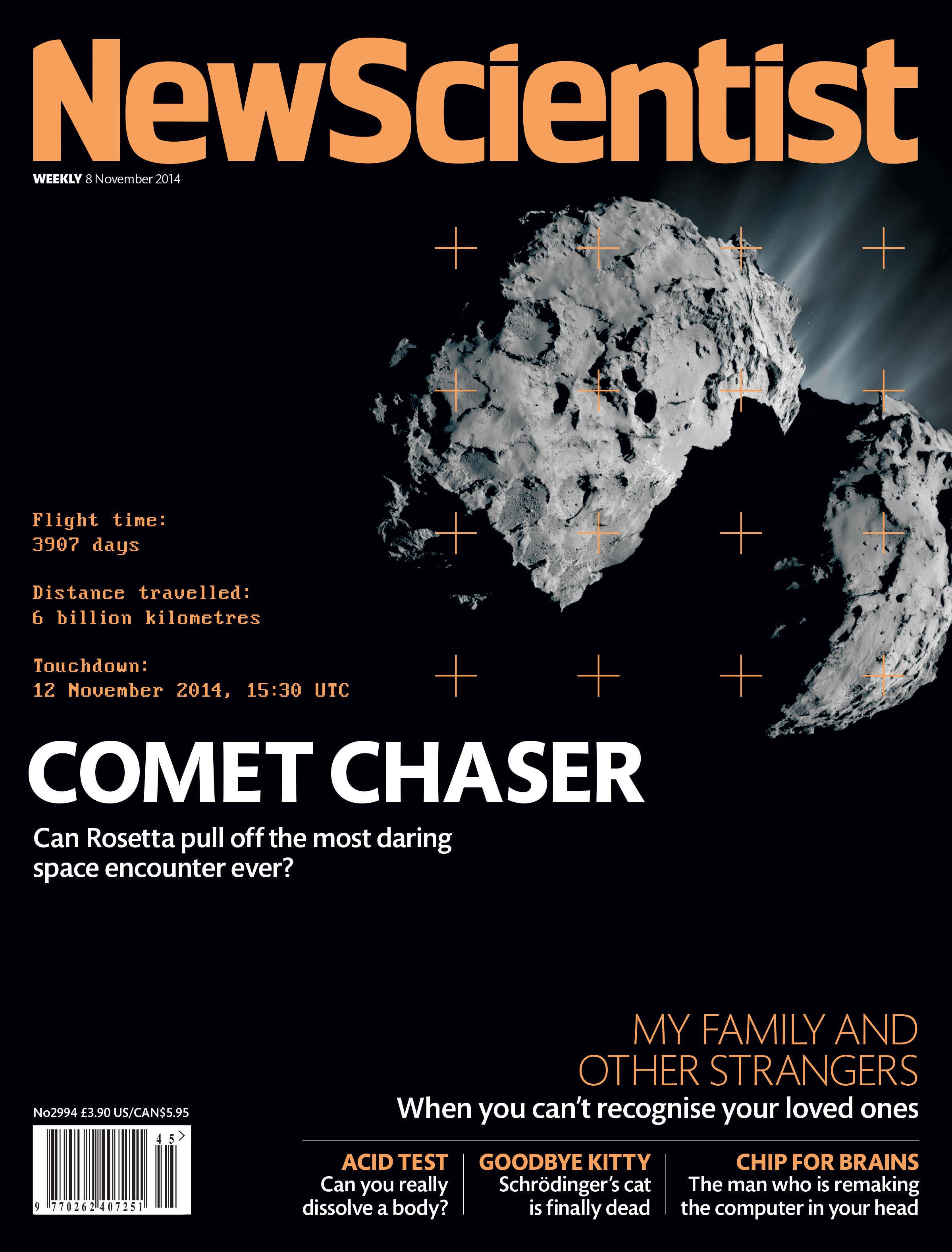
Issue no. 2994 published 8 November 2014

Sign up to our weekly newsletter

Receive a weekly dose of discovery in your inbox. We'll also keep you up to date with New Scientist events and special offers.

Sign up
Piano Exit Overlay Banner Mobile Piano Exit Overlay Banner Desktop