Subscribe now

Letters archive

Join the conversation in New Scientist's Letters section, where readers can share their thoughts and opinions on articles and see responses from experts and enthusiasts across a range of science topics. To submit a letter, please see our terms and email letters@newscientist.com


30 December 2014

All work and no pay

From Bryn Glover

Your thoughtful and thought-provoking editorial on the place of robotic workers in society left me wondering about the precise motivations of roboticists (6 December 2014, p 5) . Is it a simple desire to make a lot of money, irrespective of consequences? If so, a simple and direct opposition to their development can be mounted. …
30 December 2014

Packing for Europa

From Roger Calvert

You report that the only way for your proposed Europa CubeSat probe to send data home is to await the arrival of the larger Europa Clipper spacecraft (6 December 2014, p 42) . But how powerful a transmitter could be packed into a CubeSat if nothing else was there? Perhaps a second CubeSat could follow …

30 December 2014

Packing for Europa

From Tim Sassoon

I agree that searching for life on Europa should be an urgent priority, but I wonder why we don't try to investigate the inner workings of a body covered in unstable ice by listening to it. We might do this from very far away using lasers, similar to the way that one can eavesdrop on …

30 December 2014

Laser treatment

From Howard Medhurst

Douglas Heingartner writes about the development of a laser for blasting leaves off railway tracks (6 December 2014, p 23) . But where does the reflected light go? A piece of litter on the rail, say the reflective foil from a chocolate bar, could send it anywhere, and a laser beam powerful enough to destroy …

30 December 2014

Editor's reply to "Laser treatment"

• The laser is housed in a box underneath the train that safely contains the light. Details are available in this online report: bit.ly/LaserThor .

30 December 2014

American work

From David Flint

John Davnall asks whether 200 million people would be sufficient to produce all the products and services needed for a North American lifestyle (6 December 2014, p 32) . It does, of course, depend which North Americans he has in mind. Mexican farm workers and Texan oil barons have very different lifestyles but let's suppose …

30 December 2014

Pluto has airs

From Jay Pasachoff

Your article about the birth of habitable moons in astronomic collisions states that "previous studies suggest that a world must be at least a fifth of Earth's mass to sustain an atmosphere" (22 November 2014, p 19) . But I and my students and colleagues at Williams College and the Massachusetts Institute of Technology, as …

30 December 2014

Pluto has airs

From The editor replies

• Our anthropocentrism got the better of us. We should have said "a breathable atmosphere".

30 December 2014

Basic science

From Donald Haarmann

Erwin Vermeij discusses criminal attempts to dissolve bodies in acid (5 November 2014, p 44) . It's worth noting that Santiago Meza Lopez, also known as "El Pozolero" (the soup maker), is believed to have disposed of 300 bodies for Mexican drug cartels by placing them in barrels and adding a strong solution of sodium …

30 December 2014

Walk first, then run

From Michael Guppy

Christine Duffill questions whether running and walking at the same speed burn the same number of calories (6 December 2014, p 32) . On flat ground, the oxygen consumption of someone running at 8 kilometres an hour is the same as someone walking at the same speed. I'd suggest the situation would be similar at …

30 December 2014

Beaver fever

From Colin Bargery

Further to your article on the reintroduction of the European beaver (6 December 2014, p 26) , for some years there has been a colony of beavers living and seemingly breeding on the river Otter in Devon. This has delighted local people, but the Department for Environment, Food and Rural Affairs (Defra) has raised concerns …

30 December 2014

Guardians of the net

From Gwydion Williams

When it comes to abuse online, it seems the problem is that the police have too few people to cover it, while internet companies have little desire to police their own customers (13 December 2014, p 20) . So why not call for volunteers? People already volunteer to be special constables in the UK; they …

30 December 2014

The third degree

From John King

I read Alice Bows-Larkin's defence of the 2 °C global climate target with interest, and with dismay (6 December 2014, p 28) . Dismay because it totally fails to understand the nature of politicians. Australia's current prime minister, a Rhodes scholar at the University of Oxford, came to power saying on record that he thinks …

30 December 2014

Safe fusion

From John Evans

Any discussion of the radiological dangers or otherwise of tritium (20/27 December 2014, p 43) must involve context and quantity. The remark "not to be treated lightly" is the key, and one only has to look at the environmental concerns about tritium emissions from the Canadian Candu reactors to see that potential dangers exist. Although …

30 December 2014

Imagine that

From John Knutson

I thoroughly enjoyed Anil Ananthaswamy's article on how to think about higher dimensions (13 December 2014, p 32) . I'm not a mathematician, but maybe extra dimensions are like imaginary numbers – not real, but necessary for things to work. Winchester, Hampshire, UK

30 December 2014

Radical oxygen

From Peter Urben

It is certainly true that iron is the commonest mediator of free-radical production (6 December 2014, p 38) . But we should bear in mind iron is only the catalyst, the ultimate driver is oxygen. The potentially carcinogenic properties of this element have hitherto been sorely overlooked, although you can be sure that, should you …

30 December 2014

For the record

• We should have mentioned that Fred Pearce's trip to the mangrove forests of Aceh was funded by Wetlands International (20/27 December 2014, p 9) .

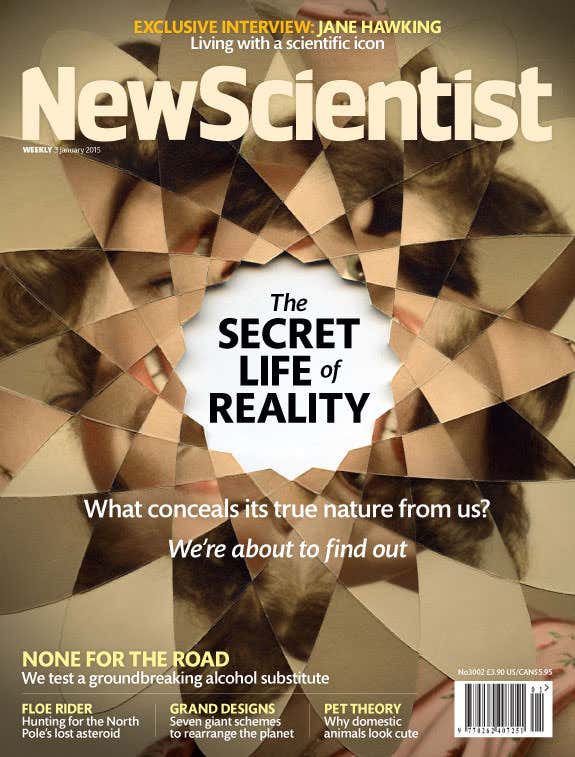
Issue no. 3002 published 3 January 2015

Sign up to our weekly newsletter

Receive a weekly dose of discovery in your inbox. We'll also keep you up to date with New Scientist events and special offers.

Sign up
Piano Exit Overlay Banner Mobile Piano Exit Overlay Banner Desktop