Subscribe now

Letters archive

Join the conversation in New Scientist's Letters section, where readers can share their thoughts and opinions on articles and see responses from experts and enthusiasts across a range of science topics. To submit a letter, please see our terms and email letters@newscientist.com


28 January 2015

Autism correction

From Penny Jackson

I was very disappointed with your article about a brain test to diagnose autism (6 December 2014, p 6) . Autism is not a "psychiatric illness". Such a term is grossly offensive to people with autism who are struggling to have it accepted as a different way of thinking, rather than simply a defect. In …
28 January 2015

Autism correction

From The editor replies

• Apologies. We should not have referred to autism as a psychiatric illness. In addition, we should have made clear that the focus of the study was on self-representation rather than emotion. These points have now been corrected in the online copy .

28 January 2015

Great adaptations

From Kimon Roussopoulos

Colin Barras considers whether adaptation helps evolution, but experts seem unsure whether this happens or matters (17 January, p 26) . Surely plasticity can enormously influence evolution with only an indirect link to heritability? Take your example of fish. Suppose the water dries up, but many fish survive marginally with the help of plasticity, long …

28 January 2015

Great adaptations

From Steve Morris

Reading Colin Barras's article on adaptation, I couldn't avoid the conclusion that there was more than a touch of "straw man" in this hypothesis. I can't see where the key difference is to separate it from what we have been teaching for years in evolution courses. The traits that allow plasticity in the first place …

28 January 2015

What time is it now?

From Ian Beaver

I enjoyed Laura Spinney's exploration of the perception of time (10 January, p 28) . We older people are commonly heard to complain that time seems to pass more quickly than when we were younger. I had presumed that this is due to life being increasingly routine, with fewer memorable moments in the near past …

28 January 2015

What time is it now?

From Jo Egerton

Questions of time are perennially fascinating, and Laura Spinney's article is no exception. As my mother's Alzheimer's progresses, her perception of passing time has expanded – something many people have observed in relation to the disease. Having shared a memory with me, 10 minutes later she may refer to it by saying, "As I told …

28 January 2015

What time is it now?

From Leighton Jones

Laura Spinney's article provides a neurological explanation for an interesting phenomenon observed in traffic collisions. Witnesses occasionally report, with certainty, that events occurred in an order that differs from reality. For example, they recall hearing a tyre burst, then the collision happening, when the physical evidence shows that the damage to the tyre was caused …

28 January 2015

Take a deep breath

From Martin Savage

Simon Thompson mentions that parachutists yawn before they leap (20/27 December 2014, p 38) . I'd imagine this has less to do with focusing on a task, and more to do with opening their Eustachian tubes in preparation for the imminent rapid change in air pressure. He also neglected to mention the main reason some …

28 January 2015

Australian fires

From Scott Southurst

You write that Australia has been hit by "the worst bush fires in 30 years", evidenced by the loss of 38 houses and more than 12,500 hectares of land to the flames (10 January, p 7) . But in February 2009 the Black Saturday fires in Victoria claimed 173 lives, with 414 people injured, and …

28 January 2015

Just say no

From Isobel Hutchinson

If chaperon's benefits in reducing alcohol consumption are to be proven, properly conducted human trials will undoubtedly be needed (3 January, p 8) . But suggesting that the drug should first be tested on rats is nothing short of absurd. Around 40 people have already tried the drug, so testing it on the wrong species …

28 January 2015

Giant snowballs

From Michael Berkson

Rather than pumping fresh water across the ocean, perhaps we should consider the ideas of a former Patent Office examiner named Arthur Pedrick (3 January, p 34) . He filed dozens of patent applications covering a wide variety of far-fetched inventions. With today's technology perhaps we should consider his patent GB 1203136 , which describes …

28 January 2015

Conscious at a guess

From Chris Britton

Ian Beaver's argument that machines could be considered conscious rests on the axiom that humans "are themselves calculating machines" (17 January, p 54) . But humans are definitely not calculating machines. When you catch a ball you do not calculate its trajectory; you guess it. When the ball is nearer, you guess again, hopefully better …

28 January 2015

Trapped wind

From Jon Richfield

Although I am no engineer, for decades I have proposed building submarine stores of pressurised air as a source of energy. I assure Steve Orchard that they could be large enough to power whole nations for days on end (15 November 2014, p 31) , that they store potential energy mainly by raising water and …

28 January 2015

Odds in favour

From Geoffrey Withington

The Monty Hall problem is a good example of the difficulties we have in understanding probability (13 December 2014, p 32) . The reason the notorious three-card scam works is likewise: most people simply aren't well versed in the mathematics of gambling. In this "game", a gullible passer-by is invited to see whether they can …

28 January 2015

Using your nut

From Lois Pryce

Intelligence is a slippery and elusive thing to define, as Anil Ananthaswamy's article on plant intelligence (6 December 2014, p 34) shows. However, in the context of living creatures I would define intelligence pragmatically as an appropriate, non-mechanical survival response to an ever-changing environment. This seems to cover the case for plants as well as …

28 January 2015

For the record

• Rats! It was these, not mice, walking the treadmill in Adam Foster's experiments into animal adaptation (17 January, p 26) . • A character defect appeared in our article on personality and health: we misspelled the name of immunologist Daniel Davis (24 January, p 10) .

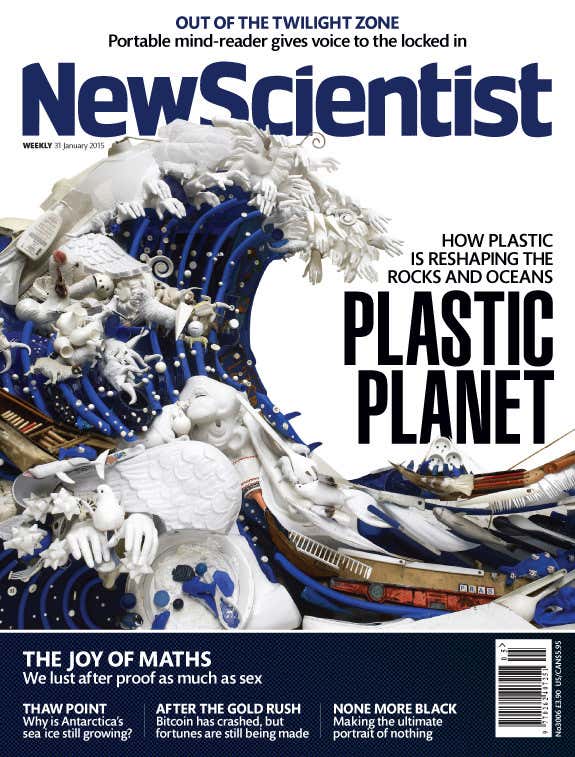
Issue no. 3006 published 31 January 2015

Sign up to our weekly newsletter

Receive a weekly dose of discovery in your inbox. We'll also keep you up to date with New Scientist events and special offers.

Sign up
Piano Exit Overlay Banner Mobile Piano Exit Overlay Banner Desktop