Subscribe now

Letters archive

Join the conversation in New Scientist's Letters section, where readers can share their thoughts and opinions on articles and see responses from experts and enthusiasts across a range of science topics. To submit a letter, please see our terms and email letters@newscientist.com


8 April 2015

Editor's pick: Antibiotic crisis long in the making

From John Hastings

Why has it taken so long for the "antibiotic apocalypse" (21 March, p 22) to get a hearing in policy-making circles? I started my training as a nurse in 1968. Though we did not have to learn about the biochemistry and pharmacology of antibiotics and of course did not prescribe any medications, we certainly learned …
8 April 2015

Laying ground rules for free will

From Carl Zetie

Randomness is not by itself sufficient to "admit free will" in an otherwise mechanical universe (14 March, p 28) . At a minimum, free will requires that the outputs of my brain are not completely determined by the inputs plus the initial state. This is unlike any other known physical system or law. Introducing randomness …

8 April 2015

Laying ground rules for free will

From Peter Abrahams

I suggest another definition of free will: that people have free will because they can make conscious decisions that can neither be predicted, with absolute certainty, by any other person nor be dictated, with absolute certainty, by another person. It is irrelevant that these decisions are made by our brains, which are part of the …

8 April 2015

Green spirits soar on coal bust

From Gerald Sutliff

Fred Pearce describes how a "coal bust" may be behind the stall in carbon emissions (21 March, p 16) . Thank you for publishing an item that keeps hope alive and gives we Greens cause to celebrate. Bakersfield, California, US

8 April 2015

Weekly social

"Nothing is certain – not even the uncertainty principle" Waseem Lone posts last month in response to "celestial signals that defy Einstein" (4 January 2014, p 30)

8 April 2015

Infinite planet and our false economy

From Liegh White

I am interested that Andy Haldane of the Bank of England now looks to several scientific "ologies" for guidance (28 March, p 28) . But your interview does not mention any questioning of the base assumption of the present economic system: namely that we inhabit a world of infinite resource in which pollution has no …

8 April 2015

Food fit for a Red Queen

From Justine Butler

Isotopes in dental enamel from the Red Lady of El Mirón revealed that 80 per cent of her diet was meat from hooved animals, the rest being fish, some starchy material, seeds and mushrooms (21 March, p 8) . You describe this as "the Paleo diet, for real". The Red Lady was, however, no ordinary …

8 April 2015

Perceptions of probability on trial

From Allan Reese

Regina Nuzzo gives a fair account of the conflicts between frequentist and Bayesian statistics (14 March, p 38) , and I agree with the conclusion that applied statisticians generally combine both approaches. The starting point of frequentist statistics – the "null hypothesis" with which results are compared – is generally a straw man. The anticipation …

8 April 2015

When charity goes wrong

From Bryn Glover

It is always depressing to read about humanity's apparent complete inability to learn from its own mistakes, and Simron Jit Singh's account of inappropriate disaster relief is a prime example. (21 March, p 34) . It reminds me of when the so-called EMI scanner was marketed in the early 1970s. Groups sprang up in the …

8 April 2015

Enceladus's mystery heater

From Chris Goldfrap

Saturn's moon Enceladus is getting attention as a possible venue for life. Last year you reported that "as Enceladus orbits Saturn, changes in the planet's gravitational pull flex the moon, but... a stiff rocky core would not flex enough to generate the heat necessary to melt the ice". But when researchers modelled a core "more …

8 April 2015

Enceladus's mystery heater

From The editor replies

• So would we, and we also look forward to finding out whether both reports are true, and how.

8 April 2015

Lights! Camera! Metamirror!

From Ernest Ager

Metamirrors that reflect face-on light at 45 degrees (14 March, p 16) are not quite new. Whenever an actor shaves or does their hair in a mirror, how do you think the camera (at an angle) manages to capture them face-on when they are shown apparently looking at themselves? Exmouth, Devon, UK

8 April 2015

For the record

• Flaring off 10 million cubic metres of methane gas will produce about 18,000 tonnes of carbon dioxide (28 March, p 20) . Letters should be sent to letters@newscientist.com

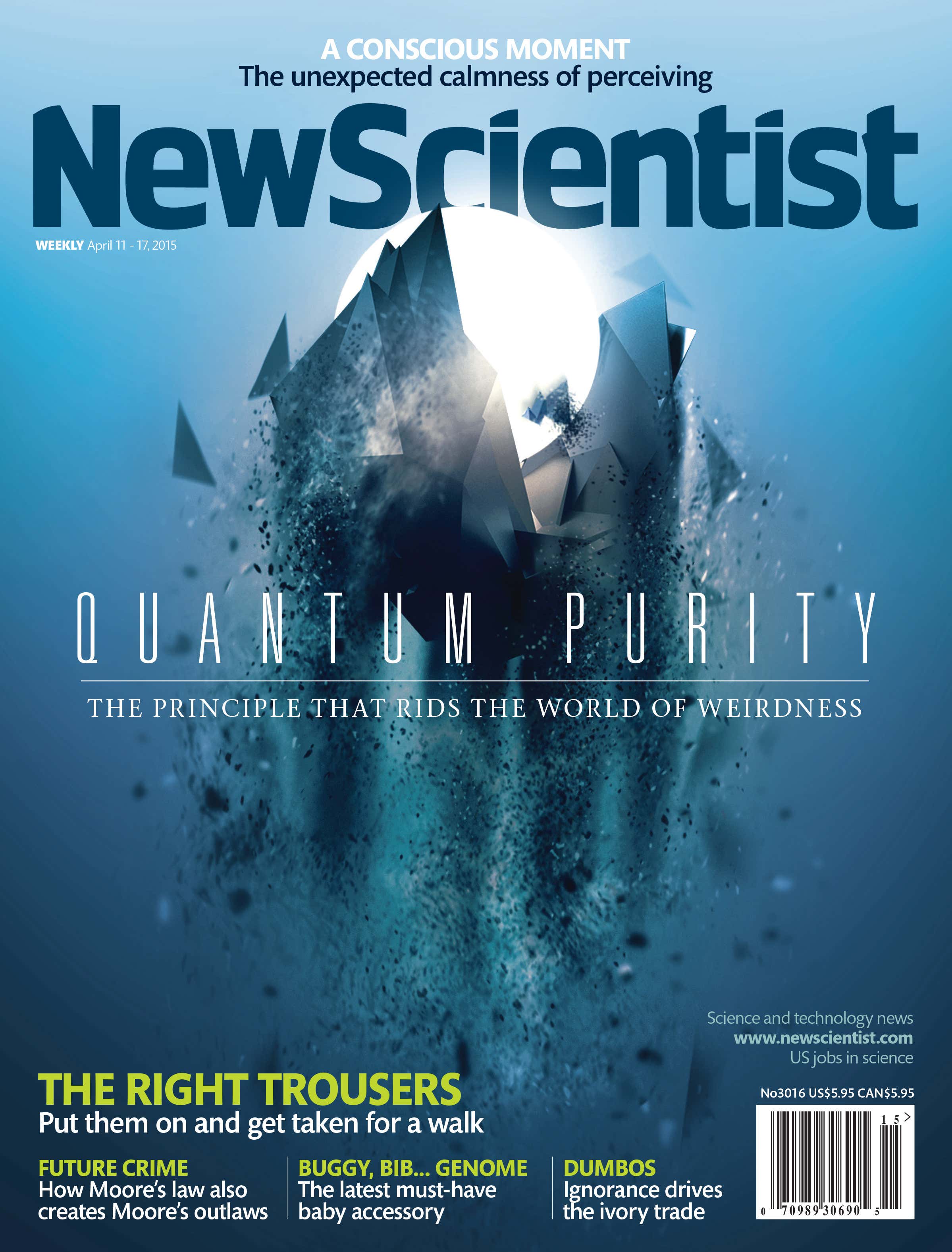
Issue no. 3016 published 11 April 2015

Sign up to our weekly newsletter

Receive a weekly dose of discovery in your inbox. We'll also keep you up to date with New Scientist events and special offers.

Sign up
Piano Exit Overlay Banner Mobile Piano Exit Overlay Banner Desktop