Subscribe now

Letters archive

Join the conversation in New Scientist's Letters section, where readers can share their thoughts and opinions on articles and see responses from experts and enthusiasts across a range of science topics. To submit a letter, please see our terms and email letters@newscientist.com


27 May 2015

Editor's pick: Put a selfishness tax on indulgence

From Gail Haslam Loose

I have noticed an increasing disparity in New Scientist between two themes: "save the planet" and "make humans happy at all costs". We moan and fret about global warming and overpopulation and in the next breath demand to live much longer lives and consume everything we want in nice convenient packaging. Now I read about …

27 May 2015

A universe not made for humans

From Nathaniel Hellerstein

Michael Slezak says that the universe is fine-tuned for life (2 May, p 32) . Balderdash. Inspection of the night sky reveals that the universe is almost entirely cryogenic pitch-black irradiated empty space, void of life, or indeed of anything much. To a high order of approximation, the universe resembles a vacuum. The universe isn't …

27 May 2015

A universe not made for humans

From Lawrence D

When considering whether our universe is fine-tuned for life, we need to consider all the possible physical parameters that go into defining a universe. Think of them arrayed in a multi-dimensional space of all possible universes, with our universe occupying one point in that space. Our universe lies within a subset of the larger space, …

27 May 2015

First class post

I think I've spotted a flaw in the 'secret' part of 'secret plane' Gav tweets about our report of the Boeing X-37B launch (23 May, p 7)

27 May 2015

Is humanity to be defended against?

From Virginia Strauss

Anders Sandberg of the University of Oxford's Future of Humanity Institute feels that "If we think we are the only life in the universe, we have a huge responsibility to spread life to the stars" (2 May, p 37) . He supposes our presence here has been for the planet's long-term good – but has …

27 May 2015

Careful with that lab, Eugene

From John Marshall

Michael Brooks asks whether we could destroy the fabric of the cosmos (2 May, p 35) . Do we have here a solution to Fermi's paradox concerning the lack of signs of extraterrestrial life? If measuring and collapsing a fundamental quantum state destroys the measurer, then each civilisation would be the only life form in …

27 May 2015

A universo-centric view is needed

From Ian Flitcroft

The contributors to your group Leader "The universe is ours" mostly took an anthropocentric approach (2 May, p 5) . I suggest that as intelligent creatures we should adopt a loftier viewpoint – the universo-centric one. If the universe is to be colonised by an intelligent organism, what type of creature would be best suited …

27 May 2015

Seed banks are not nearly enough

From David Barnard

If we ever have to use seed banks to revive agriculture (see for example 3 January, p 23) , will we also need to revive pollinators from insect banks? Cholesbury, Buckinghamshire, UK

27 May 2015

Getting to the heart of ownership

From Dave McGlade

Mabs Taylor reminds us in her letter that the question "who owns the assets" is an interesting problem with head/body transplants (18 April) . What I find equally interesting is that no one considers it a relevant question for any other transplant. Southampton, Hampshire, UK

27 May 2015

Pricing happiness out of the market

From Constance Lever-Tracy

You featured two interesting opinion pieces side by side: Ha-Joon Chang's discussion of inequality (25 April, p 28) and Richard Layard's call for a measure of general well-being (GWB) to supplement that of gross domestic product, or GDP. Economic theory may seem to make the GWB redundant, since GDP is composed of market prices, and …
27 May 2015

People in the past were not stupid

From Rosemary Sharples

I was interested to read about an Anglo-Saxon remedy that could kill MRSA (4 April, p 14) but, as ever when I read such articles, I asked myself "why are people surprised that our ancestors found a solution to a problem?" Why do people think old ideas must be crazy? And why is it unexpected …

27 May 2015

More creatures of the crossing code

From Rod Cripps

I read with interest your article about smart chimps looking both ways before crossing a road (25 April, p 19) . We have a local family of four Australian magpies. They come for a feed of minced meat every morning. One morning, when the chicks were younger, one ran out onto the road. Mother magpie …

27 May 2015

Paracetamol as panacea or placebo

From Jennifer Hush

You mention that paracetamol "blunts emotions" (18 April, p 7) . For several years, on occasions when for no reason I felt negative, anxious or stressed, I would take two paracetamol. In 20 to 30 minutes I felt back to normal. I just assumed it was all in my head. Edinburgh, UK

27 May 2015

Robots are all tax avoiders

From Martin van Raay

David Gullen's letter has a point about the economy-destroying power of robots – even more than he states (25 April) . When you replace a tax-paying taxi driver with a driverless car, who is going to pay the unemployment benefit of the former driver? Robots don't pay taxes. Culemborg, The Netherlands

27 May 2015

For the record

• We should have said that Marshall Nirenberg and Heinrich Matthaei began to break the nucleic code using artificial RNA, made only of the base uracil, to make the peptide polyphenylalanine from the amino acid phenylalanine (2 May, p 46) .

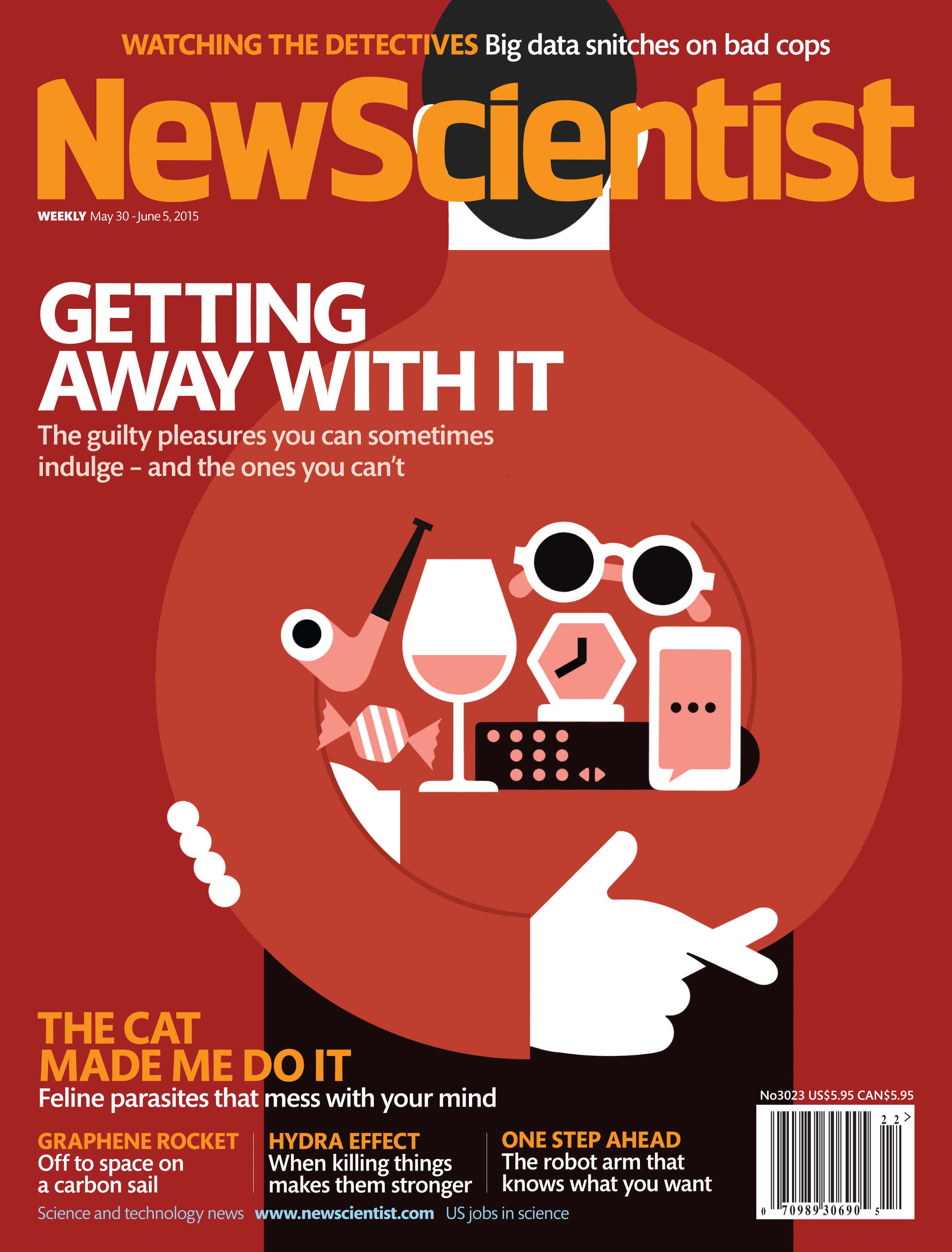
Issue no. 3023 published 30 May 2015

Sign up to our weekly newsletter

Receive a weekly dose of discovery in your inbox. We'll also keep you up to date with New Scientist events and special offers.

Sign up
Piano Exit Overlay Banner Mobile Piano Exit Overlay Banner Desktop