Subscribe now

Letters archive

Join the conversation in New Scientist's Letters section, where readers can share their thoughts and opinions on articles and see responses from experts and enthusiasts across a range of science topics. To submit a letter, please see our terms and email letters@newscientist.com


17 June 2015

Editor's pick: A long wave of innovative power

From Anton Fletcher

Reading about powering gadgets with Wi-Fi (6 June, p 18) reminded me of something similar from a very long time ago, when everybody listened to the radio as few could receive a television service. Investigators looking into a "blank spot" where long-wave (1500 metre) radio signal had been lost narrowed their search to a garden. …
17 June 2015

A Magna Carta for Mars, for whom?

From Anthony Castaldo

Andrea Maltman discusses a new bill of rights for space colonists (16 May, p 36) . For a right to have any meaning, society as a whole must agree it will collectively punish violators of the right, and defend those who exercise it. My right to free speech is meaningless if I can be threatened …

17 June 2015

A Magna Carta for Mars, for whom?

From Haydn Webb

We already have legal systems and United Nations agencies with remits to ensure that the zeal of spacefaring nations remains benign. They say that it is written that rights and sustainability should remain clear goals no matter how lucrative the heavens seem. Are we planning to trial any of these remits here on Earth any …

17 June 2015

A Magna Carta for Mars, for whom?

From Julius Wroblewski

Andrea Maltman drives home the truth that space exploration will entail difficulties beyond the mere medical. It is possible that, to paraphrase Bertolt Brecht , we will have to invent a new people. Could genetic technology create Homo spatialis , robust in body and mind and able to deal with the rigours of radiation, isolation …

17 June 2015

A Magna Carta for Mars, for whom?

From Adrian Ellis

In your article, Rhawn Joseph is quoted saying that "our cosmic biological destiny is to go forth and multiply." This isn't a scientific idea but a religious one, stated in Genesis 9:7 as part of God's covenant with Noah. It is woefully short-sighted. The destiny of a dominant, tool-using species that multiplies unchecked is ecological …

17 June 2015

Premonitions of a purple planet

From Carlo Gazzola

Various aspects of the ridiculous idea of humans travelling to Mars are regularly discussed (for example 30 May, p 27) , but I have rarely seen mention of the effect on the Red Planet itself. Presumably, for their own well-being, anyone who travels to Mars will do so with their full microbiome. So rather than …

17 June 2015

Meditation and mindful mayhem

From Andrew Jones

Your article discussing a dark side to mindfulness and meditation neglected to mention that in the traditions cited, if you wish to attain a stable peace, living a virtuous life is a vital component (16 May, p 28) . Right mindfulness is just one part of an eight-fold path advocated by the Buddha. One can …

17 June 2015

Meditation and mindful mayhem

From Robert Fizek

The meditation and mindfulness movement – like all movements – does suffer from some shallow interpretations, often based on egocentric and dualistic medical concepts. Both Buddhist and Hindu teachings point out the big problems with incomplete or unskillful instruction and practice. Both warn of the mental confusion and suffering that may arise. The ways to …

17 June 2015

To pop, or not to pop, that pill

From Mark Nelson

When you ask yourself "should I pop a pill?" the default answer should be no, unless certain conditions are met (16 May, p 30) . Pills need to provide benefit and have minimal risk of harm. Unfortunately, trial evidence is often garnered from middle-aged people despite the pills being given to elderly people who have …

17 June 2015

No monopoly on intolerance, sadly

From Richard Bending

Sanal Edamaruku gives a moving picture of the threats faced by those who stand up for rational thinking and freedom of speech in places where the prevailing culture is very different (23 May, p 24) . It is surely incorrect, though, to see this as primarily about religion versus rationalism. It isn't hard to find …

17 June 2015

The bright side of a brain infection

From Adrian Bowyer

A third of the human race is infected by Toxoplasma gondii , which is implicated in ills from schizophrenia to car accidents (30 May, p 42) . Its cysts are virtually indestructible in people. It reproduces only in cats. Surely the primary attack must be against that stage of its life cycle? I don't mean …

17 June 2015

Trickling down to community service

From Dawn Nelson

Ha-Joon Chang reminds us that trickle-down economics doesn't work, essentially because wealthy folks choose to keep their money to themselves (25 April, p 28) ; and Richard Layard that happiness is not strongly related to income – family and community matter more than money (p 28) . Perhaps we need creative and effective ways to …

17 June 2015

The wrong end of the ruminant

From Eric Kvaalen

Burping farm animals, not farting ones, are the cause of methane release (23 May, p 38) . The gas produced in their rumen exits their oesophagus. Les Essarts-le-Roi, France

17 June 2015

At video games, I'm the granddaddy

From Craig Sams

Clare Wilson says that "most action video games are too fast for older adults" (23 May, p 36) . Tripe. I am 70. My name ranks top at the Trocadero Piccadilly Circus arcade and at the Emirates Mall (bike racing); and in Bexhill (car racing). It's about practice, not age. Hastings, East Sussex, UK

17 June 2015

For the record

• We should have said that in the centuries of history of blood transfusions, thousands of people were infected with hepatitis C and HIV in the 1970s and 1980s (6 June, p 10) .

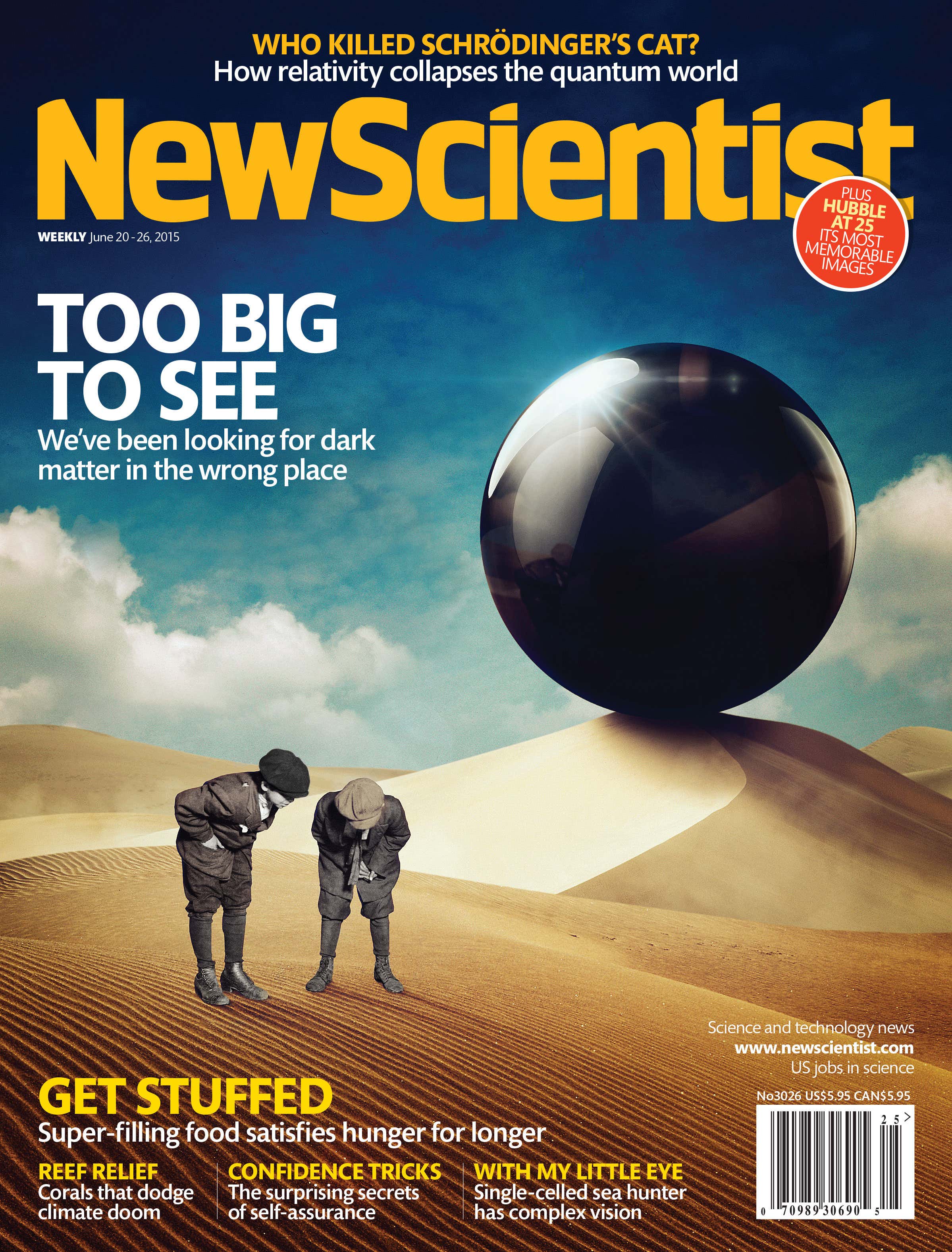
Issue no. 3026 published 20 June 2015

Sign up to our weekly newsletter

Receive a weekly dose of discovery in your inbox. We'll also keep you up to date with New Scientist events and special offers.

Sign up
Piano Exit Overlay Banner Mobile Piano Exit Overlay Banner Desktop