Subscribe now

Letters archive

Join the conversation in New Scientist's Letters section, where readers can share their thoughts and opinions on articles and see responses from experts and enthusiasts across a range of science topics. To submit a letter, please see our terms and email letters@newscientist.com


15 July 2015

Editor's pick: Diet, reductionism and desire

From Rosemary Sharples

Once again, scientists working on ways to make it easier for people to lose weight are concentrating entirely on appetite (20 June, p 14) as though this and hormones are the only factors involved in weight gain. Entirely ignored are the other reasons for eating, which include habit (it's 11 am and therefore time for …
15 July 2015

Editor's pick: Diet, reductionism and desire

From Jan Horton

I don't eat because I am hungry, I eat because I like eating, but only if it is food I enjoy. Anti-obesity scientists seem to miss this point. For me, tasty food is the solution to all of life's problems (except, unfortunately, being fat). And eating something I like stops me worrying about that too. …

15 July 2015

When wind wins lower prices

From Rowland McDonnell

I am surprised that Michael Grubb's article on wind power subsidy and energy policy (4 July, p 24) didn't mention how subsidising wind power cuts electricity bills, as explained in New Scientist (24 July 2010, p 24) . When wind power is available, it drives down the electricity spot price. This gives lower bills than …

15 July 2015

First class post

In an effort to feel human I have gone outside with a blanket and New Scientist Alison Atkin tweets her response to a beautiful summer afternoon

15 July 2015

Terpenes are good, trees are better

From Griselda Mussett

Mike Moore's work on the benefits of plants for humans will be welcomed by tree-huggers everywhere (27 June, p 26) . A recent study involving 2623 children in Barcelona, Spain, showed that those in schools with lots of greenery had improved cognitive function – specifically improved working memory and attention ( PNAS , vol 112, …

15 July 2015

Few women among our ancestors?

From Liegh White

Given a 13:1 male:female ratio, no wonder it took 40,000 years for our forebears to lay the foundations of modern Europe. That is the ratio I count in the illustration to your article on the three tribes that founded Western civilisation (4 July, p 28) . Keyworth, Nottinghamshire, UK

15 July 2015

Suspect sexual statistics sussed

From Andy Couldwell

Alongside your article on how females can be just as competitive and aggressive as males about reproduction, you highlight a claim that the average number of sexual partners in a lifetime is 12 for men but only 8 for women (27 June, p 34) . If the average is the arithmetic mean then, if we …

15 July 2015

Suspect sexual statistics sussed

From John Darlington

What I find so surprising about these statistics isn't their absurd impossibility: it is that they are so wholeheartedly believed, defended and repeated. I put this statistic to a number of men and women, who invariably said "Obviously. Everyone knows men are more immoral than women." Men concur with a certain amount of pride, whereas …

15 July 2015

A cosmos filled with phlogiston?

From Alan Wells

In your leader you ask "How long can we keep looking for dark matter?" (20 June, p 5) . The search for dark matter reminds me of the obsolete phlogiston theory, in which anomalies of weight led to the positing of phlogiston as a substance released whenever anything burned. Then Joseph Priestley discovered oxygen, and …

15 July 2015

A cosmos filled with phlogiston?

From Joe Martinez

Perhaps the question "how long can we keep looking for dark matter?" was answered in one of your articles last year (28 June 2014, p 32) . We typically make an assumption that the universe is homogeneous and isotropic – that is, that it looks roughly the same in all locations and roughly the same …

15 July 2015

It's not only dogs' noses that know

From Isobel Thrilling

Liz Bestic reports on dogs sniffing out cancer (4 July, p 34) . They aren't alone. I had half a lung excised due to lung cancer in 2004. It was diagnosed by a young Polish doctor, a locum, who visited me at home and smelled something wrong on my breath. I had no specific symptoms …

15 July 2015

Green doubts

From John Hunwick

In seeking to answer "how can we best protect nature in an increasingly crowded world?" Fred Pearce proposes a limited dichotomy (20 June, p 26) . He offers the choice between living sustainably within nature or embracing a range of new technologies. In my view, humans are faced with different choices: we can live within …

15 July 2015

Autopsies must be revived for safety

From James Bird

The virtual disappearance of the autopsy indeed poses a significant threat to the quality of medical care (20 Jun, p 6) . Many studies show that clinical diagnoses are wrong in up to half of cases; and in between a tenth and a quarter of these cases the patient received the wrong treatment. Surely this …

15 July 2015

Health hacking not just hypochondria

From Steve Haines

At first sight the "health hacking" apps that you report seem perfect for hypochondriacs (4 July, p 18) . But it has been demonstrated that those who have a greater sense of control in their lives have better health. So the sense of personal control offered by such an app could itself achieve better health. …

15 July 2015

Through a glass, ultravioletly

From Henry Johnston

Colin Brown asks your Last Word column whether he can get the full benefit of vitamin D from sunshine through glass (13 June) . When I was a small boy in Edinburgh in the early 1920s my mother had Vitaglass fitted to our huge west-facing nursery windows – she understood this was the only way …

15 July 2015

For the record

• Comet again? Cinzia Fantinati is the German Aerospace Centre's operations manager for the comet lander, Philae (27 June, p 25) . The European Space Agency controls the Rosetta mothership. • Our focus may have slipped in our illustration of the orbits of Pluto and other planets (13 June, p 30) . The sun should …

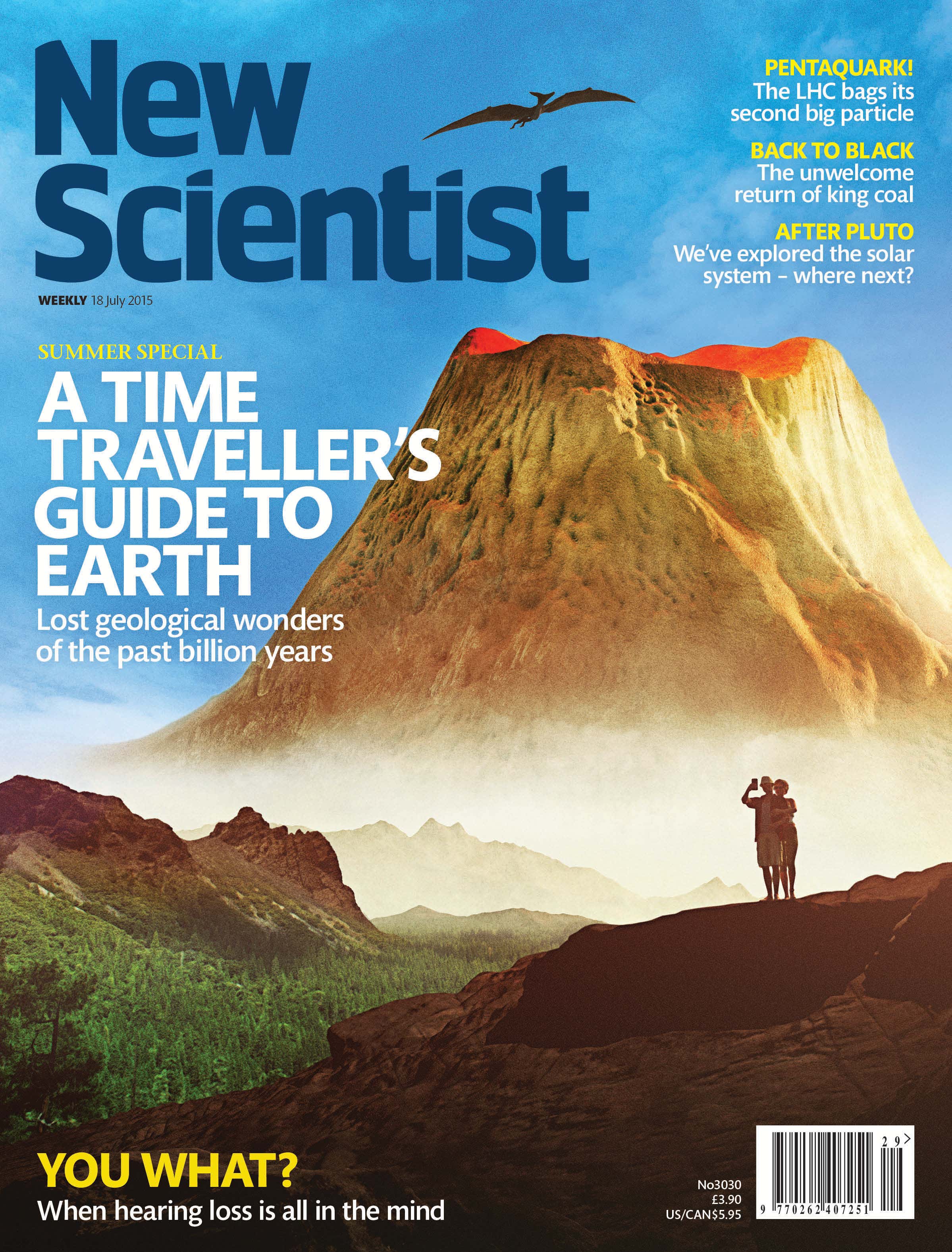
Issue no. 3030 published 18 July 2015

Sign up to our weekly newsletter

Receive a weekly dose of discovery in your inbox. We'll also keep you up to date with New Scientist events and special offers.

Sign up
Piano Exit Overlay Banner Mobile Piano Exit Overlay Banner Desktop