Subscribe now

Letters archive

Join the conversation in New Scientist's Letters section, where readers can share their thoughts and opinions on articles and see responses from experts and enthusiasts across a range of science topics. To submit a letter, please see our terms and email letters@newscientist.com


7 October 2015

Editor's pick: Artificial arbiters will never work

From Emma Fox Wilson

Ariel Procaccia's proposal that artificial intelligences should help resolve disputes ( 22 August, p 27 ) is one of the scariest things I have ever read. He wants to base this on economics, on the grounds that "a lot of work has been done on how to formalise, in mathematical terms, what fairness means" and …

7 October 2015

Consciousness, illusion and agency

From Andy Howe

When I pondered mathematical problems in my youth, my brain would sometimes take me on a ride, rushing me through the final stages to a solution. I would then have to backtrack consciously to check it through. With rose-tinted spectacles, I remember this only leading me to correct solutions, but there probably were misfires, too. …

7 October 2015

Consciousness, illusion and agency

From Pushkar Piggott

I was particularly struck by how Halligan and Oakley's ideas fit with the concept of responsibility. The conscious self is not in direct control of every little action yet, socially, it is held responsible for those actions. Compare this with the notion of responsibility in government. Ministers are held responsible for the actions of their …

7 October 2015

Consciousness, illusion and agency

From Ray Thompson

I'm reminded of Graham Lawton's observation that humans tend to seek "agents" with purpose ( 4 April, p 28 ). There is a survival advantage in always being on the lookout for the causes of things that happen around you. Could consciousness be a constructed "agent" explaining one's own unconscious actions as things that occur …

7 October 2015

Consciousness, illusion and agency

From Frank Siegrist

Anthony Castaldo takes issue with the idea that consciousness should be linked to language ( Letter, 12 September ). He brings up the example of his dog consciously reasoning that it should "ask" to be let out (to avoid making a mess on the carpet and angering its master, I suppose). I agree that dogs …

7 October 2015

First class post

What is needed is the maximum number of people participating in an economy, driving growth Michael Knight tries to inject some economic reality into Facebook responses to a "living wage" ( 3 October, p 28 )

7 October 2015

Invasion of the killer squid

From Gerald Legg

I was intrigued to read Michael Tennesen's report on Humboldt squid ( 12 September, p 32 ). What must be a fear is their potential spread from the Eastern Pacific into the Caribbean Sea and the Atlantic and Indian oceans. One voracious predator that is already having a powerful influence on coastal marine ecosystems is …

7 October 2015

A sequel to the great land grab

From Richard Vandewetering

Martin Pratt correctly praises the non-violent process used to divide up the Arctic seabed ( 29 August, p 24 ). His nonchalance about the fact that what was once "unowned" will now be split between three already wealthy states is, however, a bit distressing. Few people recognise that the process of dividing up the seas …

7 October 2015

The universe has freedom, if not will

From Nathaniel Hellerstein

John Clark asked for a definition of free will ( Letter, 5 September ). Here are three: self-control, self-determination, self-causation. Freedom, being self-caused, is neither random (uncaused) nor deterministic (externally caused). Since causal loops pervade all living processes, it follows that all life possesses free will, to at least some extent. And if everything in …
7 October 2015

The universe has freedom, if not will

From Anthony Castaldo

I agree with Clark that the known laws of physics seem to rule out free will, but I disagree with his implication that they are definitive. The issue in which his letter appears has "10 questions physicists can't answer" on the cover. I would add that physicists cannot explain dark matter, dark energy and, even …

7 October 2015

Here's one that I invented earlier

From Brian Oswald

Paul Marks's article on "Eureka machines" ( 29 August, p 32 ) that can produce inventions was very interesting, but I was surprised to see no mention of the theory of inventive problem-solving, also known as TRIZ. This was originally based on analysis of Russian patent literature, deriving 40 principles allowing a problem formulated in …

7 October 2015

Here's one that I invented earlier

From Alan Wells

Working as a patent professional, I likely dealt with algorithmically generated inventions, mainly in the field of pharmaceuticals. But the art of patent examination involves judgement not just on the objective problem but also on the nature of a person of "ordinary skill" to whom the claimed innovation would be non-obvious. I assume case law …

7 October 2015

Human origins as a dense network

From Steve Blyth

I look forward to the dating of the Homo naledi fossils discovered in South Africa ( 12 September, p 8 ). I hope, too, that surviving DNA fragments may yield data on lineages. I wonder whether the fossils may be of more than one hominin species, with cross-breeding – as seems to have happened between …

7 October 2015

Enough with the godswollop

From Connaire Kensit

Bryn Glover (Letter, 5 September ), like Alan Webb ( 4 April ), trots out that old Aunt Sally: the atheist whose "axiom that there is no god" is based on faith, not evidence. Redefining the word "atheist" to mean nothing but this mythical beast, rather than real godless folk like me and my parents …

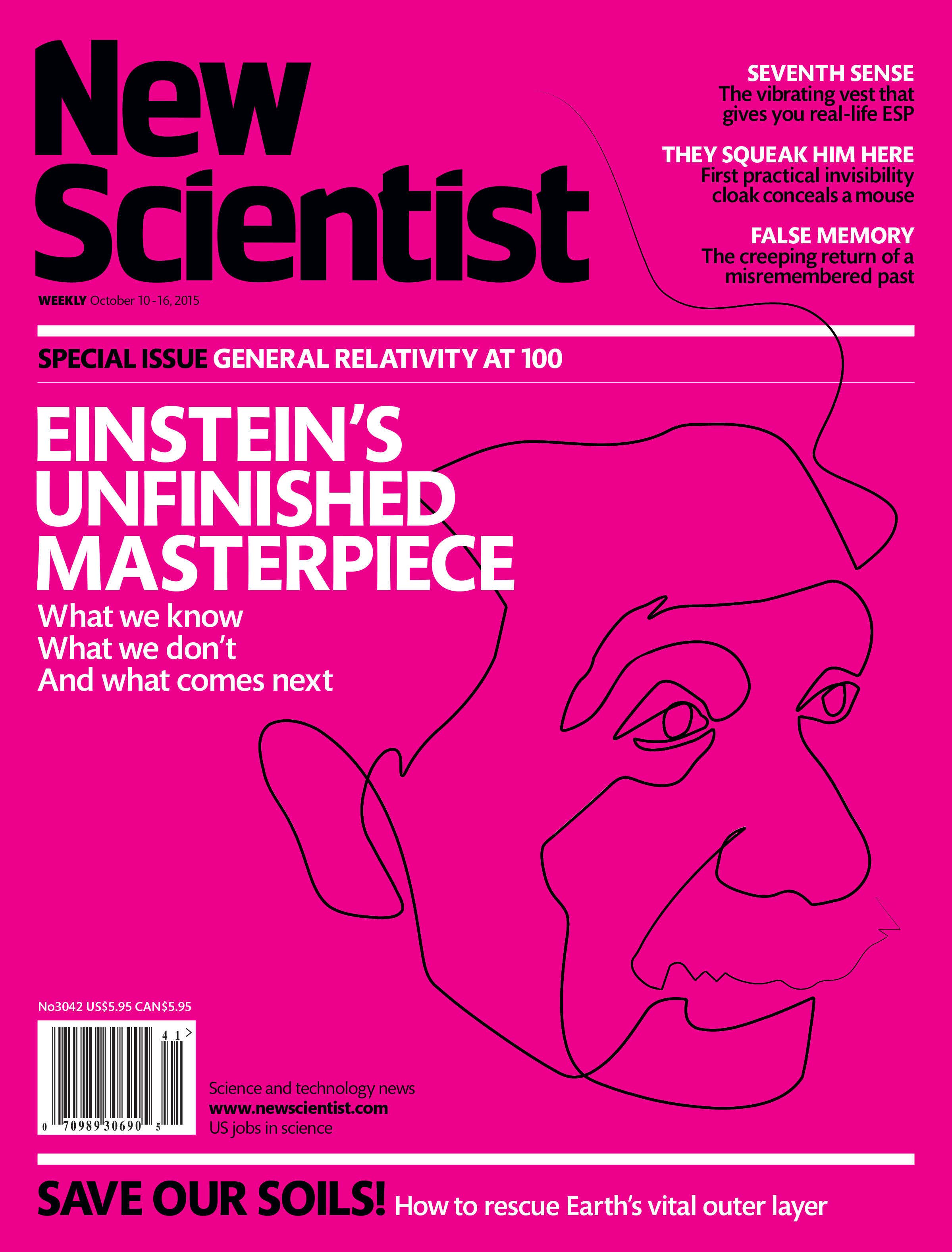
Issue no. 3042 published 10 October 2015

Sign up to our weekly newsletter

Receive a weekly dose of discovery in your inbox. We'll also keep you up to date with New Scientist events and special offers.

Sign up
Piano Exit Overlay Banner Mobile Piano Exit Overlay Banner Desktop