Subscribe now

Letters archive

Join the conversation in New Scientist's Letters section, where readers can share their thoughts and opinions on articles and see responses from experts and enthusiasts across a range of science topics. To submit a letter, please see our terms and email letters@newscientist.com


14 October 2015

Editor's pick: More than one way to slice odds

David Deutsch rightly points out that the conventional view of probability – that it is the frequency with which a phenomenon is observed – is very seldom of any real use ( 3 October, p 30 ). There are many situations in which we can talk quite meaningfully about probabilities, for which there cannot possibly …
14 October 2015

Is it qualia all the way down?

From Ed Subitzky

Michael Slezak poses the tantalising question, "If time does not flow, what makes us think it does?" ( 5 September, p 30 ). The answer to this question may not lie in physics, but in neuroscience or even in philosophy. For aeons, both scientists and philosophers have tried to get to grips with what they …

14 October 2015

First class post

So much for David Cameron's pledge to make his the greenest government yet Rebekah Mayne responds on Facebook to our report that the UK government could face a lawsuit over climate failures ( 10 October, p 6 )

14 October 2015

The roots of consciousness

From Guy Cox

Paul Mealing writes "For plants, conscious feelings would have no benefit. What's the point of experiencing fear or pain if one can't avoid its source?" (Letters, 19 September ). But that is an animal-based view. Plants respond rapidly and vigorously to attacks, whether wounds or infection. And some plants move fast – think of the …

14 October 2015

The roots of consciousness

From John Hastings

In all New Scientist articles on consciousness I have read, I cannot recall any mention of its role in learning and teaching. As a lecturer, I had to put conscious thought into preparation of my teaching plans and I had to be conscious in order to deliver a lecture. Equally, the students had to pay …

14 October 2015

Hive mentality or blockchain bloat?

From Eric Davidson

Thank you for an excellent article on how the blockchain mechanism could be used in a variety of applications ( 12 September, p 18 ). But the blockchain records will expand as transactions are added, especially when they are replicated on all the systems they are used on. How will they be archived? Dollar, Clackmannanshire, …

14 October 2015

Hive mentality or blockchain bloat?

From Donald Windsor

Blockchains seem to mimic with proof of ownership what social insects do with proof of membership. After all these millennia of suffering from top-down despotism, we humans seem finally to be able to attain a hive mentality. Norwich, New York, US

14 October 2015

The runaway train problem, again

From Alec Cawley

Why is anyone surprised by the response to the runaway train problem ( 26 September, p 36 )? The first solution, of throwing a human off the bridge, requires reframing a human as a useful mass. It is this reframing, not the throwing of the mass in the path of the train, which is abhorrent. …

14 October 2015

The runaway train problem, again

From Martin Greenwood

Unrealistic questions are likely to produce unrealistic answers. Unless one is an employee of the railway company, it is implausible that one could ever know enough to decide that changing a set of points (a switch in US parlance) might save lives. And it is even more implausible that tossing a person, no matter how …

14 October 2015

Liberate mavericks to be creative

From Bruce Denness

Donald Braben recognises that a key obstacle to creative research is the use of peer review as the gold standard for deciding what gets funded ( 12 September, p 24 ). Peer review does achieve mediocrity more efficiently. Most of us could identify one or more scientific mavericks, not all of them academics. I suggest …

14 October 2015

Liberate mavericks to be creative

From Terence Hollingworth

Braben asserts that we must either find an alternative to capitalism or "ensure we have an adequate flow of technological change" to meet capitalism's demand for incessant growth. The former is the only option. Continual growth is an impossibility. Let's have progress, scientific and intellectual, that would mean valuing equilibrium, not growth, and working towards …

14 October 2015

Dark matter that goes 'bonggg'?

From Andy Howe

Thank you for the fascinating postulate that dark matter might be clumps of quarks, "as dense as neutron stars", and that a teaspoon of them would weigh "as much as a mountain" ( 22 August, p 28 ). What happens, however, if one of these macro-particles happens to pass through the NAUTILUS gravitational wave detector's …

14 October 2015

Editor's reply to "Dark matter that goes 'bonggg'?"

• The researchers tell us that macros massive enough to have such an effect are predicted to be so rare that we'd have to wait billions of years to "see" one; those arriving more frequently would have much smaller masses.

14 October 2015

My own personal earworm triggers

From Paul Dormer

Ed Hannah reports looking for things that can trigger earworms (Letters, 12 September ). This reminds me of having The Ballad of Robin Hood in my head on moving to a new office. I'd not heard it for about 20 years. My office was close to a stairwell. Whenever someone used it, the closing door …

14 October 2015

This is where the universe began

From Graham King

Like many, I thoroughly enjoy reading your articles on big scientific questions, particularly in cosmology ( 5 September, p 30 ). One thing we can categorically state about the big bang is we know where it happened: here. Matcham, New South Wales, Australia

14 October 2015

No metal, no cry

From Richard West

Your report that most nearby planets in habitable zones probably have less iron and other metals than Earth ( 19 September, p 17 ) may explain the absence of other technological civilisations in our galaxy. With few metals it would surely be difficult for any intelligent life to proceed beyond a stone age. Perhaps we …

14 October 2015

For the record

• Our review of A Prehistory of the Cloud degraded slightly: JPEG image files commonly degrade when saved ( 5 September, p 45) . • A current of 1 amp is in fact 6.24150934×10¹⁸ electrons per second ( 3 October, p 38 ).

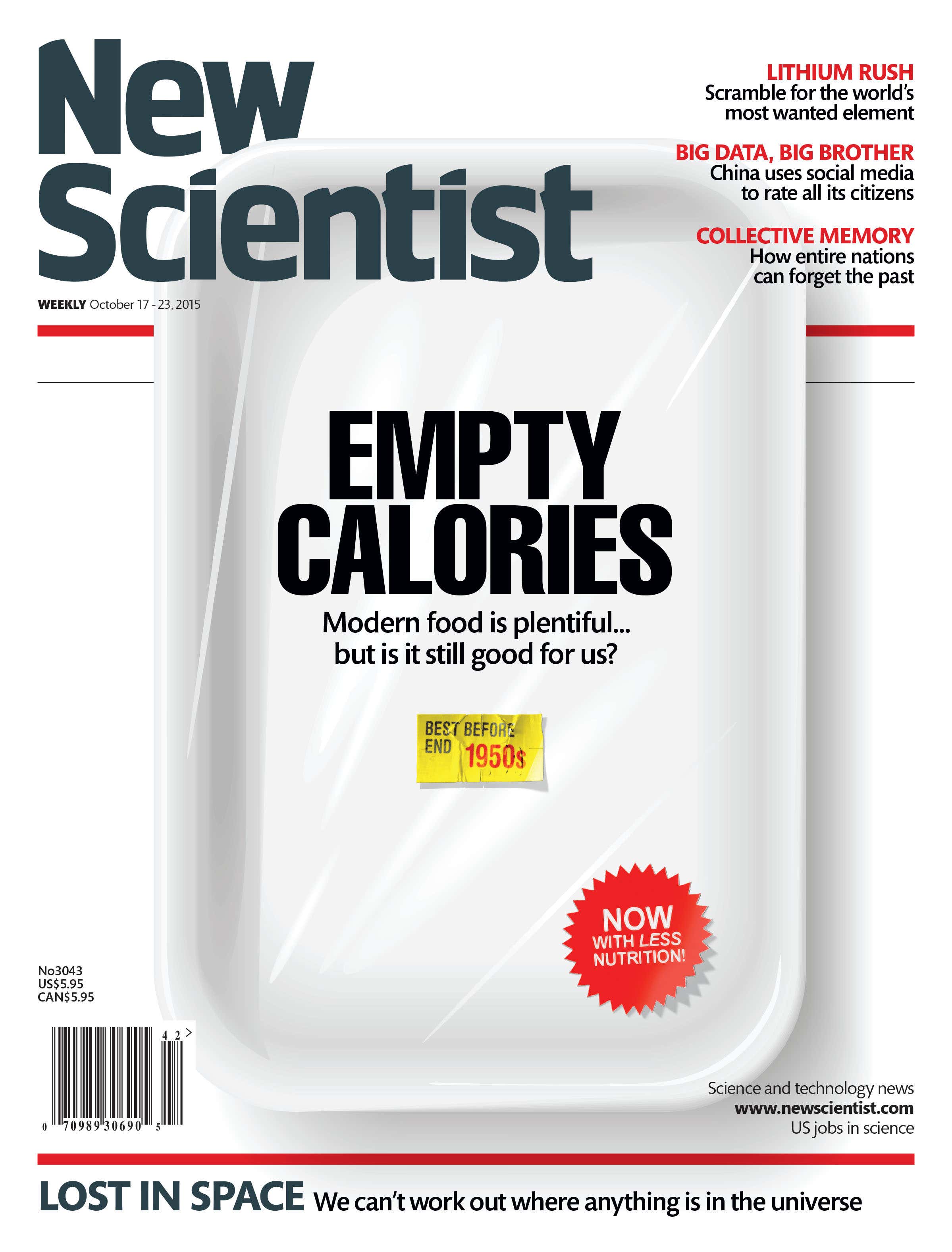
Issue no. 3043 published 17 October 2015

Sign up to our weekly newsletter

Receive a weekly dose of discovery in your inbox. We'll also keep you up to date with New Scientist events and special offers.

Sign up
Piano Exit Overlay Banner Mobile Piano Exit Overlay Banner Desktop