Subscribe now

Letters archive

Join the conversation in New Scientist's Letters section, where readers can share their thoughts and opinions on articles and see responses from experts and enthusiasts across a range of science topics. To submit a letter, please see our terms and email letters@newscientist.com


13 January 2016

Editor's pick: Existence in a complex cosmos

From Oliver and Lucy Arditi

Mary-Jane Rubenstein offers a fascinating discussion of the historical relationship between theology and cosmology ( 19/26 December 2015, p 64 ). But her opening premise is that the universe being suited to life presents us with some kind of dilemma: almost any other set of cosmic properties would be inimical to life, so how did …
13 January 2016

Waves of bearded science fashion

From Martin Bide

Your article on beard fashions ( 19/26 December 2015, p 67 ) was particularly interesting. I teach a colour science course, including a brief summary of the science of light, with slides showing portraits of famous figures who have contributed. I invite students who might otherwise lose interest to consider the change in facial hairstyles …

13 January 2016

First class post

If they escape to the wild, will they form dyes in surface waters, disrupting the food chain? Sandra Knuteson ponders possible downsides of growing dyestuffs in microbes ( 9 January, p 18 ) .

13 January 2016

Saving soil from scientism

From Charles Merfield

While I fully agree with your leader article on the need for better science education ( 12 December 2015, p 5 ), I am concerned that an uncritical approach will increase scientism. For example, my field is agriculture. In mainstream farming, the value system demands maximising yield and profit. Organic agriculture has values of sustainability, …

13 January 2016

What exactly is your gut gas?

From Peter Urben

Your afflated correspondent appears to think that the sulphur in foods, possibly reappearing anally as hydrogen sulphide and other malodours, is present as sulphate compounds ( 19/26 December 2015, p 58 ). Were this the case, it would cause even more embarrassing problems. There are restrictions on sulphate in drinking water and its laxative effect …

13 January 2016

What exactly is your gut gas?

From Martin Greenwood

Was Kate Douglas too embarrassed to tell us the quantity of digestive greenhouse gas emissions per anus per annus ( 19/26 December 2015, p 58 )? Stirling, Western Australia

13 January 2016

Anthropocene nomenclature

From Jeff Harte

Robert Macfarlane's call for an Anthropocene glossary is timely ( 19/26 December 2015, p 82 ). The desecration of the planet is a real concern, among the younger generation in particular. This is reflected in The New Geography Dictionary published by the Geography Teachers' Association of New South Wales in Australia, which defines a "quoquake" …

13 January 2016

Dishwashers and dipping sheep

From Brian Horton

Arranging the dishes in a dishwasher in a circle is more effective than in a square (19/26 December 2015, p 62). But most dishwashers have a rectangular shape. The manufacturers have obviously not tried dipping sheep to eradicate lice. It is well known to those who have that round dips are far more effective than …

13 January 2016

The difficulty of teaching numeracy

From Mike Freeman

You quote Gerd Gigerenzer saying that children need to be taught uncertainty as well as the certainty of mathematics ( 12 December 2015, p 30 ). While developing my book The Doubtful Realities , I proposed a teacher able to answer arithmetic questions only with a question mark or a cross. To the question "what …

13 January 2016

Clarifying the sulphur forecast

From Guy Cox

Your Feedback column was recently seeking "Truly Horrible Ideas for Saving the Planet" ( 29 August ). Oliver Morton's book The Planet Remade is surely one. He proposes veiling the atmosphere with sulphur to stabilise global temperatures ( 12 December 2015, p 47 ). All forms of sulphur end up as sulphates, which reflect sunlight. …

13 January 2016

Editor's reply to "Clarifying the sulphur forecast"

• Oliver Morton clarifies that the amount of stratospheric sulphur envisaged is on the order of 1 per cent of current anthropogenic sulphur emissions. So the effect on acid rain would be marginal.

13 January 2016

Sunflowers don't turn to the sun

From Graham Worthington

You quote naturalist Scott Weidensaul saying "like sunflowers, always turn to face the sun so their backs are always in the shade" ( 19/26 December 2015, p 53 ). Once the buds have opened, sunflowers all face east and do not move . Broad Hinton, Wiltshire, UK

13 January 2016

A singular quantum achievement

From Brian Reffin Smith

I've been waiting for someone to celebrate your breakthrough in quantum lexical representation ( 14 November 2015, p 14 ): "...a trick in which the photon seem to be in two different states at once." Perfect. Personally, I think all the different things is one. Berlin, Germany

13 January 2016

There is no longer a law against suicide

From Tony Richards

I am surprised and disappointed to see a journal as respected as New Scientist still referring to people in the UK "committing" suicide ( newscientist.com/article/dn28634 ). To prefix "suicide" with "commit" is to imply a criminal offence. It has not been an offence in England and Wales since 1961 and never was in Scotland. Banbury, …

13 January 2016

For the record

• The name of the performer who entertained cabaret audiences as Le Pétomane was Joseph Pujol ( 19/26 December 2015, p 58 ). • Don't get lost in cyberspace: to trace the path of your data on a Macintosh or Unix-flavoured computer, type the command traceroute into the terminal window ( 12 December 2015, p …

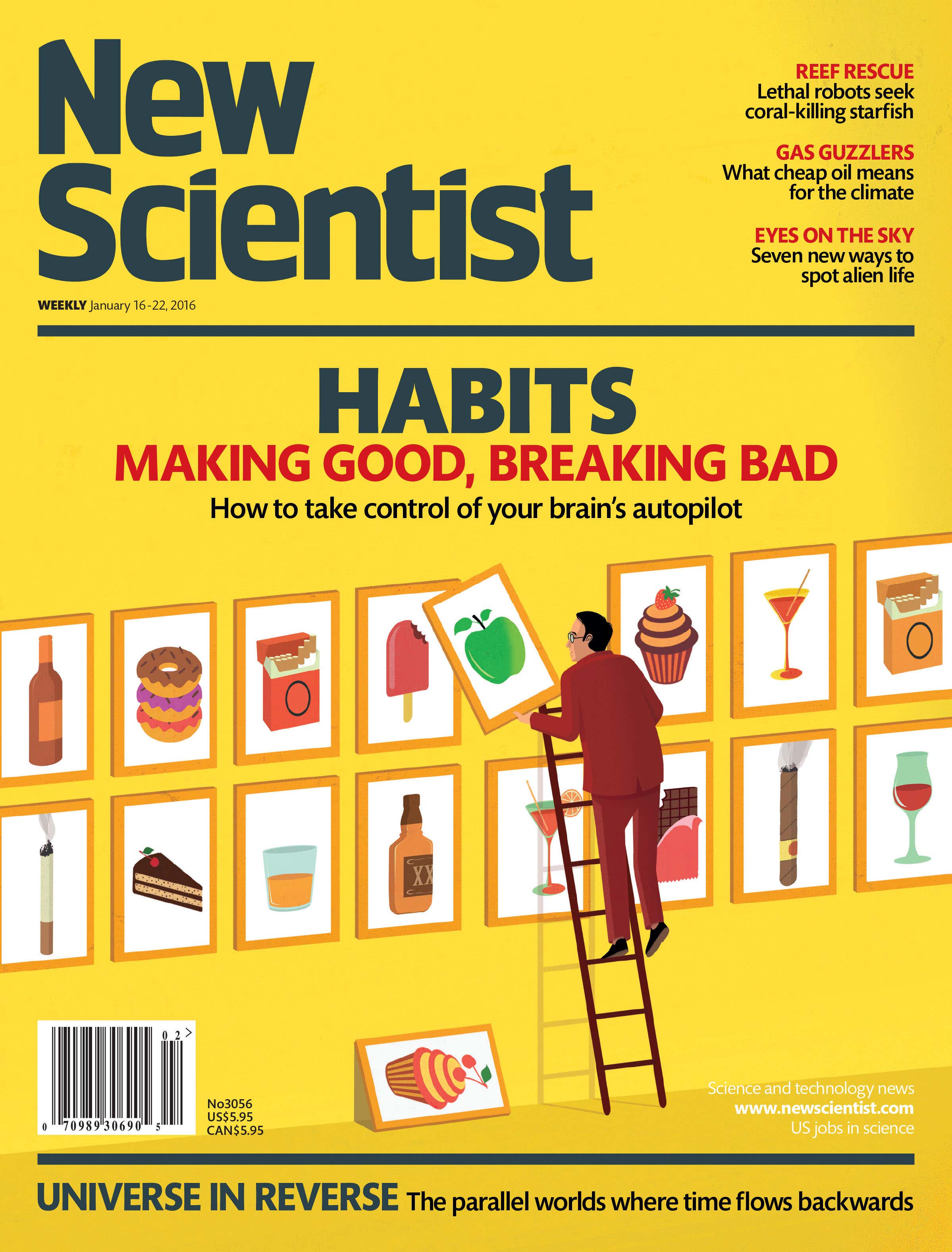
Issue no. 3056 published 16 January 2016

Sign up to our weekly newsletter

Receive a weekly dose of discovery in your inbox. We'll also keep you up to date with New Scientist events and special offers.

Sign up
Piano Exit Overlay Banner Mobile Piano Exit Overlay Banner Desktop