Subscribe now

Letters archive

Join the conversation in New Scientist's Letters section, where readers can share their thoughts and opinions on articles and see responses from experts and enthusiasts across a range of science topics. To submit a letter, please see our terms and email letters@newscientist.com


20 January 2016

Editor's pick: Facing up to catastrophe's cost

From Bryn Glover

I agreed with every word of Debora MacKenzie's commentary on the World Health Organization's response to the Ebola outbreak ( 19/26 December 2015, p 40 ), but I wish she had taken the argument one stage further. She refers to concerns about "upsetting" member states and obliquely to the need for funding. It is this …
20 January 2016

Deities versus multiverses

From Liz Berry

Mary-Jane Rubenstein describes the argument that because our universe's constants are so precisely honed to produce suns, planets and even life, there must be many universes, each with a different set of constants; or there must be a creator who deemed it so ( 19/26 December, p 64 ). Maybe there is a third option. …

20 January 2016

Deities versus multiverses

From Donald Mathewson

Rubenstein described the switch from a geocentric to a heliocentric point of view simplifying our description of the solar system. Replacing an anthropocentric view of the cosmos with one that sees life as arising from the universe's properties could do the same. The question is no longer "Why is the universe so well suited for …

20 January 2016

Deities versus multiverses

From Michael Lucas

Rubenstein appears to conclude that the traditional Jewish/Christian/Muslim view of God being separate and distinct from the universe is incompatible with the notion of an infinite universe or multiverse: if either were infinite, there would be no room left for a separate and distinct God. But we know there are many infinities. The set of …

20 January 2016

Deities versus multiverses

From Mary-Jane Rubenstein writes

• I am trying to show that when secular cosmologies appeal to infinite explanatory powers, they do philosophical, mythological, and even theological work. One might interpret that as doing away with God, or as fully compatible with God, or – and this is simply the position I find most compelling – as redefining what the …

20 January 2016

First class post

I like the sound of my voice the way I hear it. Other people hear it differently Joanna Bialek expands on the finding that listening to your own voice helps understand your emotions ( 16 January, p 18 ) .

20 January 2016

Disturbed sleep is memory's real foe

From Geoff Browne

You report that "midnight feasts hamper memory" ( 2 January, p 18 ). Is it not more likely that disturbed sleep is the determining factor? The forgetful group of mice had "shorter bouts of sleep" and their circadian rhythms were "out of sync". I suggest a trial with two equally sleep-deprived groups of mice, one …

20 January 2016

The risks of vaping are not negligible

From David Bareham

As an avid observer of the debate on the safety and efficacy of electronic cigarettes, I read your report ( newscientist.com/article/dn28723 ) with great interest. I agree with toxicologist John Britton that the exposures used in the study were excessive and unrealistic. But I also note his statements at a recent conference that the "likely …

20 January 2016

A glossary for the Anthropocene

From Andrew Clegg

Can I suggest that we start a "glossary for the Anthropocene" ( 19/26 December 2015, p 82 ) with a word to replace "warming" in "global warming"? When we use this phrase we are really talking about energy altering the climate more than temperature. Sadly, we do not yet have a useful vernacular word that …

20 January 2016

Chicken and the power of prayer

From Guy Cox

Daniel Cossins, writing about game theory ( 12 December 2015, p 36 ), describes a game of chicken in which the first car to turn away from a potential collision loses. The article suggests that throwing your steering wheel out of the window guarantees you a win – but the choice matrix left out the …

20 January 2016

Will see around corners for food

From Sparky Holkham

While pondering the laser that can see round corners ( 12 December 2015, p 18 ), I felt the need to point out that, despite being just a Jack Russell terrier, I can do this for little more than the price of a meal a day. I do it using my sense of smell. Perhaps …

20 January 2016

Electric vehicles are not greenwash

From Peter Shand

Fred Pearce suggests that plugging an electric vehicle into the mains when the grid relies on coal-fired generators means "it has merely shifted its emissions elsewhere" ( 12 December 2015, p 37 ). Here in New Zealand 80 per cent of our electricity comes from renewable sources. Electric vehicles are generally charged at night, when …

20 January 2016

Spider webs, the guano of yore

From Andrew Wager

Stephen Battersby's description of the effect that bird droppings have on electric power lines ( 19/26 December 2015, p 75 ) reminded me of an article I came across in The Railway News of 24 September 1881. (Yes, my reading is a little in arrears.) It reports that "one of the chief hindrances to telegraphing …

20 January 2016

There's nothing new under the sun

From Tony Williams

Reporting a flexible organic solar cell, you pose the question: "Would you wear solar power on your wrist?" ( 19/26 December 2015, p 20 ). I can only reply that I have been doing so for years – I have a solar-powered watch. Whaley Bridge, Derbyshire, UK

20 January 2016

Boredom not known here

From Brian King

I note your correspondence on boredom (Letters, 14 November 2015 ). I do not recall ever being bored. There are far too many things to do and books to read – and letters to write, although these may bore their recipients. Barton on Sea, Hampshire, UK

20 January 2016

For the record

• It pours: it is heavy rain like that from storm Desmond that Friederike Otto found to be about 40 per cent more likely as a result of climate change ( 9 January, p 11 ). • The UK imports 48 per cent of its food and animal feed ( 9 January, p 6 ).

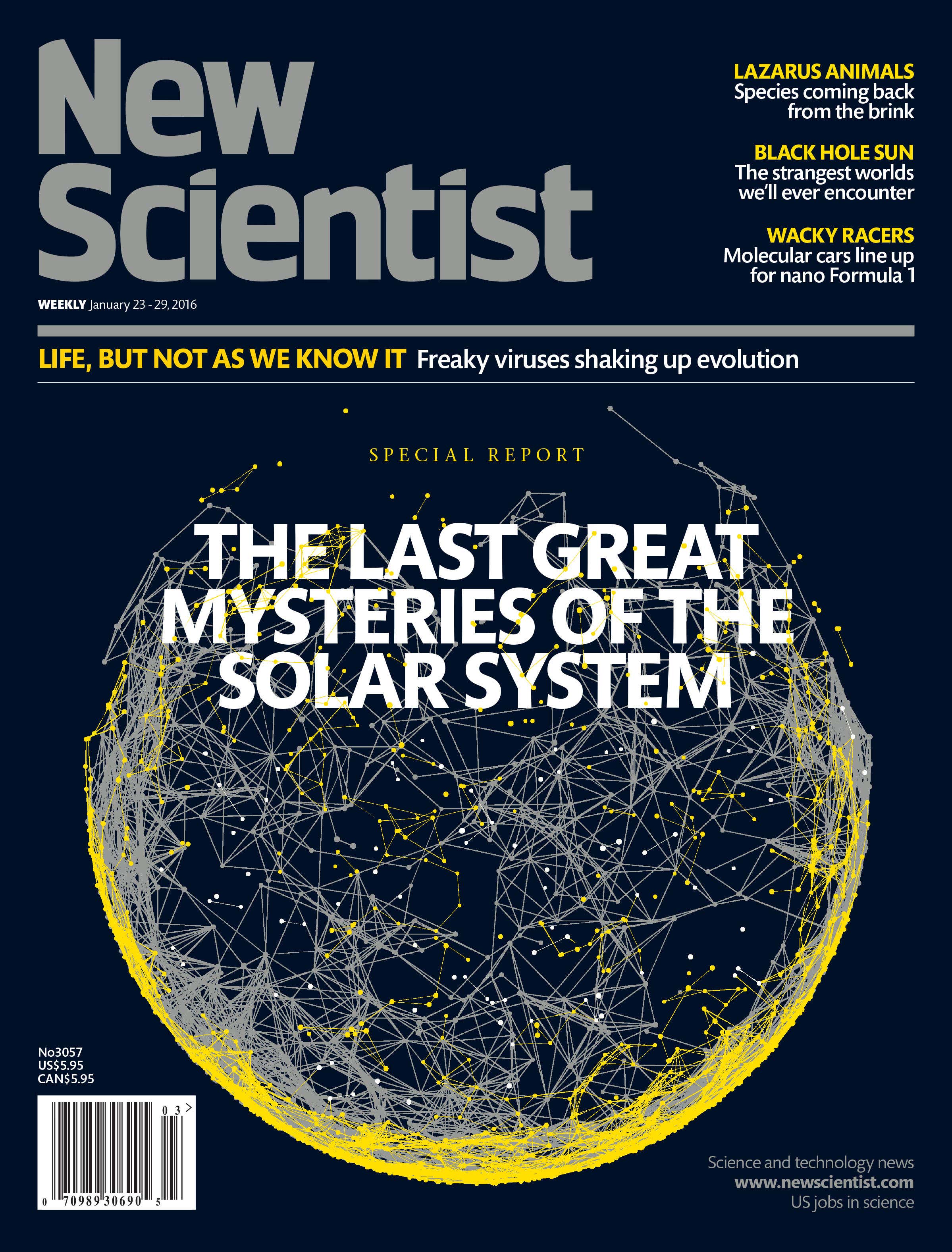
Issue no. 3057 published 23 January 2016

Sign up to our weekly newsletter

Receive a weekly dose of discovery in your inbox. We'll also keep you up to date with New Scientist events and special offers.

Sign up
Piano Exit Overlay Banner Mobile Piano Exit Overlay Banner Desktop