Rethinking reality: Is the entire universe a single quantum object?
5 July 2023
In the face of new evidence, physicists are starting to view the cosmos not as made up of disparate layers, but as a quantum whole linked by entanglement
5 July 2023
In the face of new evidence, physicists are starting to view the cosmos not as made up of disparate layers, but as a quantum whole linked by entanglement

10 May 2023
So-called virtual particles aren't particles at all. Some argue that they are merely mathematical figments, and that we need to find a better way to understand particle interactions

10 May 2023
The symmetries of matter are deeper and stranger than they first appear, and they have driven many of the biggest breakthroughs in particle physics. But have we exhausted their usefulness?

5 April 2023
Get to grips with the deepest layer of reality we know of with our inventory of the subatomic realm, from known particles like quarks and the Higgs boson to hypotheticals including the fifth force and strings in 11 dimensions
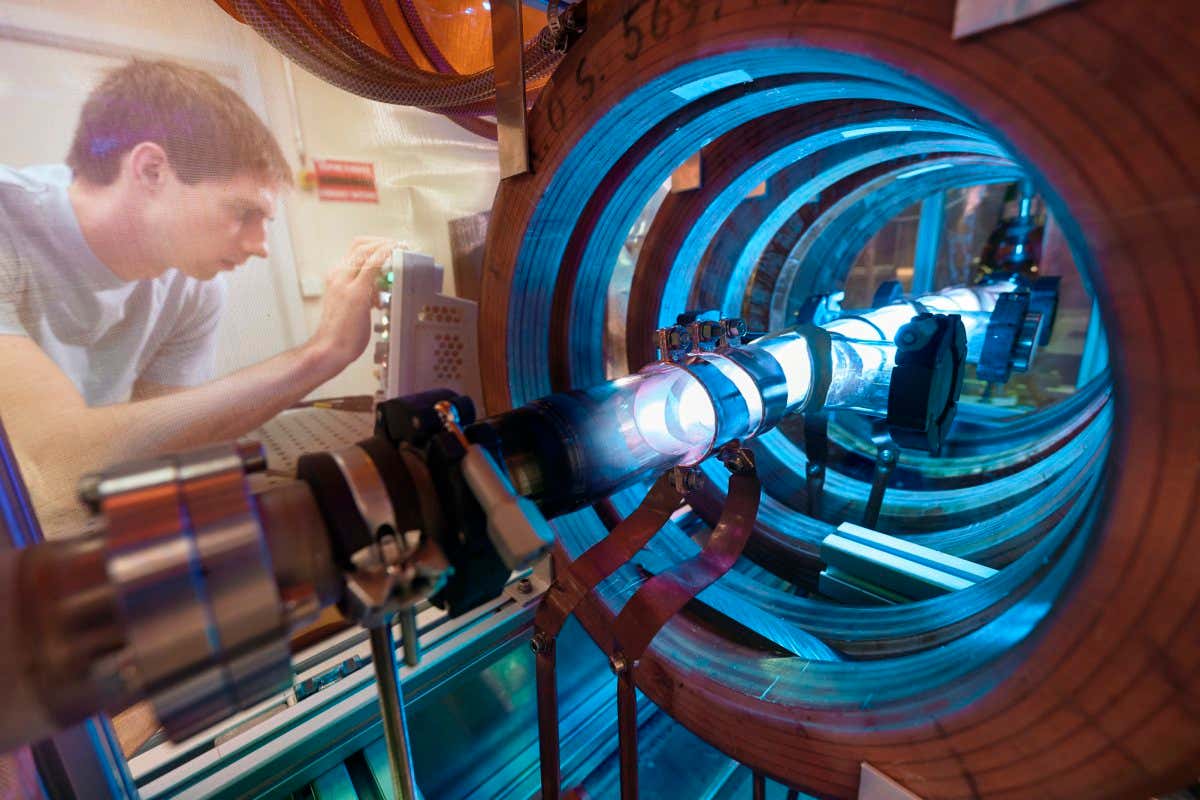
21 February 2023
A new breed of collider, called plasma wakefield accelerators, can study fundamental physics in new ways by doing something the Large Hadron Collider cannot do: colliding electrons
27 June 2022
After the Higgs, the Large Hadron Collider was expected to find other theorised particles. It didn’t, but particle physicists are optimistic about a new era of experiment-led exploration
30 June 2021
The most famous subatomic particle has revealed nothing we didn’t expect – so far. Now physicists want to build a “Higgs factory” to better interrogate it for signs of new physics

26 February 2020
Why is there something rather than nothing? We’re finally making enough antimatter to extract an answer – and it might reveal the dark side of the universe too

20 November 2019
The particle physics discoveries have dried up but in politically uncertain times CERN's cooperative model is an example to the world, says its chief Fabiola Gianotti

2 October 2019
Quarks are the subatomic particles thought to make up nearly everything we can see. Now it turns out they could be an illusion created by quantum trickery
