Applying voltage to a water drop on the tangled nanotube surface changes its shape (Image:ACS)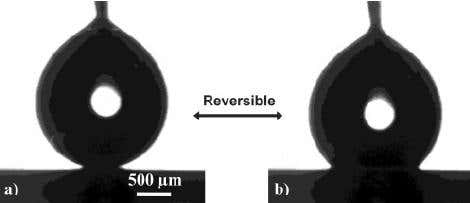
A tangled surface of Teflon-coated silicon nanowires can be used to electronically tune the shape of water droplets, research shows. The trick could lead to sophisticated new chemistry techniques, in which liquid droplets are moved around with great precision.
The novel surface was created by French researchers investigating a technique known as “electrowetting”, where a droplet is placed on a water-repellent surface and its shape is changed by applying a voltage. Using this method with very hydrophobic surfaces – on which water drops roll like marbles – could give chemists fine control over chemical reactions.
One promising way to make a “super-hydrophobic” surface requires a nanostructure that props droplets like a human on a bed of nails, combined with a water-repellent coating like Teflon. Until now, however, it has not been possible to manipulate droplets in quite the right way using this set-up – they can be squashed but will not spring back into shape. Some of the deformed droplet creeps into the gaps between the “nails”, or pillars, preventing the whole drop reforming.
Advertisement
Rabah Boukherroub and colleagues from the Institute of Electronics, Microelectronics and Nanotechnology in Lille, France, took a different approach. Instead of using upright pillars they grew a tangled mass of silicon nanotubes.
“It’s like spaghetti,” Boukherroub told New Scientist. “It seems the water doesn’t penetrate that arrangement as much.”
Reversible manipulation
Increasing the voltage across a water droplet caused it to squash down. When the voltage was removed, it sprang back into shape. Although the French team only managed to distort their drops a little, this should be enough to push them around by controlling the voltage between many different surface electrodes.
“We are working on designing another system we hope will allow greater reversible manipulation,” Boukherroub says. Their idea is to combine the nano-scale structure with one tens or hundreds of times bigger to mimic the lotus leaf which strongly repels water using many tiny bumps (also see Anti-fog glass-coating has clear applications)
“Electrowetting should make completely electronic control of water possible,” Boukherroub says. “It could be better than messy pumps and valves.”
Glen McHale at Nottingham Trent University in the UK is also investigating ways to reversibly distort droplets. “It is interesting to see that they have a surface that doesn’t impale the drop,” he says. McHale and colleagues have already achieved this feat using a different method. They make “liquid marbles” by coating droplets with a powder of hydrophobic material.
“The powder sticks to the air-water interface all over the droplet,” he explains. “The result is as if it’s suspended on tiny stilts all over.” Applying voltage to the “liquid marbles” makes them change shape due to electrowetting – but they readily spring back. Using a line of twenty electrodes the Uk team have managed to push their liquid marbles along.