The second-stage body of the Long March CZ-2F rocket that will launch Shenzhou IV is pictured being moved at the Jiuquan centre on 9 August 2005 (Image: MAXPPP/IMAGINECHINA)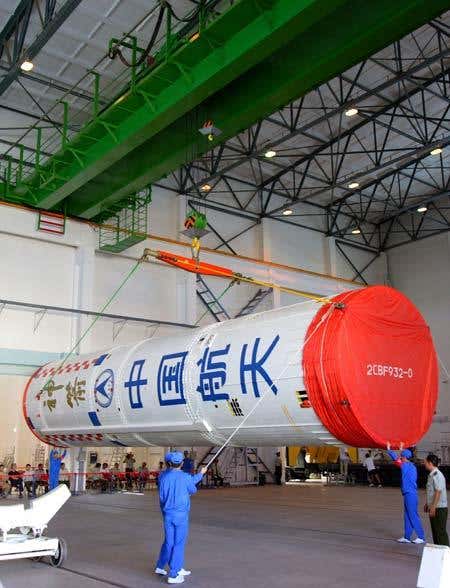
The Jiuquan Satellite Launch Centre, from where China’s Shenzhou VI spacecraft will launch, resembles man’s quest for space – an effort to sustain humans in a big void where life was not meant to exist.
The satellite centre is located on the edge of the Gobi desert, a tiny dot of human habitation surrounded by brown, featureless terrain. This is the South Launch Site, which has risen from the desert sand in less than a decade to serve China’s endeavour to send men, and perhaps soon also women, into space.
Rising above the desolate surroundings is a 105-metre launch tower, which became the centre’s most recognisable feature when about one billion Chinese watched China’s first manned space launch on television in 2003.
Advertisement
Connected to the tower by a 1.5-kilometre rail is another tall building designed for inspections of the Long March series of rockets – the workhorses of China’s space programme.
MORE: Read about the latest launch, China’s 50-year-long space programme and Shenzhou, the “divine ship”.
Orange and pale blue buildings make up the futuristic-looking cityscape inside the site’s gates, and visitors travel down streets with names like “Space Road” before they are taken to the East Wing Guesthouse, where food is served astronaut-style on aluminium trays.
Unlike NASA’s launch centre in Cape Canaveral, Florida, there are no beaches within a 2000-kilometre radius. So planners have thought of other ways to make life tolerable for the 15,000 people living at the centre.
“We’ve got three schools, a movie theatre, a post office, a hospital,” said an official during an earlier visit arranged for foreign journalists. “We’ve even got a fast-food restaurant serving fried chicken, although I don’t fancy it so much.”
All the facilities that China allows outsiders to look at are at the South Launch Center. A higher level of secrecy rules at the North Launch Site, which played a key role at the height of the Cold War, and probably continues to do so.


